Band 6.0 IELTS Writing Task 1 Model Answer
Overall Band Score: 6.0 · Cambridge IELTS 19 · 2026-11-28
IELTS Writing Task 1 question
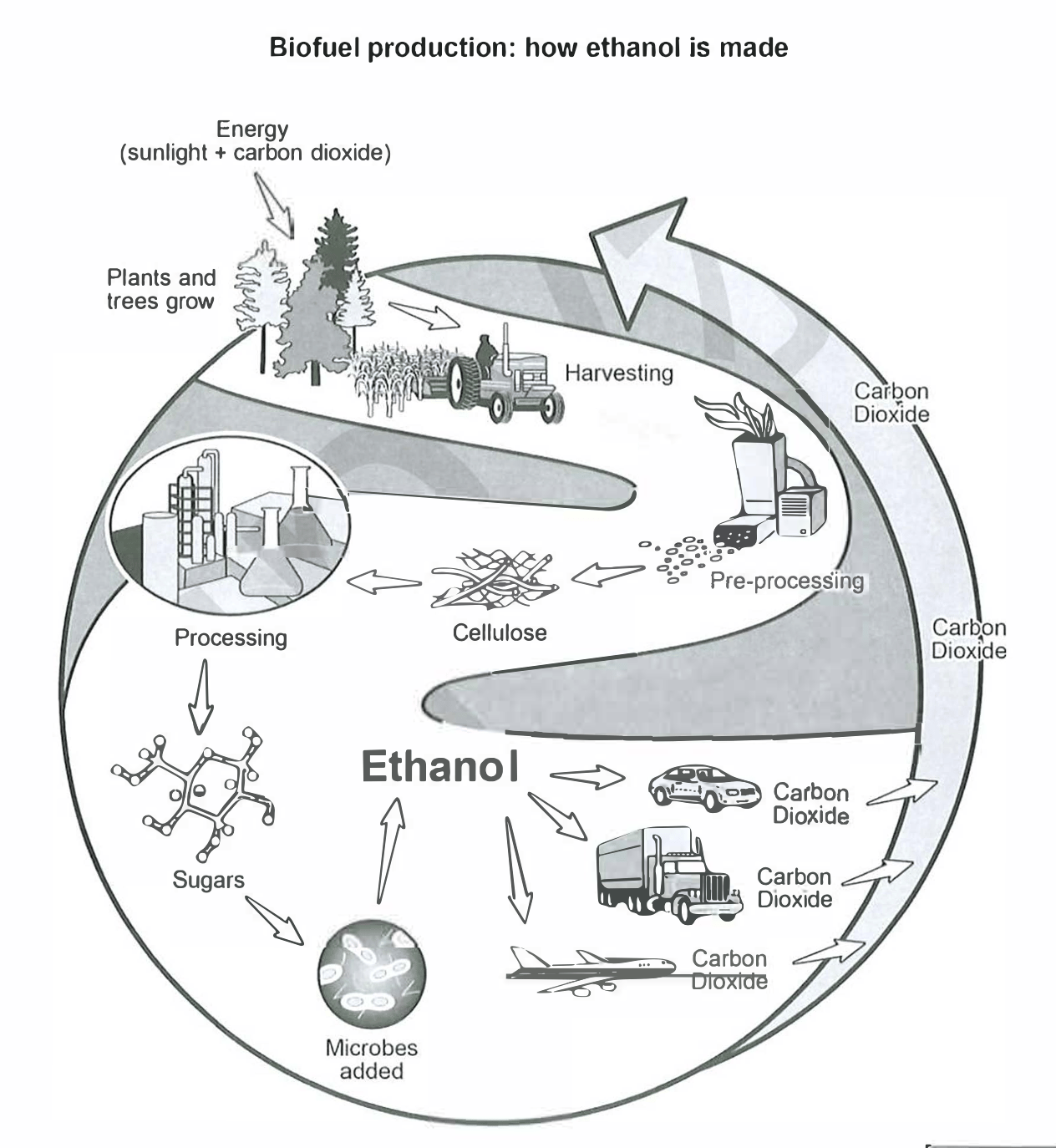
The diagram below shows how a biofuel called ethanol is produced.
Summarise the information by selecting and reporting the main features, and make comparisons where relevant.
Student answer (Band 6.0)
Biofuel is a renewable fuel made living organisms and there waste. One such fuel is ethanol.
The given diagram named as biofuel production shows how ethanol is made.
Plants and trees take up the energy from the sun thst helps them to grow. This energy is in the form of sunlight and carbon dioxide. The farmers perform the process of harvesting, which leads next to pre-processing. The cellulose are made in the next step and then they are taken to lab for processing. After processing cullulose convert to sugars and then the microbes are added to them. This leads to the forming of biofuel ethanol. Ethanol is used in vehicles such as cars, trucks and airplanes as fuels.The vehicles then emit out carbon dioxide and it is taken by plants and trees to grow.
Hence, production of ethanol is a cyclic process as the process is starting where it ended.
AI examiner evaluation
| Criterion | Band |
|---|---|
| Task Achievement / Task Response | 6.0 |
| Coherence and Cohesion | 6.0 |
| Lexical Resource | 5.5 |
| Grammatical Range and Accuracy | 5.5 |
| Overall | 6.0 |
Task Achievement / Task Response: Band 6.0
You cover the main stages, from plant growth and harvesting through processing, sugar production, the addition of microbes, and the use of ethanol in transport. You also identify the key overall feature: the process is cyclical, with carbon dioxide returning to support plant growth. These points address the task, but some stages are less fully or precisely described. For example, the diagram shows cellulose being produced after pre-processing and then processed into sugars; the sentence “The cellulose are made” is unclear about this sequence. The opening definition of biofuel is not needed and is not shown in the diagram. To strengthen the report, focus more consistently on the diagram’s stages and explain the carbon-dioxide loop clearly.
Coherence and Cohesion: Band 6.0
The response follows the process in a generally logical order, and the final sentence gives the reader a useful sense of the cycle. Sequencing phrases such as “in the next step,” “After processing,” and “then” help connect the stages. However, the information is presented in one main block, so the introduction, process description, and overview are not clearly separated. Some links are also mechanical or imprecise: “which leads next to pre-processing” and “This leads to the forming” do not express the relationships smoothly. The reference in “it is taken by plants” is understandable but could be more explicit. Use a brief overview paragraph and clearer transitions to make the progression easier to follow.
Lexical Resource: Band 5.5
You use relevant process vocabulary, including “harvesting,” “pre-processing,” “cellulose,” “microbes,” and “carbon dioxide,” which allows you to describe the diagram’s main stages. There is some variety in how you refer to the process and its outputs. However, several word-choice, collocation, and spelling problems reduce precision: “taken to lab” is informal and incomplete, “forming of biofuel ethanol” is awkward, and “emit out carbon dioxide” is not a natural expression. There are also spelling errors such as “thst” and “cullulose,” and “fuels” is not the best fit when describing ethanol’s use. Aim for accurate process collocations and proofread technical terms carefully.
Grammatical Range and Accuracy: Band 5.5
You use a mix of simple sentences and some longer structures, and the sequence is usually understandable. For example, “After processing … and then the microbes are added” attempts to connect stages in a more complex sentence. Some grammatical errors remain, however. In “made living organisms,” the required preposition is missing; “there waste” should use a possessive form; and “The cellulose are made” has a subject–verb agreement error. The sentence “After processing cullulose convert to sugars” also lacks a clear subject–verb structure and consistent passive construction. Try using controlled passive forms for the stages, such as “Cellulose is converted into sugars,” and check articles, agreement, and punctuation.
See this exact question answered at other band scores. The same prompt compared across bands.
Browse more IELTS Writing model answers or get your own writing scored by the same AI examiner.