Band 5.5 IELTS Writing Task 1 Model Answer
Overall Band Score: 5.5 · Cambridge IELTS 19 · 2026-11-04
IELTS Writing Task 1 question
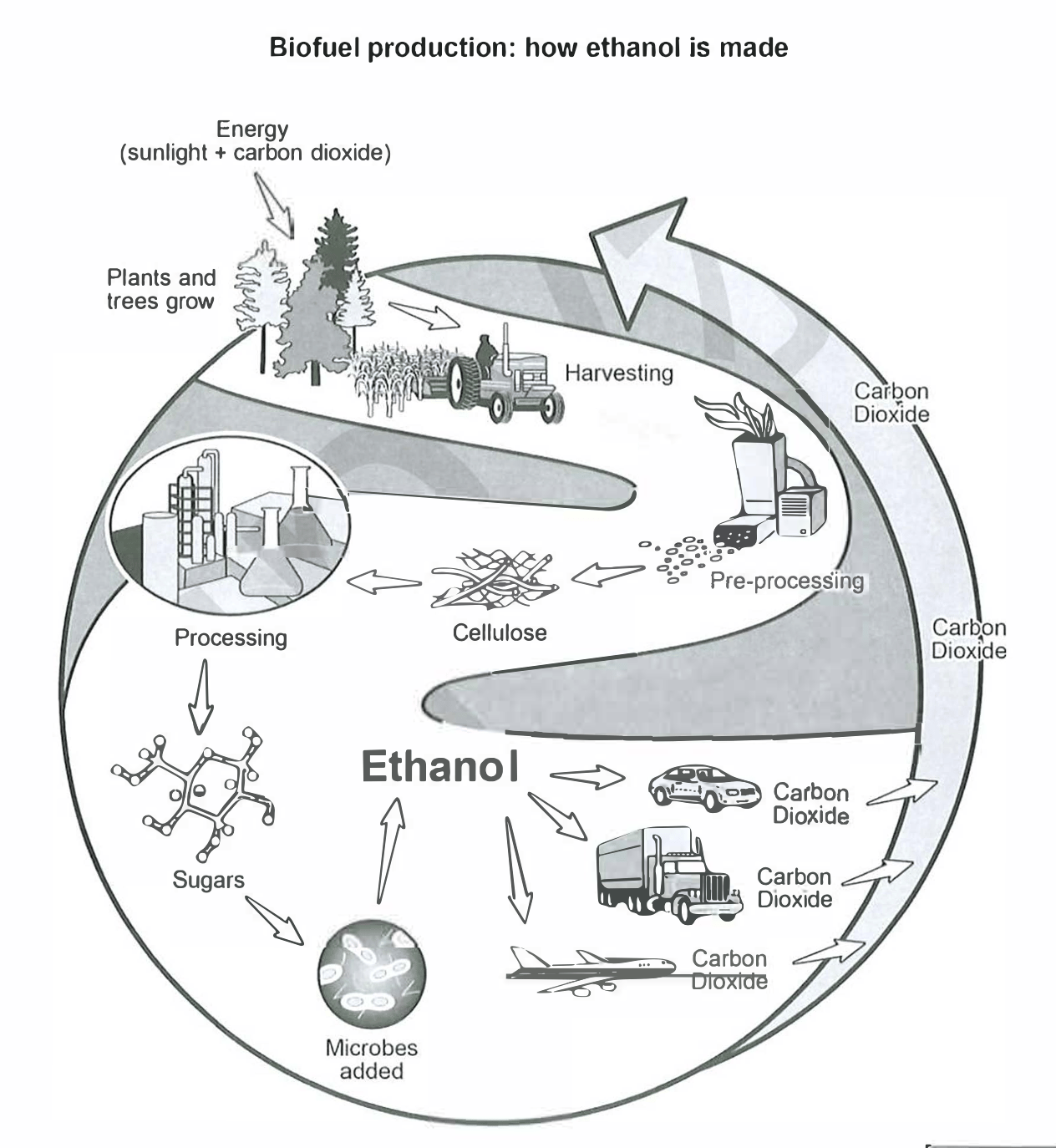
The diagram below shows how a biofuel called ethanol is produced.
Summarise the information by selecting and reporting the main features, and make comparisons where relevant.
Student answer (Band 5.5)
DIagram illustrates themanufacturing of biofuel commonly known as ethanol. Green plants and trees harvest from the forests and vegatative area. Harvested plants under goes pre-processing to chnage into cellulose that use as a diet of herbivores. Cellulose undergoes processing at industries to mitigate it into sugar. Addition of microbes to the sugar undergoea fermentation which produce the ethanol and carbondioxide. Ethanol mixes in petrol to oxygenate it as it imporve the combustion efficiency which cause less air pollution. It uses as a biofuel to replace the pure fossil fuel and as a portable heat energy that uses in spirit lamps, camping stoves and portable heaters. As a combustion agent in aeroplane, car, trucks or in other vehicle it causes the release of carbondioxide which goes in air that inhale by plants and green trees. Carbondioxide used in photosynthesis along with water from roots and sunlight from surrounding to re-start the cycle of ethanol formation.
AI examiner evaluation
| Criterion | Band |
|---|---|
| Task Achievement / Task Response | 6.0 |
| Coherence and Cohesion | 5.5 |
| Lexical Resource | 6.0 |
| Grammatical Range and Accuracy | 5.0 |
| Overall | 5.5 |
Task Achievement / Task Response: Band 6.0
You identify the process as ethanol production and describe several central stages, including plant growth, harvesting, pre-processing, cellulose, processing, sugars and the addition of microbes. You also recognise the cycle in which carbon dioxide returns to support plant growth. However, some details are inaccurate or go beyond the diagram: it does not say plants are harvested from forests, that cellulose is herbivore food, or that ethanol is mixed with petrol to improve combustion. The diagram shows ethanol being used by cars, trucks and aircraft, with carbon dioxide released from these modes of transport. A clearer overview of the cycle and a more precise account of the stages would make the summary more complete; omit unsupported uses and explanations.
Coherence and Cohesion: Band 5.5
The response follows a broadly sensible sequence, moving from plant growth through processing to ethanol use and the return of carbon dioxide. This gives the reader an overall sense of the cycle. However, the information is presented as one long paragraph, and the transitions between diagram stages and added background claims are not always clear. For example, the shift from fermentation to petrol, then to other uses such as spirit lamps, interrupts the process description. Organise the response into a short overview followed by the production stages and the final transport-and-carbon-dioxide loop. Use clear links such as “next,” “after this,” and “finally” selectively, and ensure each sentence connects directly to the diagram.
Lexical Resource: Band 6.0
You use a reasonable range of process-related vocabulary, including “pre-processing,” “cellulose,” “processing,” “microbes,” “photosynthesis” and “combustion.” These terms show an attempt to describe the stages precisely. However, several word choices or collocations are inaccurate or awkward, such as “harvest from the forests,” “mitigate it into sugar,” and “a diet of herbivores.” Spelling errors, including “vegatative,” “chnage” and “carbondioxide,” also reduce the polish of the description. Choose vocabulary that matches the diagram rather than adding technical claims, and check spelling and natural combinations of words. For instance, say that cellulose is “processed into sugars” and that microbes are “added to the sugars.”
Grammatical Range and Accuracy: Band 5.0
You attempt both simple and more complex sentence forms, including a relative clause in “which goes in air that inhale by plants” and a sequence linked with “along with.” However, errors in verb forms, agreement, articles and sentence construction sometimes make the meaning difficult to follow. Examples include “plants and trees harvest,” “Harvested plants under goes,” “which produce the ethanol,” and “that inhale by plants.” The final sentence also combines several ideas without a clear grammatical structure. Use a consistent present simple for process descriptions, check subject–verb agreement, and make sure each clause has a complete subject and verb. Shorter, accurately formed sentences would improve clarity while retaining some complex structures.
See this exact question answered at other band scores. The same prompt compared across bands.
Browse more IELTS Writing model answers or get your own writing scored by the same AI examiner.