Band 6.5 IELTS Writing Task 1 Model Answer
Overall Band Score: 6.5 · Cambridge IELTS 19 · 2026-11-05
IELTS Writing Task 1 question
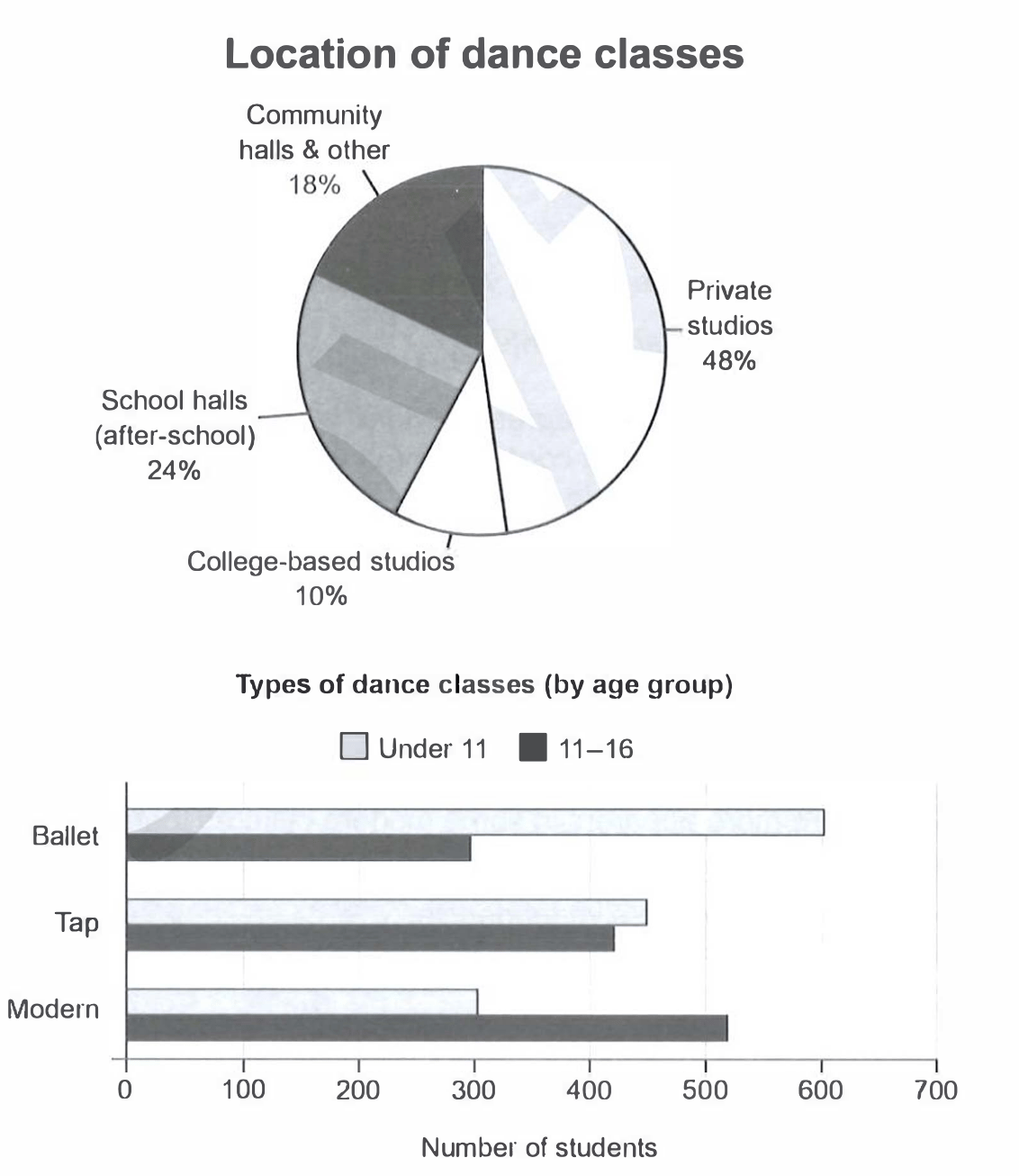
The charts below give information on the location and types of dance classes young people in a town in Australia are currently attending.
Summarise the information by selecting and reporting the main features, and make comparisons where relevant.
Student answer (Band 6.5)
The bar chart illustrates information on the type of dance classes( by age group) and location in a town in Australia are currently attending.
Overall, the number of under 11 students are more in ballet and tap classes except modern class. In addition, private studios has the highest proportion of location where dance classes were held.
In detail, the number of under 11 students in ballet was 600, while the number of age group 11-16 was significantly less at 300. Likewise, the number of under 11 students in tap was also higher than age group 11-16 about 450 and 400. By contrast, the number of age group 11-16 was significantly higher than under 11 age group, which was 510 and 300 respectively.
However, private studio was the most attented place for dance classes at 48%.School hall(after-school) was the second highest after private studios, with a figure of 24%. School hall was followed by community hall around 18%. College based studio was the least at 10%.
AI examiner evaluation
| Criterion | Band |
|---|---|
| Task Achievement / Task Response | 6.5 |
| Coherence and Cohesion | 6.5 |
| Lexical Resource | 6.5 |
| Grammatical Range and Accuracy | 6.0 |
| Overall | 6.5 |
Task Achievement / Task Response: Band 6.5
You cover both charts and identify the main location feature: private studios account for the largest share, while college-based studios are the smallest. You also compare the age groups across all three dance styles, and the figures are generally close to the chart, including the clear reversal for modern dance. This gives the report a relevant overview and supporting detail. However, the overview says under-11 students are more numerous in both ballet and tap, which is accurate, but the tap comparison is not expressed precisely: the chart shows about 450 versus 420, rather than a substantial difference. The location figures are reported clearly, though the age-group comparisons could be developed with more precise wording and a sharper summary of the contrasting patterns.
Coherence and Cohesion: Band 6.5
The response has a clear overall arrangement: an introduction, an overview, details about dance styles, and then details about locations. This makes the two chart topics easy to follow, and linking expressions such as “Likewise” and “By contrast” help signal comparisons. The progression is generally logical, but some connections are mechanical or unclear. For example, “By contrast” introduces the modern figures, but the sentence is long and its comparison is awkwardly framed. The final paragraph also begins with “However,” although it shifts to the second chart rather than presenting a contrast. Use a more neutral transition such as “Regarding locations,” and make each comparison’s reference explicit. These refinements would make cohesion more flexible and the paragraph links more natural.
Lexical Resource: Band 6.5
You use an adequate range of task-relevant vocabulary, including “proportion,” “significantly less,” “followed by,” and “least,” and the meaning is generally clear. There are also some attempts at more precise reporting language, such as “with a figure of 24%.” However, several choices or forms are inaccurate or unnatural: “attented” is misspelled, “private studio” is used where the plural category is meant, and “the second highest” would be more naturally expressed as “the second-largest share.” Repetition of “number of” and “students” also limits flexibility. Aim for accurate collocations such as “accounted for,” “participation,” and “the proportion of classes held at…” while keeping the wording concise and avoiding unnecessary repetition.
Grammatical Range and Accuracy: Band 6.0
You attempt a mix of simple and complex sentences, including comparisons with “while” and “whereas”-type contrast, and most meanings remain understandable. Some grammatical errors persist, however. In the overview, “the number of under 11 students are” has subject–verb disagreement; use “the number … is” or “there are more under-11 students.” The opening sentence is also structurally incomplete: “the type … and location … are currently attending” does not clearly identify who is attending. In “the number of under 11 students in tap was also higher … about 450 and 400,” the comparison needs a clearer grammatical construction, such as “was about 450, compared with 420.” Check sentence boundaries and spacing after full stops as well. More consistently controlled clauses would strengthen accuracy.
See this exact question answered at other band scores. The same prompt compared across bands.
Browse more IELTS Writing model answers or get your own writing scored by the same AI examiner.