Band 6.0 IELTS Writing Task 1 Model Answer
Overall Band Score: 6.0 · Cambridge IELTS 19 · 2026-11-05
IELTS Writing Task 1 question
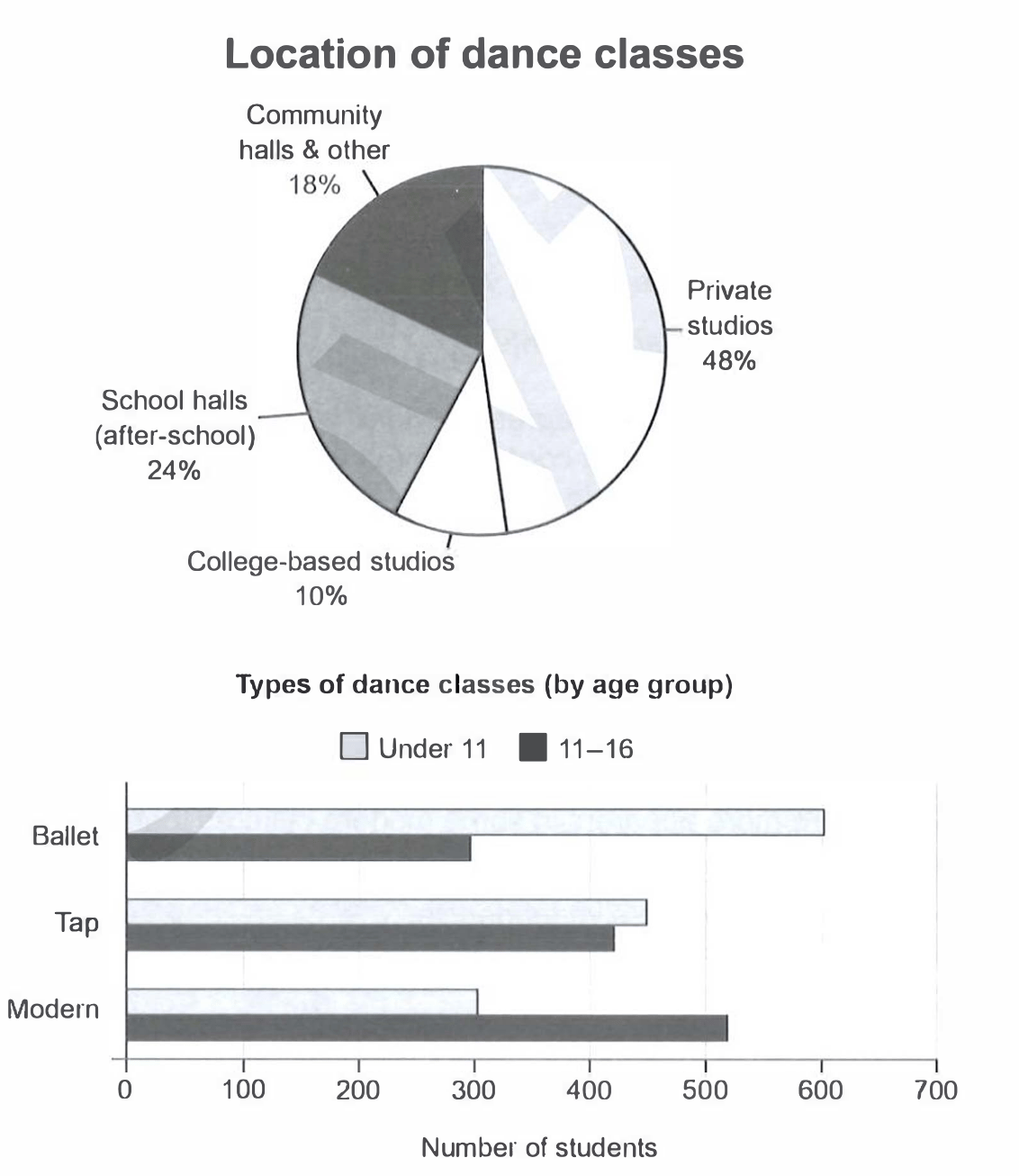
The charts below give information on the location and types of dance classes young people in a town in Australia are currently attending.
Summarise the information by selecting and reporting the main features, and make comparisons where relevant.
Student answer (Band 6.0)
The given charts illustrate types of dance classes that being held at five different locations attended by children of different ages.
Overall it can be seen as the place mostly students like to go is private studios having 48% of the total student ratio attending it , follwed by school halls having its percentage upto 24 percent of students attending it after-school.10% of the students like to go to college-based studios for their dance classes and rest of the 18% of students like to go to community halls and other places.
It can be observed that mostly students under 11 like to attend ballet dance and with the numbering rising upto almost 600 students and about 300 students having their age between 11 to 16 years like to go for ballet dance.Futhermore,it can be seen that the tap dance ratio of both the students of age under 11 and 11 to 16 go neck to neck having their figures aligning at almot 450 for students for the age group of less than 11 years and 420 for the students of age group in between 11 to 16 years.It can also be seen that students of age group in between 11 to 16 years like to attend modern dance classes having their numbering upto 530 and almost 300 students attend the modern dance classes that are under 11.
AI examiner evaluation
| Criterion | Band |
|---|---|
| Task Achievement / Task Response | 6.0 |
| Coherence and Cohesion | 6.0 |
| Lexical Resource | 5.5 |
| Grammatical Range and Accuracy | 5.5 |
| Overall | 6.0 |
Task Achievement / Task Response: Band 6.0
You cover both charts and report the main location proportions as well as comparisons across the three dance styles. The overview identifies private studios as the leading venue, and the class figures are generally accurate: for example, you note that ballet is more popular among under-11s, while modern is more popular among 11–16-year-olds. However, the overview is mostly a list of location shares rather than a concise summary of the strongest patterns across both charts. The tap figures are described as “neck to neck,” although the groups differ slightly, and the response does not clearly highlight that ballet leads for younger students while modern leads for older students. A sharper overview and more selective comparisons would make the key features clearer and better developed.
Coherence and Cohesion: Band 6.0
The response has a generally understandable sequence: it first discusses class locations and then moves to the age-group comparisons. Linking expressions such as “Overall,” “Furthermore,” and “It can also be seen” help signal progression, and the information is presented in a sensible order. However, the response is written as one continuous block, so the shift between the two charts is less clear than it could be. Several transitions are repetitive, particularly the repeated use of “It can be seen,” and the long sentences sometimes combine several figures without clear separation. Use distinct paragraphs for the overview and chart details, and vary linking language while making comparisons explicit. This would improve the flow without changing the relevant content.
Lexical Resource: Band 5.5
You use relevant vocabulary for describing charts, including “percentage,” “attend,” “age group,” and “figures,” so the reader can follow the main comparisons. There are also attempts at more descriptive phrasing, such as “neck to neck,” though this is not a natural fit for the small difference between the tap figures. Some word choices and collocations are awkward or repetitive: “student ratio attending it” and “like to go for ballet dance” could be expressed more precisely as proportions or preferences for classes. Spelling slips such as “follwed,” “Futhermore,” and “almot” also reduce accuracy. Aim for concise chart language and check spelling; for example, use “accounted for” when reporting shares and “enrolled in” for class attendance.
Grammatical Range and Accuracy: Band 5.5
You attempt both simple and more complex sentence forms, including clauses beginning with “that” and comparisons between age groups. The main information remains understandable, but some grammatical errors recur. The opening phrase “types of dance classes that being held” is missing a verb form, and “the place mostly students like to go is private studios” has an unclear singular/plural structure. There are also problems with articles and sentence boundaries, as in “having their figures aligning at almot 450 for students,” while spacing after full stops is inconsistent. These issues do not generally prevent understanding, but they make several sentences less controlled. Practise accurate patterns such as “the most popular location is…” and “about 600 under-11s attend ballet classes,” then proofread punctuation and agreement.
See this exact question answered at other band scores. The same prompt compared across bands.
Browse more IELTS Writing model answers or get your own writing scored by the same AI examiner.