Band 6.0 IELTS Writing Task 1 Model Answer
Overall Band Score: 6.0 · Cambridge IELTS 19 · 2026-11-06
IELTS Writing Task 1 question
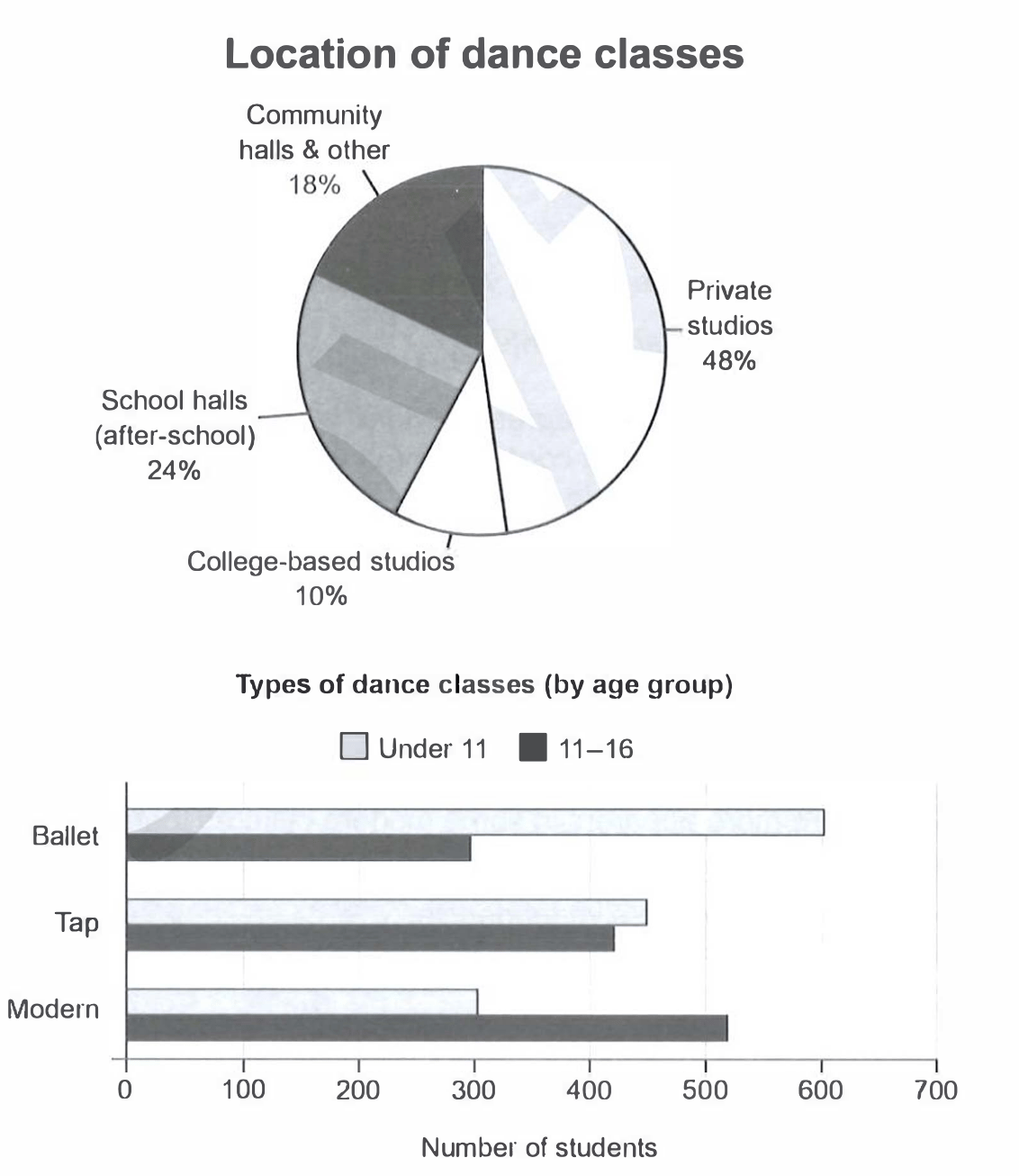
The charts below give information on the location and types of dance classes young people in a town in Australia are currently attending.
Summarise the information by selecting and reporting the main features, and make comparisons where relevant.
Student answer (Band 6.0)
The pie chart provides information on the location of dance classes while, the bar graph illustrates the types of dance classes by age group in a town in Australia are currently attending.
Overall it is clear that, location of the private studios recorded as the highest proportion and the college based studios represented the lowest shares.In addition, under 11 years old residents are stood at highest number in ballet dance type and over 11 years old are in modern dance classes.
Looking at the pie chart in more detail, 48% of individuals location of dance classes at private studios that are highest percentage. Following this, school halls stood at 24%, community hall and other recorded at 18% and the percentage of college-based studios is 10.
In bar graph, almost 600 students under 11 years old and around 300 students 11 to 16 years old attending the ballet dance classes, approximatley 450 students under 11 and almost 440 children 11 to 16 are involved in tap classes.In modern classes, above 500 participants 11 to 16 years old and 300 under 11 years old are involved.
AI examiner evaluation
| Criterion | Band |
|---|---|
| Task Achievement / Task Response | 6.5 |
| Coherence and Cohesion | 6.5 |
| Lexical Resource | 6.0 |
| Grammatical Range and Accuracy | 5.5 |
| Overall | 6.0 |
Task Achievement / Task Response: Band 6.5
You cover both charts and report the main location proportions accurately: private studios are highest at 48%, while college-based studios are lowest at 10%. You also include the key age-group comparisons for ballet, tap and modern, with figures that broadly match the chart. The overview identifies the leading and smallest locations, and notes the age-group leaders in ballet and modern. However, the overview is not fully precise: “over 11 years old” is not the chart’s 11–16 group, and the tap comparison—where the figures are close—is not highlighted. Some details are also awkwardly expressed, making the intended comparison less clear. A more complete overview would summarise the contrasting age patterns across all three dance styles, while keeping the age labels exact.
Coherence and Cohesion: Band 6.5
The response has a clear overall structure: an introduction, an overview, and separate paragraphs for the pie chart and bar graph. This makes the two sources of information easy to follow, and phrases such as “Looking at the pie chart in more detail” and “In bar graph” signal the shift between them. The progression within each chart is generally logical, moving from the largest location share to the smaller ones and then through the dance styles. Some linking is mechanical, particularly “Following this,” and the long final paragraph would be clearer with more deliberate separation of the three age-group comparisons. Punctuation and spacing also interrupt the flow in places. More precise referencing and smoother links between comparisons would strengthen cohesion.
Lexical Resource: Band 6.0
You use a relevant range of chart vocabulary, including “proportion,” “percentage,” “participants,” and “attending,” and the reader can generally understand the comparisons. There are also attempts at more formal reporting language, such as “represented” and “recorded.” However, several word choices or collocations are unnatural, including “individuals location of dance classes,” “stood at highest number,” and “are involved.” Repetition of “students” and “classes” also limits flexibility. Spelling errors such as “approximatley” reduce accuracy, while “residents” is not a suitable label for the age groups shown. Aim for concise, conventional expressions such as “accounted for,” “the number of students,” and “participated in,” and check spelling carefully.
Grammatical Range and Accuracy: Band 5.5
You attempt a mix of simple statements and more developed sentences, and the overall meaning is usually recoverable. However, grammatical control is uneven. The opening sentence has an unnecessary comma after “while” and an awkward clause ending, while “location of the private studios recorded as the highest proportion” is missing a clear subject and verb structure. Other examples include “under 11 years old residents are stood” and “almost 600 students … attending,” where the verb forms do not fit the sentence. Articles and plurals are also inconsistent, as in “the highest percentage” and “community hall.” Improve accuracy by using complete subject–verb clauses and checking agreement and verb forms; for example, “Private studios accounted for the largest share” is both clear and grammatically controlled.
See this exact question answered at other band scores. The same prompt compared across bands.
Browse more IELTS Writing model answers or get your own writing scored by the same AI examiner.