Band 5.5 IELTS Writing Task 1 Model Answer
Overall Band Score: 5.5 · Cambridge IELTS 19 · 2026-11-06
IELTS Writing Task 1 question
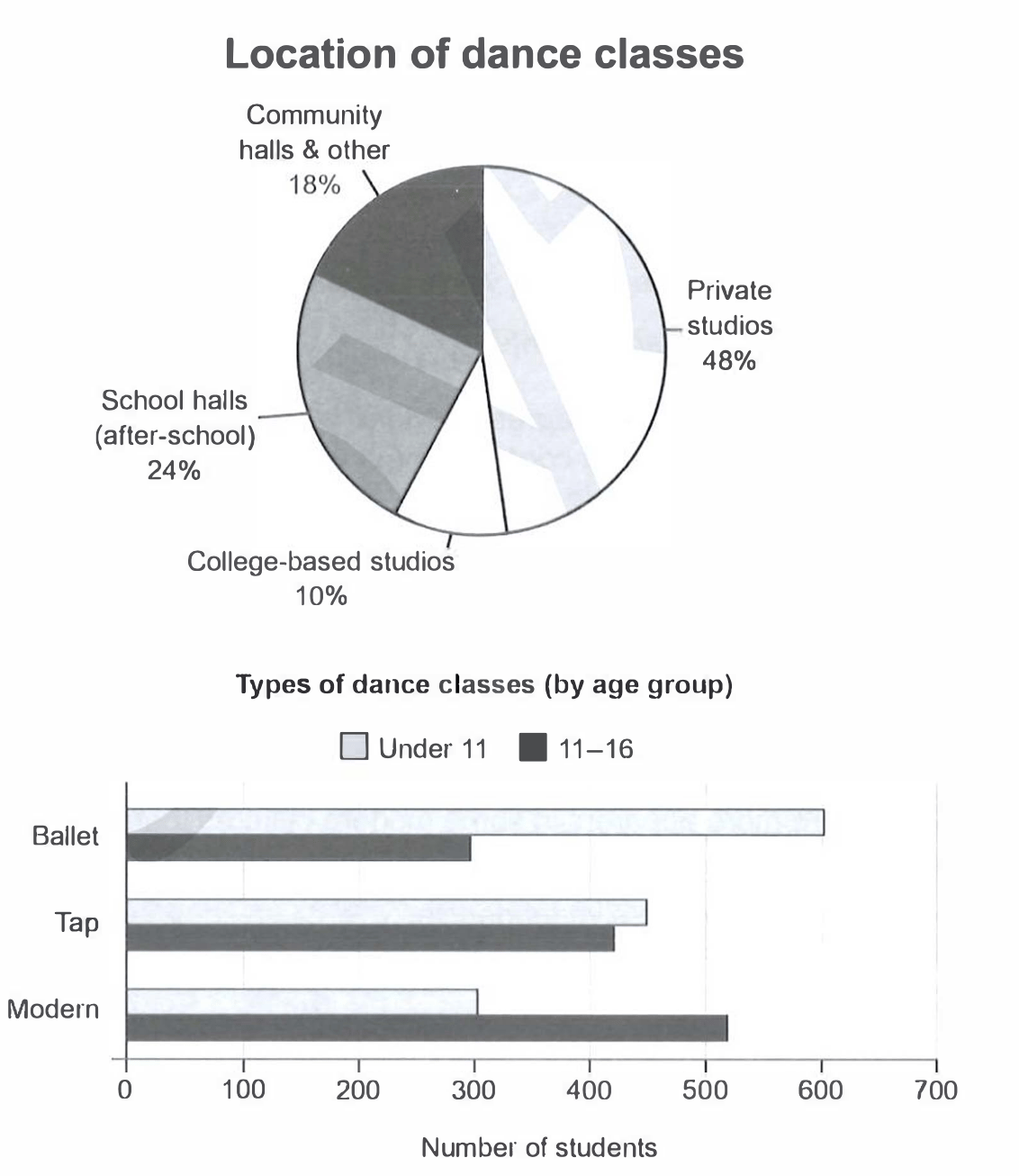
The charts below give information on the location and types of dance classes young people in a town in Australia are currently attending.
Summarise the information by selecting and reporting the main features, and make comparisons where relevant.
Student answer (Band 5.5)
The given figures demonstrate the no of adults and kids attending dance classes with respect to their location and type of dance they are doing in differents towns of australia.
According to given data we can conclude that huge no teenagers about 600 are taking classes of ballet dancing with kids below 11 are more into modern dance 500 of them are taking classes of it while kids have shown less interest in ballet, 300 kids a learning ballet and same proportion of teenagers(300) are taking modern dance classes.However tap dancing have almost same number of children and youngsters somewhere between 400 to 500.
If we look into location a large proportion of students are taking classes in private studio around 48% and a few percentage of childrens only 10% are taking classes at college-based studios.Community halls and school halls have a medium ratio of children taking dance classes18% and 24% vice versa.
AI examiner evaluation
| Criterion | Band |
|---|---|
| Task Achievement / Task Response | 5.5 |
| Coherence and Cohesion | 6.5 |
| Lexical Resource | 5.5 |
| Grammatical Range and Accuracy | 5.0 |
| Overall | 5.5 |
Task Achievement / Task Response: Band 5.5
You cover both charts and identify the main location pattern: private studios account for the largest share, while college-based studios have the smallest. You also attempt comparisons across the dance styles. However, several key figures and age-group trends are misreported: ballet is highest among under-11s at about 600, not among teenagers; modern is highest among 11–16-year-olds at about 520, not among younger children; and the under-11 figure for modern is about 300, not 500. The statement that teenagers take modern classes in the same proportion as children also reverses the chart. These inaccuracies weaken the overview and leave the main comparisons only partly clear. Check each series against its age-group label and summarise the strongest contrasts accurately.
Coherence and Cohesion: Band 6.5
The response has a generally understandable order: it first discusses dance types and age groups, then moves to class locations. Phrases such as “According to given data” and “If we look into location” help signal these shifts, and the comparisons give the reader some progression. This meets the lower-band expectation of an overall coherent arrangement and shows some movement towards more controlled organisation. However, the first paragraph combines several comparisons in one long sentence, making the relationships between figures difficult to follow. The overview is also not clearly separated from supporting details. Use distinct paragraphs for the two charts, begin with a concise summary of the main patterns, and use clearer links such as “By contrast” when comparing age groups.
Lexical Resource: Band 5.5
You use some relevant vocabulary for describing charts, including “large proportion,” “private studio,” “college-based studios,” and “less interest.” These choices show an attempt to vary language beyond simply listing figures. However, the range is limited and several expressions are imprecise or informal for an academic report, such as “huge no,” “a few percentage,” and “medium ratio.” There are also word-form and spelling problems, including “differents” and “childrens,” while “with respect to their location and type of dance they are doing” is awkwardly phrased. Aim for precise terms such as “share,” “proportion,” and “number of students,” and use consistent labels for the age groups. This would make the comparisons clearer and more appropriately formal.
Grammatical Range and Accuracy: Band 5.0
You attempt to connect several ideas in longer sentences, for example by using “while” and “if,” but these complex structures are often difficult to control. The opening sentence has an unclear construction (“demonstrate the no of adults and kids attending”), and the sentence beginning “According to given data” runs together multiple claims without clear punctuation. Other issues include missing articles in “According to given data,” agreement and number problems in “a few percentage,” and the ungrammatical sequence “300 kids a learning ballet.” Full stops are also missing before “However” and between several clauses. These errors sometimes make the intended comparisons hard to interpret. Build accuracy with shorter sentences first, then combine ideas using correctly punctuated contrast clauses.
See this exact question answered at other band scores. The same prompt compared across bands.
Browse more IELTS Writing model answers or get your own writing scored by the same AI examiner.