Band 5.5 IELTS Writing Task 1 Model Answer
Overall Band Score: 5.5 · Cambridge IELTS 19 · 2026-11-08
IELTS Writing Task 1 question
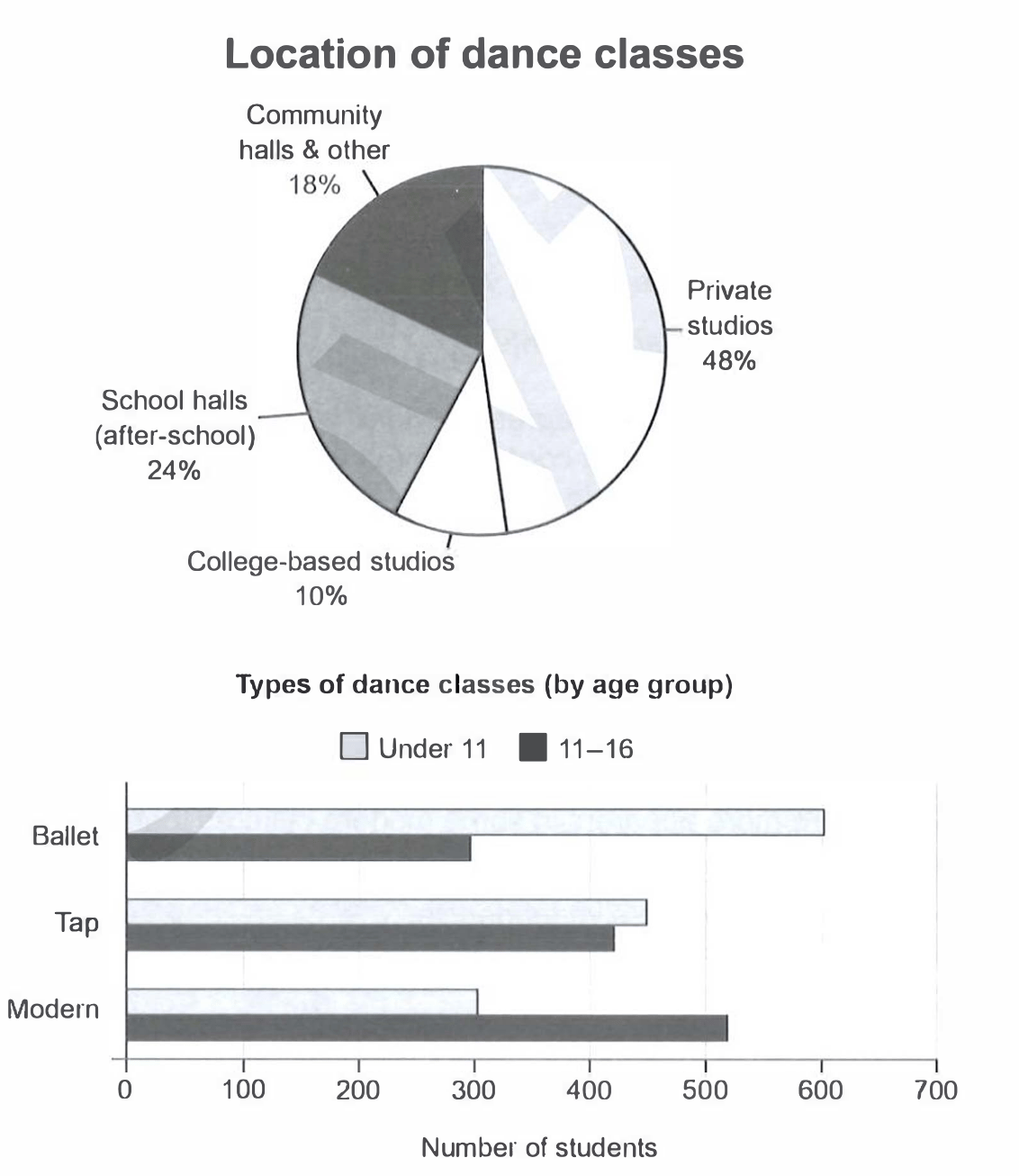
The charts below give information on the location and types of dance classes young people in a town in Australia are currently attending.
Summarise the information by selecting and reporting the main features, and make comparisons where relevant.
Student answer (Band 5.5)
The charts below depict information on the location and types of dance classes for individuals ( by age group) in a town in Australia are currently attending.
Overall, in terms of location, Private studios accounted for the major proportion, Nevertherless, college-based studios contibuted the smallest proportion. Meanwhile, figures for primary school students enrolled for Ballet dance classes is far more than modern dance classes. In contrast, most secodnary school individuals attending modern dance classes.
Looking first at the location of dance classes, private studios accounted for 48% followed by school hall, which represented 24% and then communtiy halls and other, at 18%. Least proportion of individuals recorded at college-based studios as 10% only.
Regarding the line graph on types of dance classes, approximately 600 students below 11 are attending Ballet class followed by 400 attending Tap. Whereas only 300 students (under 11) are going for Modern dance classes, as compared to 500 (11-16).
AI examiner evaluation
| Criterion | Band |
|---|---|
| Task Achievement / Task Response | 5.5 |
| Coherence and Cohesion | 5.5 |
| Lexical Resource | 5.5 |
| Grammatical Range and Accuracy | 5.5 |
| Overall | 5.5 |
Task Achievement / Task Response: Band 5.5
You identify the main location pattern accurately: private studios are the largest share at 48%, while college-based studios are smallest at 10%, and you include several class figures. However, the comparison of age groups is incomplete: you report under-11 ballet, tap and modern figures, but give only the 11–16 figures for modern and do not compare ballet or tap across both groups. The overview also says primary and secondary school students, whereas the chart labels age groups, and its summary of the leading dance types is not fully supported. The response is 136 words, below the 150-word minimum; the 17 words copied from the prompt do not count. Add a fuller overview and the key age-group contrasts.
Coherence and Cohesion: Band 5.5
The response has a recognisable structure, with an introduction, an overview and separate paragraphs for location and dance types. This helps the reader distinguish the two charts. However, progression within the overview is uneven: it moves from locations to age-group comparisons without clearly summarising the main pattern in both charts. Some linking is mechanical or incomplete, as in “Whereas only 300 students…” which is a fragment rather than a connected comparison. The location paragraph lists percentages in sequence but could group the larger and smaller venues more clearly. Use complete comparison sentences and organise the age-group data together so the relationships are easier to follow.
Lexical Resource: Band 5.5
You use relevant chart vocabulary, including “accounted for,” “proportion,” “represented” and “approximately,” and the reader can generally understand the information. However, the range is limited and several word-choice, collocation and spelling errors reduce precision: “major proportion” is awkward, “Least proportion” is not idiomatic, and “going for Modern dance classes” is informal for an academic report. There are also noticeable spelling errors such as “Nevertherless,” “contibuted,” “communtiy” and “secodnary.” Choose standard chart-reporting phrases and check spelling carefully. More precise terms for shares and participation would make the comparisons clearer and more formal.
Grammatical Range and Accuracy: Band 5.5
You attempt both simple statements and more complex comparisons, but control is inconsistent. The opening sentence has a faulty structure: “depict information … in a town in Australia are currently attending” does not form a grammatical clause. The overview also contains agreement and sentence-boundary problems, including “figures … is” and the fragment “Whereas only 300 students …”. Articles and number forms are sometimes awkward, as in “attending Ballet class.” These errors do not prevent the reader from understanding the main figures, but they make several sentences difficult to read. Build comparisons as complete clauses, check subject–verb agreement, and use a consistent sentence pattern when reporting each figure.
See this exact question answered at other band scores. The same prompt compared across bands.
Browse more IELTS Writing model answers or get your own writing scored by the same AI examiner.