Band 6.0 IELTS Writing Task 1 Model Answer
Overall Band Score: 6.0 · Cambridge IELTS 19 · 2026-11-08
IELTS Writing Task 1 question
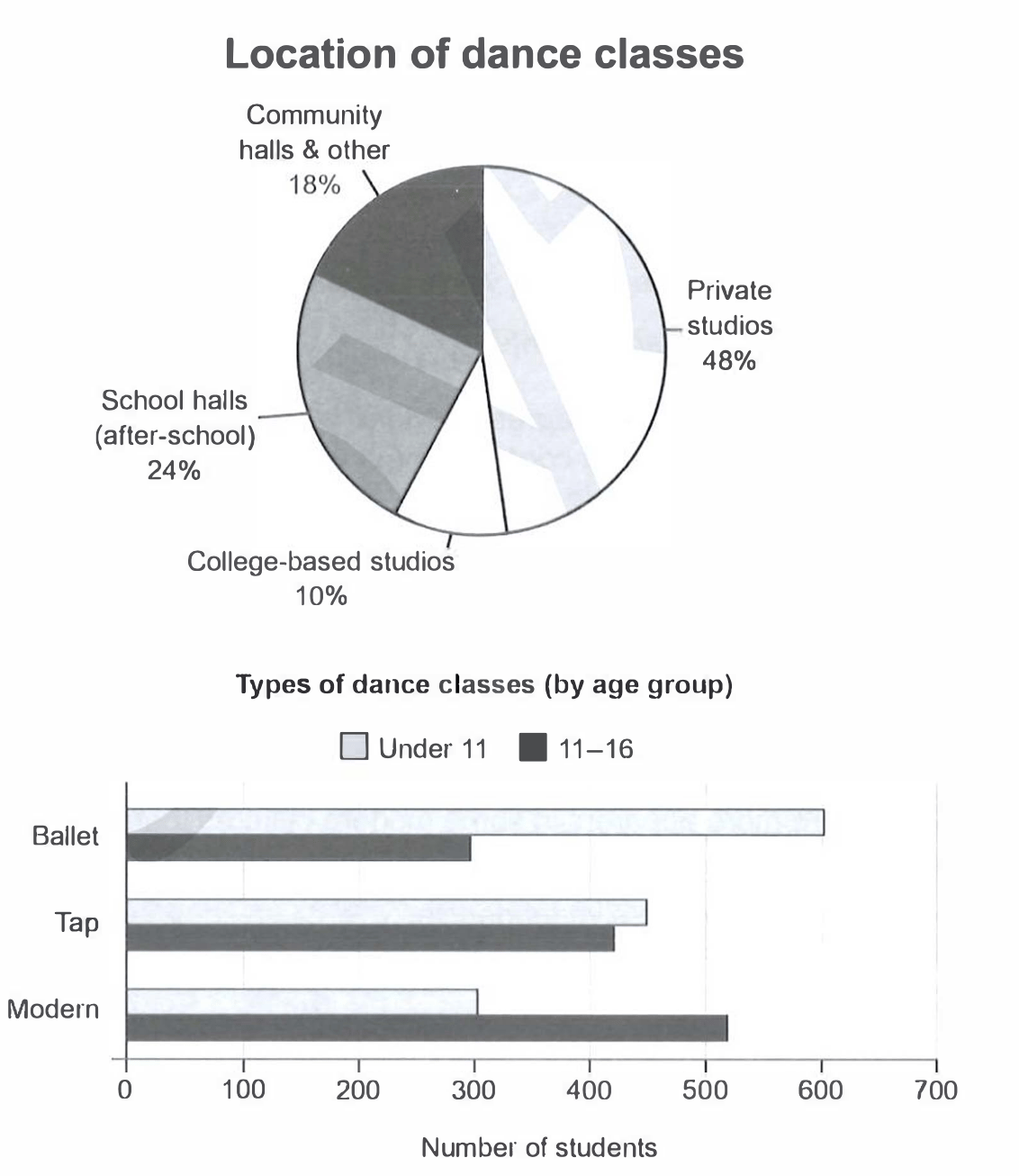
The charts below give information on the location and types of dance classes young people in a town in Australia are currently attending.
Summarise the information by selecting and reporting the main features, and make comparisons where relevant.
Student answer (Band 6.0)
The pie chart illustrates the location and types of dances classes attended by young individuals in Australia.
Overall, it is clear that private studios are the most popular location for dance classes, while college based studios are the least popular. However, Ballet was most popular for under 11, while Modern was most popular for 11-16. Tap was similar for both.
Regarding the location, private studios are the most useful location for dance classes at 48%. School halls (after-school) are the second most famous location accounts for 24%. Furthermore, community halls and others at 18%. The least popular location was college based studios at 10%.
Types of dance classes, Ballet students who are under 11 have 600 students which was followed by 300 students who are 11 to 16 years old. Additionally, tap 450 students under age 11 and 420 of age 11 to 16. Finally, the last type is modern where students who belongs to age 11 decline up to 300 number of students which is compared with 510 students.
AI examiner evaluation
| Criterion | Band |
|---|---|
| Task Achievement / Task Response | 6.0 |
| Coherence and Cohesion | 6.5 |
| Lexical Resource | 5.5 |
| Grammatical Range and Accuracy | 5.5 |
| Overall | 6.0 |
Task Achievement / Task Response: Band 6.0
You cover both charts and provide a clear overview: private studios are identified as the leading location, college-based studios as the least common, and the age-group preferences are compared. Most figures are reported accurately, including the location percentages and the ballet and tap totals. However, the overview says modern is most popular among 11–16-year-olds without making clear that this is a comparison with the other dance types for that age group; the final sentence also reverses the comparison’s order and says the younger group’s figure “decline[s]” to 300 before comparing it with 510. This makes an important feature less clear. State directly that modern rises from about 300 among under-11s to about 520 among 11–16s, and ensure the overview captures the contrasting preferences across age groups.
Coherence and Cohesion: Band 6.5
The response has a clear overall arrangement: an introduction, an overview, and separate paragraphs for location and dance types. This makes the two charts easy to follow, and linking expressions such as “Overall,” “Furthermore,” and “Finally” help signal progression. The organisation is generally effective, though some connections within the data paragraph are awkward. In particular, “Finally, the last type is modern where…” does not smoothly introduce the comparison, and the final comparison is difficult to follow because the figures are presented in reverse order. Use parallel structures for each age group and connect the figures explicitly—for example, “Modern attracted about 300 under-11s, compared with approximately 520 students aged 11–16.” This would make the progression more precise and less dependent on formulaic transitions.
Lexical Resource: Band 5.5
You use enough topic vocabulary to describe the charts, including “private studios,” “school halls,” “popular,” and “students,” and the meaning is generally understandable. However, several choices are imprecise or unnatural for reporting data: “most useful location” and “second most famous location” do not mean most attended, while “types of dances classes” is an inaccurate phrase. “College based” also needs a hyphen when used before a noun. The repeated use of “popular” limits precision, and “decline” is not the right word for describing the difference between two age groups. Choose neutral reporting language such as “accounted for,” “attracted,” and “was the most common,” and use the chart’s category labels consistently. This would improve accuracy and range without requiring more elaborate vocabulary.
Grammatical Range and Accuracy: Band 5.5
You attempt both simple and more developed sentence forms, and the overview uses a contrast structure with “while.” Most of the message remains understandable, but some grammatical errors make individual comparisons unclear. For example, “School halls … are the second most famous location accounts for 24%” combines two sentence patterns without a grammatical link; write “School halls accounted for 24%, making them the second most common location.” In “students who belongs,” the verb does not agree with the plural subject, and “students who are under 11 have 600 students” uses an awkward structure for reporting a figure. The final sentence also has a confusing clause structure. Practise concise subject–verb patterns such as “There were 600 under-11 ballet students” and check agreement, articles, and sentence boundaries when combining information.
See this exact question answered at other band scores. The same prompt compared across bands.
Browse more IELTS Writing model answers or get your own writing scored by the same AI examiner.