Band 6.0 IELTS Writing Task 1 Model Answer
Overall Band Score: 6.0 · Cambridge IELTS 19 · 2026-11-08
IELTS Writing Task 1 question
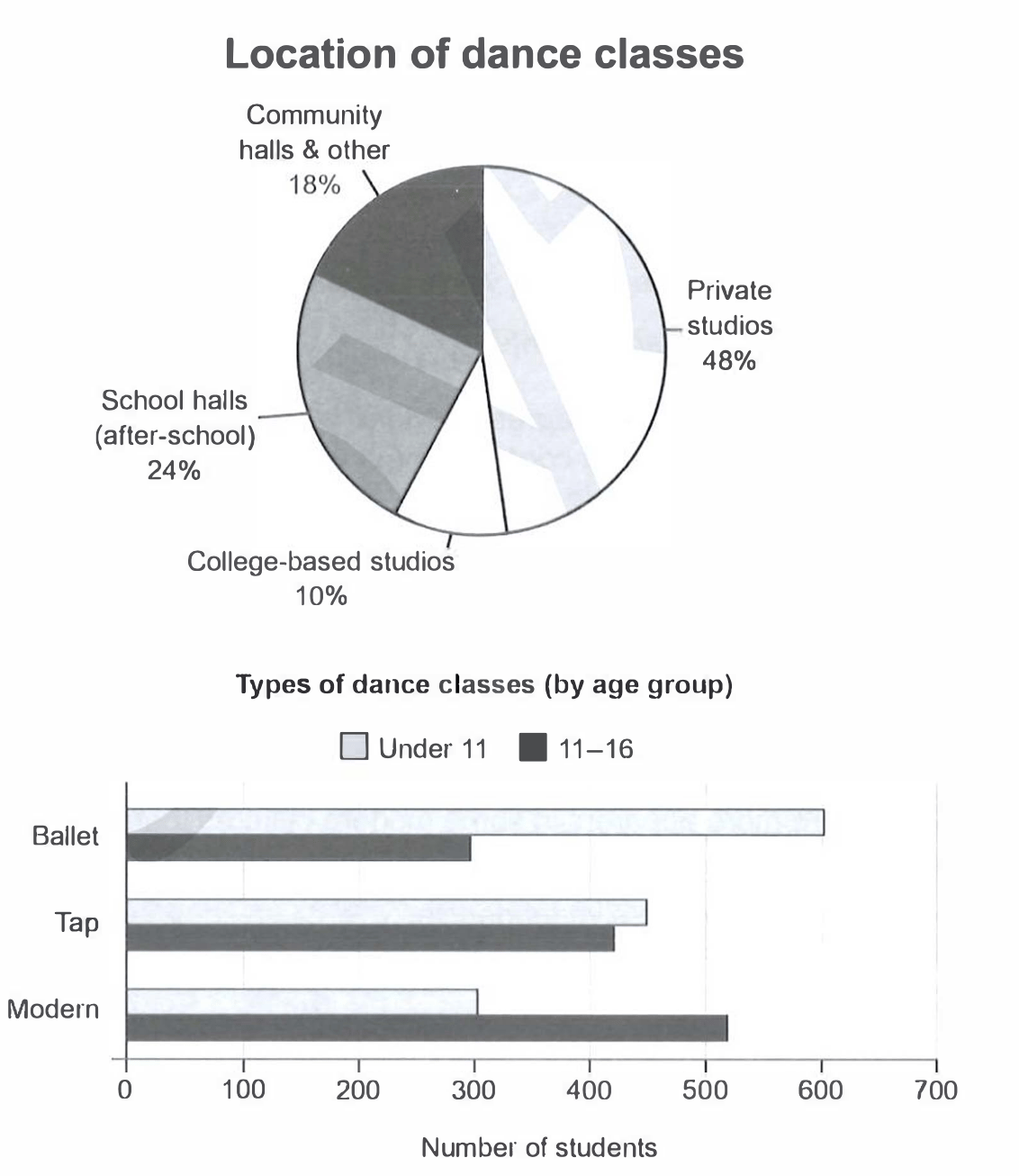
The charts below give information on the location and types of dance classes young people in a town in Australia are currently attending.
Summarise the information by selecting and reporting the main features, and make comparisons where relevant.
Student answer (Band 6.0)
The pie chart illustrates the area and kinds of dance classes in a town in Australia of young people.
To begin with the location of dance classes, it is divided into four sections; community halls, private studios, collage- based studios and school halls.
Private studios comprised 48% ratio of dance classes which is far more then other three sections. In addition community halls and other allocated for 18% proportion of location. What's more is about school halls and collage based studios, both took 24% and 10% space of dance class respectively.
Dance classes further proceeds in three parts; ballet, tap and modern. They are separeted by age groups and number of students.
Firstly, ballet has 600 students under the age of 11 years childern, while 300 students are those having age between 11 to 16 year adults. However, in section of tap the number of students are in between 400 and 450 for both age groups respectively. Furthermore, in modern section 300 students are those who were under 11 year childerns and 500 and litter more students lied in 11 to 16 year adults.
Overall, in location of dance classes private studios comprised higher ratio. Wheras other represented the smallest proportion. While, in section of type of dance classes ballet showed maximun number of students of under 11 years childern others show the minimum.
AI examiner evaluation
| Criterion | Band |
|---|---|
| Task Achievement / Task Response | 6.0 |
| Coherence and Cohesion | 6.5 |
| Lexical Resource | 5.5 |
| Grammatical Range and Accuracy | 5.0 |
| Overall | 6.0 |
Task Achievement / Task Response: Band 6.0
You cover both charts and include several relevant figures, such as private studios at 48%, ballet at 600 students under 11, and modern at just over 500 among 11–16-year-olds. The main location feature—that private studios are the largest category—is clear. However, some comparisons are inaccurate or unclear: school halls and college-based studios did not both take 24% and 10% “space” respectively as phrased; the figures are 24% and 10%, while community halls account for 18%. The tap figures are also reversed: under-11s are about 450 and 11–16-year-olds about 420. Your overview identifies the leading location and under-11 ballet, but calling other categories the minimum is vague. State the main age-group contrast more clearly: younger students favour ballet, while older students favour modern.
Coherence and Cohesion: Band 6.5
The response has a generally clear sequence: it first describes the location chart, then the dance types, and ends with an overview. Paragraphing helps distinguish these sections, and signposts such as “To begin with,” “Furthermore,” and “Overall” make the progression easy to follow. This already provides a coherent overall arrangement. Some linking, however, is mechanical or awkward: “Dance classes further proceeds in three parts” does not clearly connect the charts, and “While” begins a fragment-like final thought after “Wheras.” The repeated use of “Firstly” and “Furthermore” also makes the transitions feel formulaic. To strengthen progression, group the age comparisons by the clearest contrast and use precise references such as “the younger group” and “their older counterparts.”
Lexical Resource: Band 5.5
You use enough topic vocabulary to report the charts, including “proportion,” “location,” “age groups,” and “allocated,” and the reader can generally understand the intended comparisons. However, several word choices and collocations are inaccurate or unnatural, which limits precision: “48% ratio,” “24% and 10% space,” and “students lied in” do not describe chart data naturally. There are also noticeable spelling errors, including “collage,” “separeted,” “childerns,” “Wheras,” and “maximun.” Use standard chart-reporting language consistently—for example, “accounted for,” “represented,” and “the number of students was”—and check spelling carefully. More precise vocabulary would also help distinguish the largest and smallest categories without relying on vague phrases such as “other represented the smallest proportion.”
Grammatical Range and Accuracy: Band 5.0
You attempt both simple and more complex sentence forms, including clauses introduced by “while” and “which,” and most of the data remains understandable. However, errors in sentence construction and agreement recur. For example, “Dance classes further proceeds” has a subject–verb agreement problem, while “both took 24% and 10% space” does not form a clear grammatical comparison. The final sentence beginning “While, in section…” is incomplete, and “students are those having age between 11 to 16 year adults” has an unclear clause structure. Articles, plurals, and prepositions also need more consistent control. Build each comparison around a clear subject and verb, and check that dependent clauses are attached to a complete sentence; this will make your range of structures more accurate and easier to follow.
See this exact question answered at other band scores. The same prompt compared across bands.
Browse more IELTS Writing model answers or get your own writing scored by the same AI examiner.