Band 5.0 IELTS Writing Task 1 Model Answer
Overall Band Score: 5.0 · Cambridge IELTS 19 · 2026-11-10
IELTS Writing Task 1 question
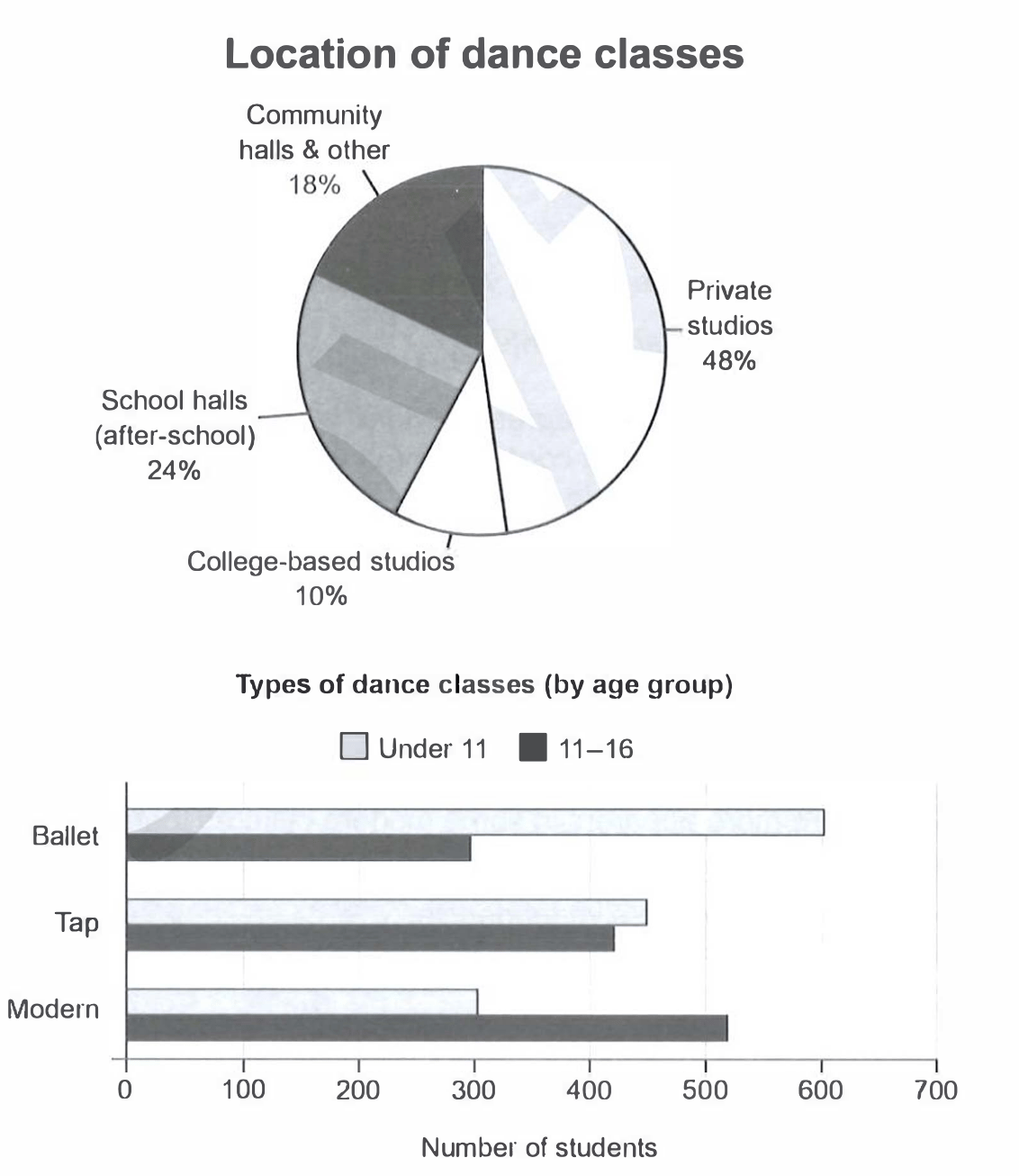
The charts below give information on the location and types of dance classes young people in a town in Australia are currently attending.
Summarise the information by selecting and reporting the main features, and make comparisons where relevant.
Student answer (Band 5.0)
The piechart shows different locations in a town of austraila where multiple dance classes are attended by the young people including two age groups under 11 and 11-16 years old teenagers.
almost 600 of the young kids which is the highest number of students under 11 are attending the ballet dance classes in private studios and only 300 teenage student are attending the ballet class, whereas in comparison the majority of the students from 11-16 are attending the modern dance classes in the community hall & other college based studios, while in the tap dance classes almost 450 from under 11 and 430 students from age 11-16 are attending in the respective locations of private studios and community halls where we see that the students under 11 has the lowest ratio about 300 students attending the modern dance classes, and almost equal in the tap dance class.
AI examiner evaluation
| Criterion | Band |
|---|---|
| Task Achievement / Task Response | 4.5 |
| Coherence and Cohesion | 4.5 |
| Lexical Resource | 5.5 |
| Grammatical Range and Accuracy | 5.0 |
| Overall | 5.0 |
Task Achievement / Task Response: Band 4.5
You identify the two age groups and report several relevant comparisons, including the high figure for under-11 ballet and the lower figure for teenage ballet. However, the response does not give a clear overview of the main patterns, and some details are inaccurate or confusing: the chart does not link dance types to particular locations, so claims that ballet students attend private studios or that tap students attend particular venues are unsupported. The location percentages are not reported, and the largest age-group figures are not clearly compared. The response is also 147 words, three words below the required minimum. To improve, summarise the main contrasts first, report accurate figures, and keep the two charts’ information separate.
Coherence and Cohesion: Band 4.5
There is a basic attempt to organise the information, beginning with the charts and then comparing dance styles and age groups. Linking expressions such as “whereas,” “while,” and “in comparison” show an effort to connect ideas. However, the response is essentially one long paragraph, with no clear overview or progression from the location chart to the age-group chart. The final sentence contains several comparisons joined together, making it difficult to follow which figures relate to which dance type or venue. Some references, such as “the respective locations,” are unclear because the chart does not connect locations with dance styles. Use separate paragraphs for an overview and key details, and group comparisons consistently.
Lexical Resource: Band 5.5
You use some relevant task vocabulary, including “majority,” “highest number,” “ratio,” and “attending,” and the reader can generally identify the topic and comparisons you intend. However, several choices are imprecise or repetitive: “ratio” is not suitable for a student count, and “dance classes” and “students” recur without much variation. There are also spelling and form errors, including “piechart” and “austraila,” which reduce accuracy. Some phrases, such as “teenage student,” are awkward in context. Aim for precise chart language and accurate spelling, using terms such as “proportion,” “number of students,” and “participated in” where appropriate.
Grammatical Range and Accuracy: Band 5.0
The response attempts to use complex comparisons, particularly with “whereas,” “while,” and “in comparison,” but these structures are often difficult to control. For example, the opening sentence lacks a clear grammatical structure, and the long second sentence combines several clauses without clear boundaries. There are recurring agreement and article problems, as in “300 teenage student are attending” and “the students under 11 has.” Capitalisation and punctuation are also inconsistent, including the lowercase opening and the absence of a full stop at the end. These errors sometimes make relationships between figures hard to understand. Build shorter, complete sentences first, then add one controlled comparison clause at a time.
See this exact question answered at other band scores. The same prompt compared across bands.
Browse more IELTS Writing model answers or get your own writing scored by the same AI examiner.