Band 6.0 IELTS Writing Task 1 Model Answer
Overall Band Score: 6.0 · Cambridge IELTS 19 · 2026-11-10
IELTS Writing Task 1 question
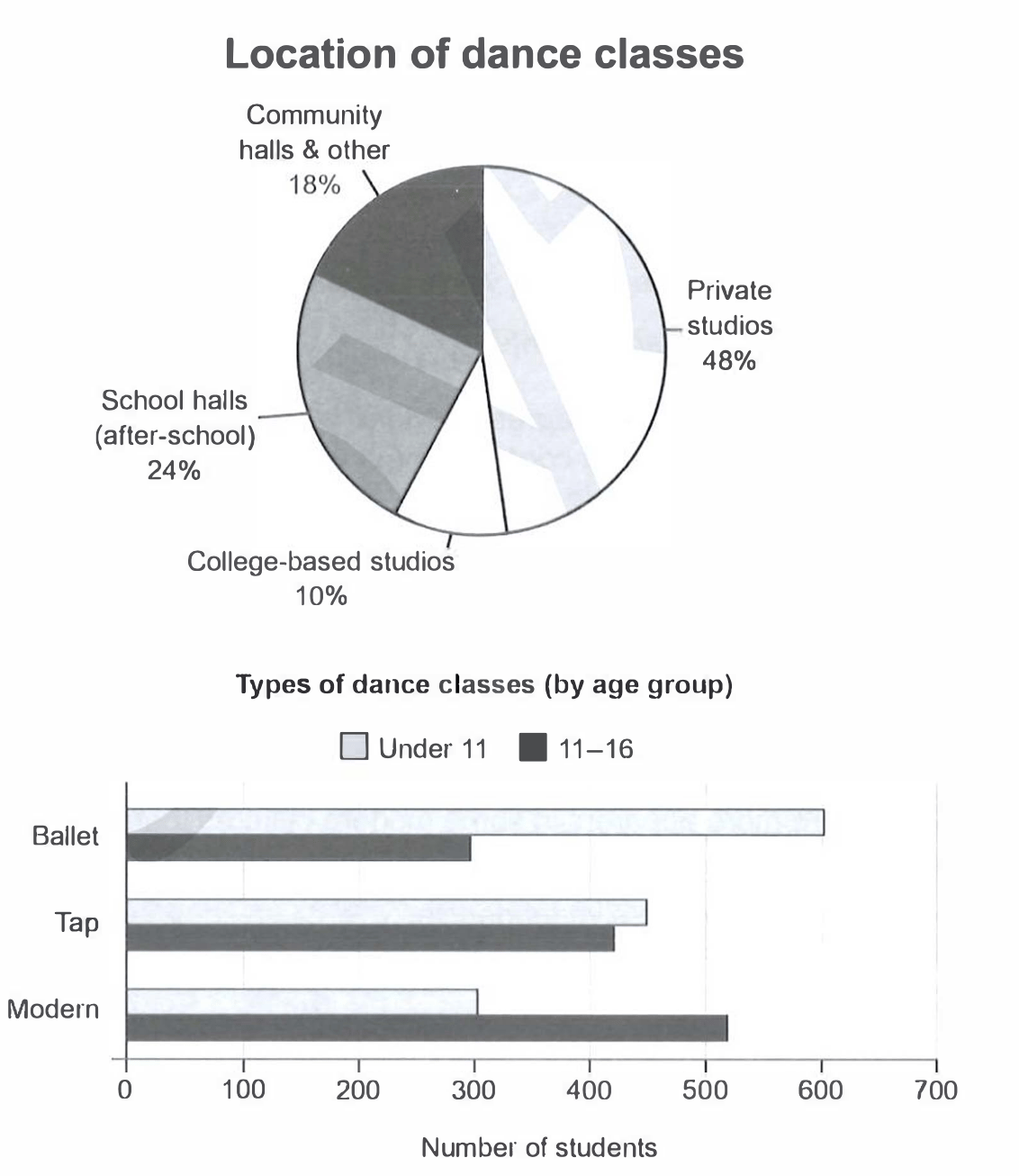
The charts below give information on the location and types of dance classes young people in a town in Australia are currently attending.
Summarise the information by selecting and reporting the main features, and make comparisons where relevant.
Student answer (Band 6.0)
The given pie chart demonstrates the location of dance classes and bar chart depicts the three different types of dance classes attending by young people in a town in Austrialia.
Overall, it can be observed that the maximum dance classes held in private studios . Whereas, a large number of under 11 students preferred ballet type of dance .
Turning to the details, it is evident from the pie chart , most of the dance classes organinsed in private studios which make dominant location accounted for 48%.School halls are the second most preferred location which recorded at 24% share. Interestingly closely, Community halls&others and college based studios least favourable location for held dance classes at 18% and 10% respectively.
Moving further, under 11 age group students are most interested in bullet type of dance classes with about 600 pupils. 11-16 young people contributed with 300 students . Apart from that, under 11 students chose tape type of dance class at nearly 450 students , followed closely by teenagers with 400 learners. Lastly, teenagers taking a maximum interest in modern category of dance class with above 500 students and half of the teenagers total taken by under 11 students.
AI examiner evaluation
| Criterion | Band |
|---|---|
| Task Achievement / Task Response | 6.5 |
| Coherence and Cohesion | 6.5 |
| Lexical Resource | 5.5 |
| Grammatical Range and Accuracy | 5.5 |
| Overall | 6.0 |
Task Achievement / Task Response: Band 6.5
You cover both charts and provide a clear overview, identifying private studios as the leading location and ballet as the most popular choice among children under 11. Most location figures are reported accurately, and the comparisons across age groups show relevant selection of key data. However, some details are unclear or inaccurate: the 11–16 group’s tap figure is about 420, not 400, and “half of the teenagers total taken by under 11 students” does not clearly express that the under-11 modern figure is about 300 compared with roughly 520 among older students. The overview could also capture the contrasting pattern more fully: younger children favour ballet, while older students favour modern. This gives the response solid coverage, but some comparisons need clearer development.
Coherence and Cohesion: Band 6.5
The response has a recognisable structure: an introduction, an overview, and separate paragraphs for the location and dance-type data. Sequencing is generally logical, and phrases such as “Turning to the details” and “Moving further” help signal progression. However, some linking is mechanical or awkward, particularly “Apart from that” and “Lastly,” and the sentence beginning “Interestingly closely” disrupts the flow. The final comparison about modern dance is difficult to follow, so the relationship between the two age groups is not clearly conveyed. Use fewer formulaic transitions and connect each comparison directly to the relevant figures. Clearer referencing and more controlled sentence links would make the progression smoother and more consistent.
Lexical Resource: Band 5.5
You use a reasonable range of task-related vocabulary, including “accounted for,” “share,” “preferred,” and “contributed,” and the reader can generally understand the intended comparisons. However, several word choices and collocations are inaccurate or unnatural, such as “bullet type of dance” for ballet, “tape type” for tap, “maximum interest,” and “least favourable location for held dance classes.” There are also spelling errors, including “Austrialia” and “organinsed,” which reduce precision. Aim for accurate chart language such as “the largest proportion,” “the most popular style,” and “classes were held.” Check the spelling of key labels carefully, since errors in the names of the categories can make otherwise relevant data harder to interpret.
Grammatical Range and Accuracy: Band 5.5
You attempt a mix of simple and more complex sentence forms, including the overview contrast beginning “Whereas” and comparisons between age groups. Meaning is usually recoverable, but some grammatical errors recur. For example, “the three different types of dance classes attending by young people” needs a passive form (“attended by”), while “which make dominant location” has an incorrect verb form and missing article. The sentence “under 11 age group students are most interested” also needs clearer article use and phrasing. Punctuation and spacing are inconsistent, as in “48%.School halls” and the comma spacing in “pie chart ,”. Build accuracy by checking subject–verb agreement, articles, and complete sentence structure, especially when combining comparisons.
See this exact question answered at other band scores. The same prompt compared across bands.
Browse more IELTS Writing model answers or get your own writing scored by the same AI examiner.