Band 6.0 IELTS Writing Task 1 Model Answer
Overall Band Score: 6.0 · Cambridge IELTS 19 · 2026-11-10
IELTS Writing Task 1 question
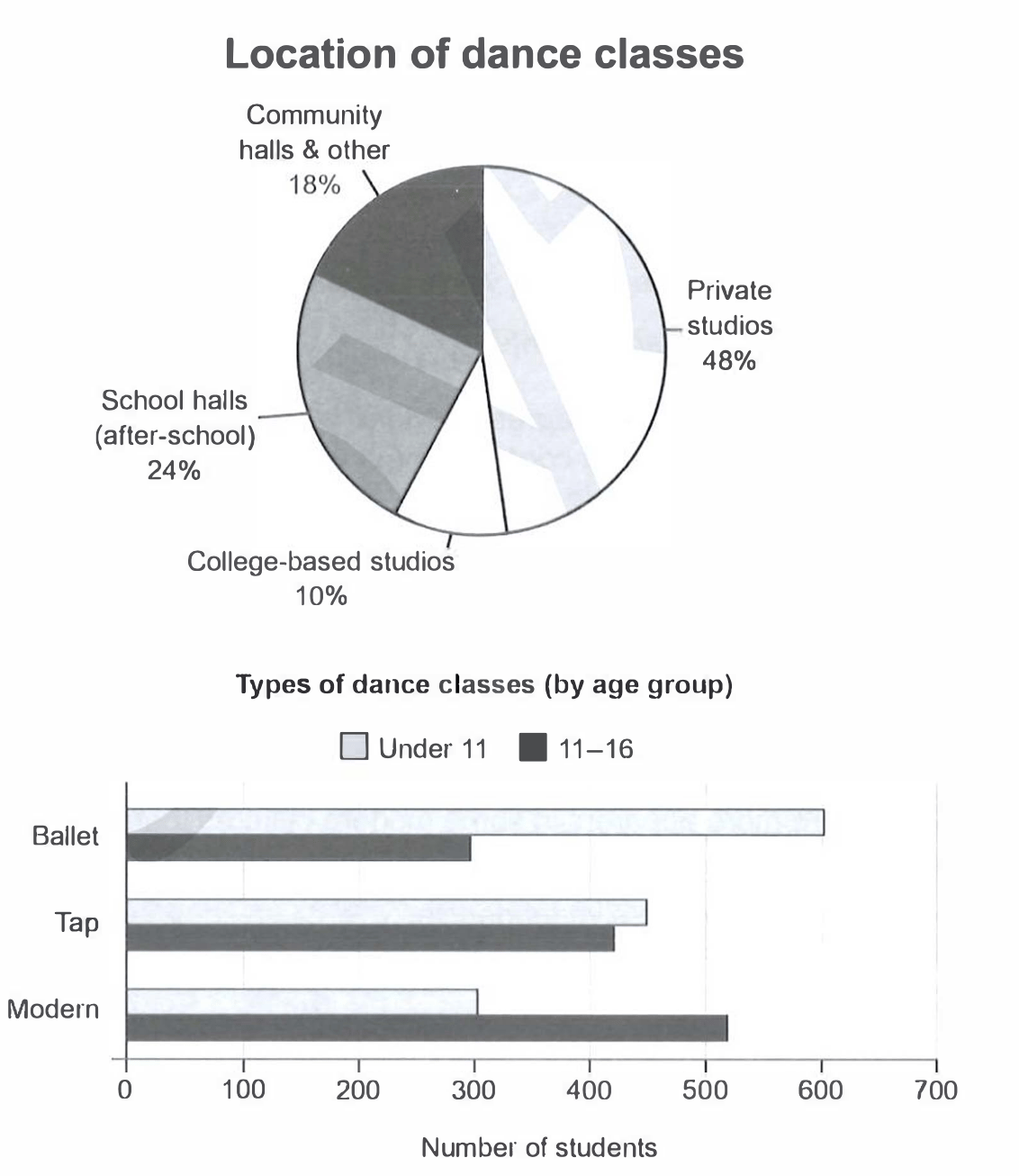
The charts below give information on the location and types of dance classes young people in a town in Australia are currently attending.
Summarise the information by selecting and reporting the main features, and make comparisons where relevant.
Student answer (Band 6.0)
There are shown two types of statistical diagram, a pie chart which represents the different types of locations of dance classes in Australia and a bar diagram that represents the various types of dance classes according to the age group.
Most of the dance classes are located at Private studios which is around 48% while the least found in college based studios which is around 10%. Other locations like School halls occupy 24% and Community halls and others carry remaining 18% of total places.
On the other hand, the bar diagram claims that the most popular dance types among under age of 11 is Ballet which is around 600 of students and the least desirable in the age group of 11 to 16 years old which is around 300 in number while Modern dance type is carried the most of the age between 11 to 16 years old students which is above 500 in number as well as least famous for the age group under 11 years old which is around 300 in number. So the preferences of dance types (Ballet and Modern) are vice-versa according to the age group of the students. Another dance form is called Tap which is mediocore for both age group, while under 11 years old students prefer almost 450 in number as well as upto 11 years old students prefer approximately 400 in number.
AI examiner evaluation
| Criterion | Band |
|---|---|
| Task Achievement / Task Response | 6.5 |
| Coherence and Cohesion | 6.5 |
| Lexical Resource | 6.0 |
| Grammatical Range and Accuracy | 5.5 |
| Overall | 6.0 |
Task Achievement / Task Response: Band 6.5
You cover both charts and identify several important features: private studios are the largest location category, college-based studios the smallest, and the preferences for ballet and modern differ by age. Most figures are close to the chart, and the comparison of ballet and modern is a useful overview. However, some details are unclear or inaccurate: the 11–16 tap figure is about 420, not simply “approximately 400,” and “mediocore for both age group” does not clearly describe the comparison. The response also lacks a concise, distinct overview of the main patterns across both charts. To strengthen it, summarise the key contrasts first, then support them with precise comparisons and avoid ambiguous claims such as “vice-versa.”
Coherence and Cohesion: Band 6.5
The response has a generally understandable order: it introduces the two charts, describes the location figures, and then discusses dance types by age. Linking phrases such as “On the other hand” and “So” help signal relationships, and the reader can follow the main comparisons. However, the long final paragraph combines several figures and interpretations, making the age-group comparisons harder to track. Some connections are also imprecise: “while” introduces a comparison that is not clearly expressed, and the repeated “as well as” construction obscures which age group prefers which number of tap students. Use separate paragraphs for the overview and detailed comparisons, and organise the bar-chart information consistently by age group or dance style.
Lexical Resource: Band 6.0
You use a reasonable range of task-related vocabulary, including “occupy,” “preferences,” “popular,” and “age group,” so the main information is usually clear. There are also attempts at more varied phrasing, such as “least desirable” and “vice-versa,” but some choices are inaccurate or unnatural for describing chart data. “The bar diagram claims” gives a chart human agency, while “mediocore” is misspelled and does not precisely convey that tap figures are similar. “Carry remaining 18%” and “least found” are also awkward collocations. Aim for standard reporting language and accurate spelling; terms such as “account for,” “record,” and “approximately equal” would make the comparisons more precise and natural.
Grammatical Range and Accuracy: Band 5.5
You attempt a mix of simple and more complex sentences, including comparisons joined with “while” and “as well as,” and the overall meaning can generally be understood. However, some sentence structures are awkward or incomplete, and errors in articles, agreement, and prepositions reduce accuracy. For example, “There are shown two types” has an unnatural passive construction; “the least found in college based studios” lacks a clear grammatical structure; and “the most popular dance types among under age of 11 is Ballet” has agreement and phrasing problems. The final sentence also shifts between age groups without a clear grammatical parallel. Practise building shorter, complete comparison sentences, checking singular/plural agreement, and using articles and prepositions consistently.
See this exact question answered at other band scores. The same prompt compared across bands.
Browse more IELTS Writing model answers or get your own writing scored by the same AI examiner.