Band 6.0 IELTS Writing Task 1 Model Answer
Overall Band Score: 6.0 · Cambridge IELTS 19 · 2026-11-10
IELTS Writing Task 1 question
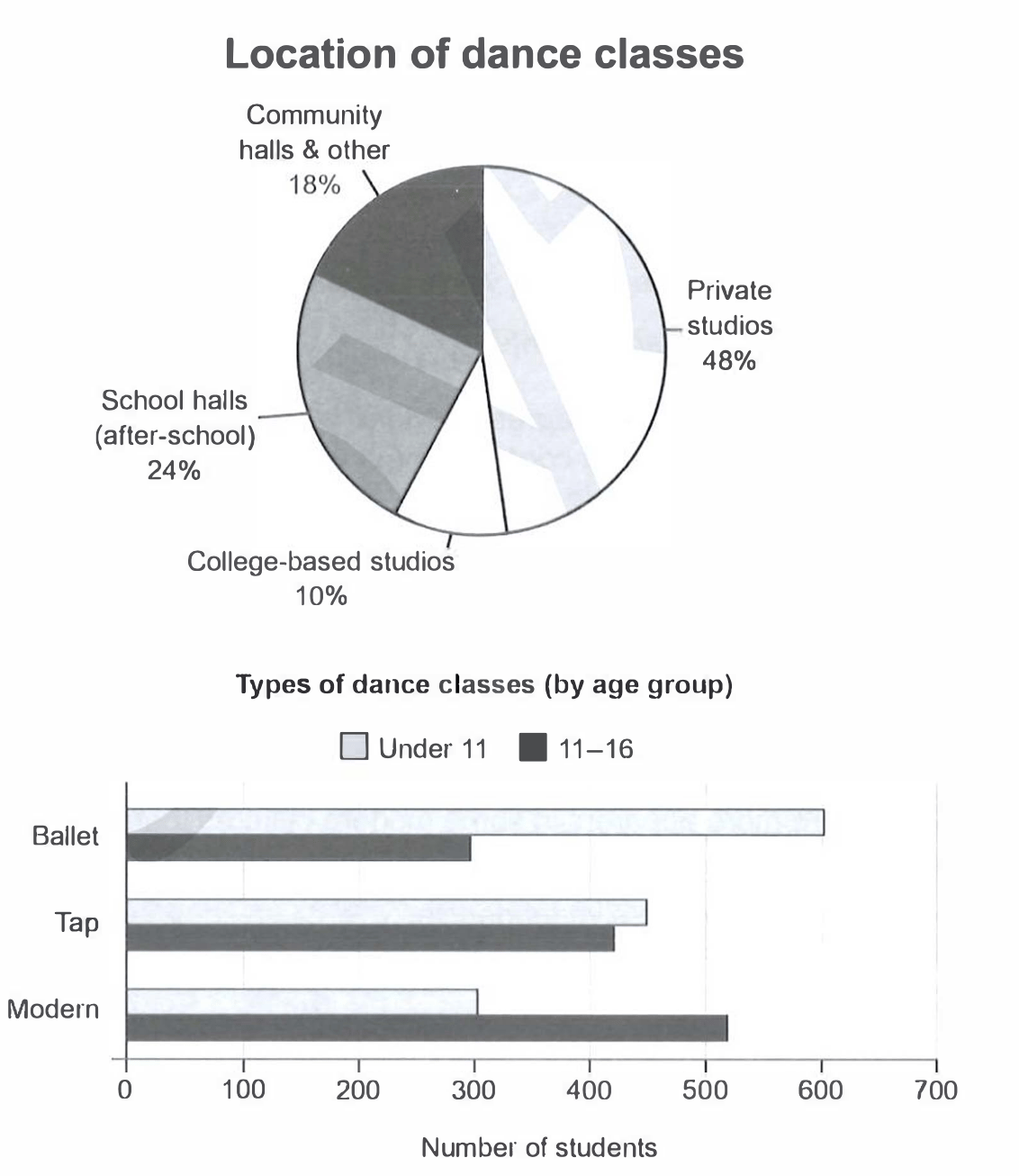
The charts below give information on the location and types of dance classes young people in a town in Australia are currently attending.
Summarise the information by selecting and reporting the main features, and make comparisons where relevant.
Student answer (Band 6.0)
The charts illustrate the four locations and three types of dance classes based on the attendance of urban young people in Australia at present.
Among four locations, majority of young people goes to private studios where minority chooses college-based studios. On the other hand, young peole who are under 11, like ballet than other two dance types, though people who are aged between 11 and 16, like modern type of dance.
According to the location of dance classes, 48% of young aged boys and girls, which means majority, attend classes at private sudios, 24% of them do dancing at school halls after finishing school. Besides, 18% of them goes to community halls and other and 10 % people which is less in number goes to college-based studios.
According to the tyes of dance classes which is catagorized by age group. Ballet is the most demanding form of dance for the young people who are under 11 and it's almost 600 in number. Around 450 people like tap and 300 people like modern dance. On the other hand, modern is liked by most of the young people who are aged between 11 and 16 and it's arounf 500 in number. 400 of them like tap and the 300 of them like ballet which is minimum than other types.
AI examiner evaluation
| Criterion | Band |
|---|---|
| Task Achievement / Task Response | 6.5 |
| Coherence and Cohesion | 5.5 |
| Lexical Resource | 5.5 |
| Grammatical Range and Accuracy | 5.5 |
| Overall | 6.0 |
Task Achievement / Task Response: Band 6.5
You cover both charts and identify the main patterns: private studios are the most common location, college-based studios the least common, and preferences differ by age group. The location percentages are reported accurately. Your comparisons between dance types are also generally sound, including ballet leading among under-11s and modern among 11–16-year-olds. Some details are less precise: the older group’s tap figure is about 420, rather than 400, and modern is approximately 520 rather than 500. The opening overview could also state the age-group contrast more fully, including that tap attendance is similar in both groups. This gives a relevant, mostly accurate account, with some features developed more clearly than others; greater precision and a fuller overview would strengthen it further.
Coherence and Cohesion: Band 5.5
The response has a recognisable structure: an introduction, a brief overview, and separate paragraphs for location and dance-type data. This helps the reader follow the two charts, and phrases such as “On the other hand” signal a comparison. However, progression within paragraphs is sometimes mechanical, with repeated openings such as “According to” and frequent use of “Besides” and “On the other hand.” The overview also repeats details that are then given again in the body, while some references, such as “them,” are not always precise. Grouping the age-group comparisons more systematically and using a wider range of clear linking and referencing would make the organisation smoother and less repetitive.
Lexical Resource: Band 5.5
You use relevant chart vocabulary, including “private studios,” “school halls,” “attendance,” and “age group,” so the topic is generally clear. There is also some attempt at more formal reporting language, such as “categorized” and “majority.” However, several word choices and collocations are unnatural or imprecise: “most demanding form of dance” does not mean the most popular, and “people goes to” is not an appropriate way to describe attendance. Spelling errors such as “peole,” “sud ios,” “tyes,” “catagorized,” and “arounf” also reduce accuracy. Aim for precise terms such as “most popular” and “attend classes,” and proofread spelling and word forms.
Grammatical Range and Accuracy: Band 5.5
You attempt both simple and more complex sentences, including clauses with “where,” “though,” and “which,” and the overall meaning is usually understandable. However, some sentence patterns are not controlled consistently. For example, “majority of young people goes” has an agreement problem, while “24% of them do dancing” uses an awkward grammatical construction. The sentence beginning “Ballet is the most demanding form … and it's almost 600 in number” also joins ideas unclearly. Articles and plural forms are sometimes missing or inconsistent, as in “the young people who are under 11” and “the 300 of them.” Build accuracy by using straightforward reporting structures, checking subject–verb agreement, and separating comparisons into complete sentences.
See this exact question answered at other band scores. The same prompt compared across bands.
Browse more IELTS Writing model answers or get your own writing scored by the same AI examiner.