Band 6.0 IELTS Writing Task 1 Model Answer
Overall Band Score: 6.0 · Cambridge IELTS 19 · 2026-11-11
IELTS Writing Task 1 question
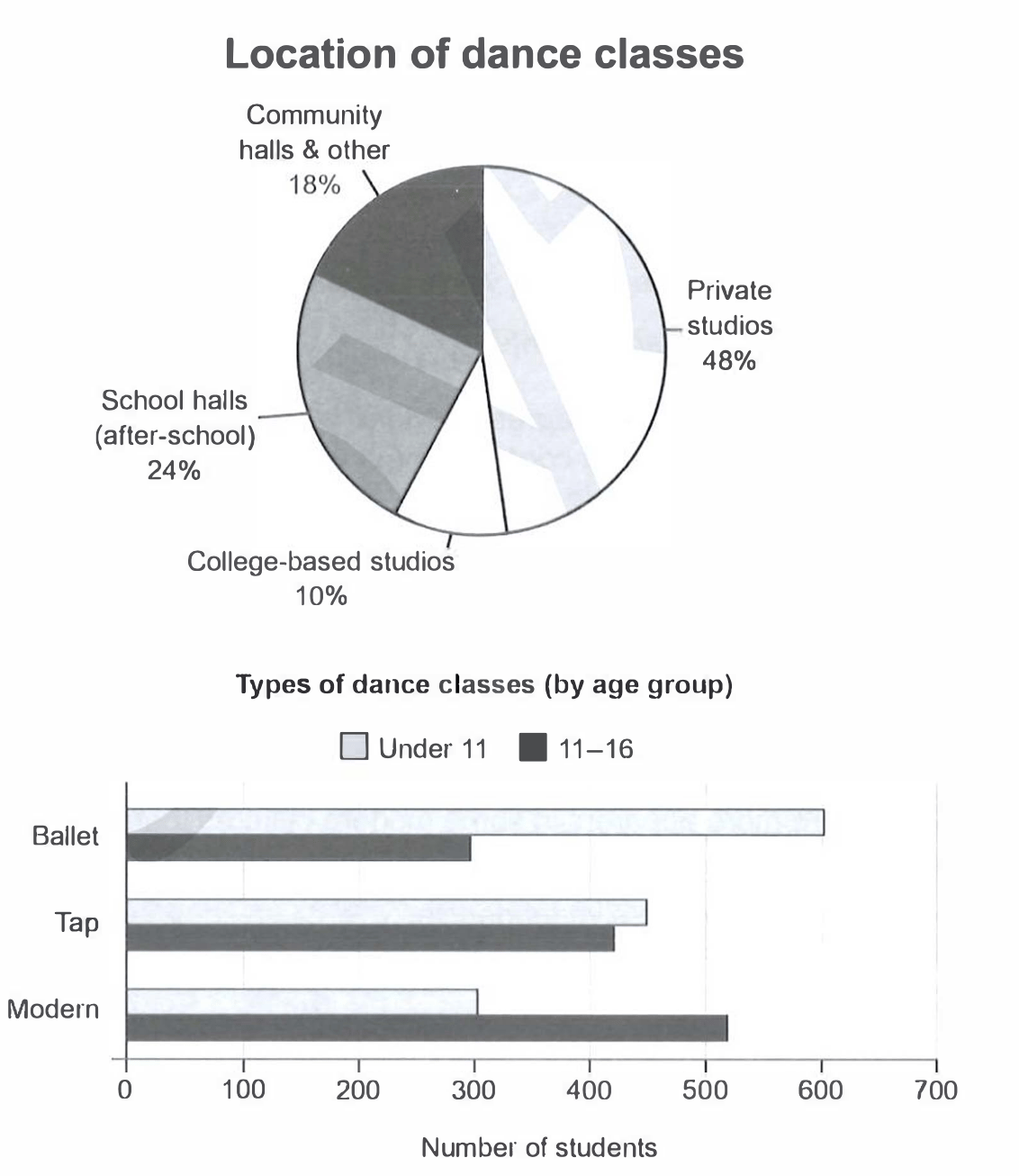
The charts below give information on the location and types of dance classes young people in a town in Australia are currently attending.
Summarise the information by selecting and reporting the main features, and make comparisons where relevant.
Student answer (Band 6.0)
The pie chart illustrates in which locations dance sessions are held. The bar chart presents types of dance classes by age group are taken currently by young people of australian town.
Overall, mostly people use private studios for their classes while the least amount of citizens prefer college-based studios. In contrast, small students who take Ballet classes are largest from younger ones whereas, the modern dance classes experience more younger students who age is greater than 11 year.
Regarding the location of classes, 48% people use private studios to learn dance while the school halls account at 24%. On other side, the persons who are used community halls and other locations they are 18% followed by 10% participants who are the students of college-based studios.
On the other hand, ballet classes have 600 students who's age less than 11 while the students with age between 11 and 16 they are 300 in total. Furthermore, approximately 520 students are enrolled in modern dance who's are above 11 year meanwhile, under 11 year old students accounted at 300. In tap classes the numbers are close to each other as around 425 with above 11 and nearly 450 under 11 students.
AI examiner evaluation
| Criterion | Band |
|---|---|
| Task Achievement / Task Response | 7.0 |
| Coherence and Cohesion | 6.5 |
| Lexical Resource | 5.5 |
| Grammatical Range and Accuracy | 5.0 |
| Overall | 6.0 |
Task Achievement / Task Response: Band 7.0
You cover both charts and give a clear overview of the main contrasts: private studios are the most common location, college-based studios the least common, and ballet and modern show opposing age patterns. The location figures are accurately reported, and the comparisons for ballet and modern match the chart. You also identify tap as relatively close between age groups, although the figures are slightly reversed: under-11s number about 450, compared with about 420 aged 11–16. The overview’s phrase “small students” is unclear, and “more younger students who age is greater than 11” obscures the intended comparison. To strengthen the response further, state the key patterns precisely in the overview and ensure every comparison is expressed unambiguously.
Coherence and Cohesion: Band 6.5
The response has a recognisable four-paragraph structure: introduction, overview, location details, and age-group details. This gives the reader a sensible route through the two charts, and transitions such as “Regarding” and “Furthermore” help signal shifts. However, some linking is mechanical or imprecise. “On the other hand” does not clearly mark the move from locations to dance types, and “In contrast” introduces an unclear comparison in the overview. Within the final paragraph, the sequence of ballet, modern, and tap is understandable, but comparisons could be grouped more consistently by age group or by dance type. Use clearer references and transitions so the relationships between figures are easy to follow without rereading.
Lexical Resource: Band 5.5
You use relevant chart vocabulary, including “account for,” “enrolled,” “participants,” and “approximately,” and the reader can generally identify the categories being compared. However, word choice and collocation are often unnatural or imprecise, which limits clarity: “small students” does not mean a small number of students, “the least amount of citizens” is unsuitable for this data, and “the persons who are used community halls” is difficult to interpret. There is also repetition of “students” and “classes,” while phrases such as “age is greater than 11 year” show limited control of natural expression. Aim for concise, standard reporting language and accurate collocations; this will make your comparisons sound more precise and fluent.
Grammatical Range and Accuracy: Band 5.0
You attempt a mixture of simple and more complex sentences, including clauses introduced by “while” and “whereas.” However, complex structures are often faulty, and errors occur frequently enough to make some sentences difficult to process. For example, “The bar chart presents types of dance classes by age group are taken” combines incompatible structures; “who’s age less than 11” misuses the relative form and omits a verb; and “the students with age between 11 and 16 they are 300” has an unnecessary repeated subject. There are also problems with articles, agreement, and sentence construction. Practise building accurate comparison patterns, such as “There were 600 under-11 ballet students, compared with 300 aged 11–16,” before adding more complex clauses.
See this exact question answered at other band scores. The same prompt compared across bands.
Browse more IELTS Writing model answers or get your own writing scored by the same AI examiner.