Band 6.5 IELTS Writing Task 1 Model Answer
Overall Band Score: 6.5 · Cambridge IELTS 19 · 2026-11-11
IELTS Writing Task 1 question
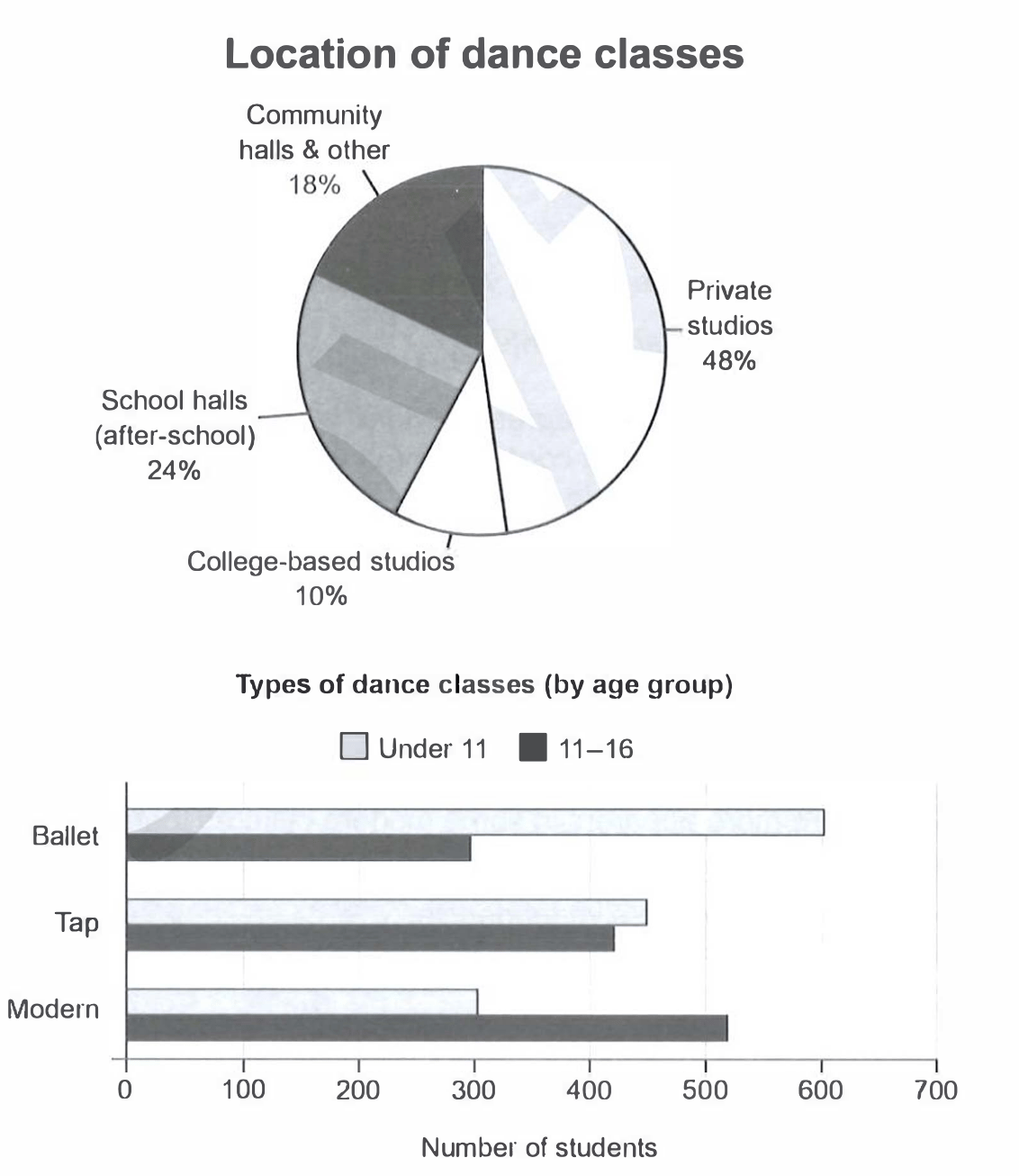
The charts below give information on the location and types of dance classes young people in a town in Australia are currently attending.
Summarise the information by selecting and reporting the main features, and make comparisons where relevant.
Student answer (Band 6.5)
The pie chart illustrates the location of dance lectures and the bar chart compares the varities of dance classes in Australia, pupils are attending right now.
Overall, it is evident that the major contribution in location is private studios and the biggest number of children under 11 is in Ballet and the highest number of teenagers is in Modern dance.
According to the pie chart, private studios contribute 48 percent of location of dance classes while, college-based studios contribute just 10 percent. The percentage of contribution of school halls is 24 percent as compared to just 18 percent contribution of community halls and other.
Moving towards the bar chart, There are 600 young ones under 11 as compared to the half number of teenagers in Ballet dance. The number of children in Tap dance is around 400 of both age groups. In Modern dance, there are only 300 students under 11 while, the number exceeds 500 of children from 11 to 16.
AI examiner evaluation
| Criterion | Band |
|---|---|
| Task Achievement / Task Response | 6.5 |
| Coherence and Cohesion | 7.0 |
| Lexical Resource | 5.5 |
| Grammatical Range and Accuracy | 6.0 |
| Overall | 6.5 |
Task Achievement / Task Response: Band 6.5
You cover both charts and provide a clear overview, identifying private studios as the leading location and the contrasting peaks for younger children and teenagers. Most figures are reported accurately: the location percentages match the chart, and the ballet and modern comparisons are broadly correct. However, the overview says “the biggest number of children under 11 is in Ballet” without explicitly comparing it with the other classes, and the bar-chart details are less precise in places. For example, “around 400 of both age groups” for tap obscures the difference between approximately 450 and 420. The response therefore presents the main features, but some comparisons could be more fully developed and precise.
Coherence and Cohesion: Band 7.0
The response has a clear overall progression: an introduction and overview are followed by a paragraph on the pie chart and one on the bar chart. This makes the two sources easy to distinguish, and phrases such as “According to the pie chart” and “Moving towards the bar chart” guide the reader through the information. The organisation is logical, though some linking is mechanical, and the opening sentence combines the chart descriptions in a slightly crowded way. Within the bar-chart paragraph, comparisons could be grouped more deliberately—for example, by stating the figures for each dance and then highlighting the age-group contrast. More varied, precise transitions and clearer links between comparisons would make the progression smoother.
Lexical Resource: Band 5.5
You use enough topic vocabulary to communicate the chart information, including “private studios,” “college-based studios,” “percentage,” and “age groups.” However, several choices are inaccurate or unnatural for this task. “Dance lectures” does not describe classes, “major contribution” is an awkward way to identify the largest share, and “the half number of teenagers” is unclear. “Young ones” and “contribution of location” are also imprecise. There is a spelling error in “varities,” and repeated use of “number” limits flexibility. Choose standard chart language such as “share,” “proportion,” and “student total,” and use accurate terms for the groups and activities to improve precision and naturalness.
Grammatical Range and Accuracy: Band 6.0
You use a mix of simple and more complex sentence forms, and the meaning is generally clear. Comparisons with “while” and “as compared to” show an attempt to vary sentence structure. Some errors in punctuation and sentence construction remain, however. The opening sentence joins two independent clauses with a comma, while “while, college-based studios” has an unnecessary comma after the conjunction. In “There are 600 young ones under 11 as compared to the half number of teenagers,” the comparison is not formed clearly. Capitalisation is also inconsistent after a paragraph break: “There” begins mid-sentence after “Moving towards the bar chart,” and should be lowercase. More careful clause punctuation and clearer comparative structures would improve accuracy.
See this exact question answered at other band scores. The same prompt compared across bands.
Browse more IELTS Writing model answers or get your own writing scored by the same AI examiner.