Band 5.5 IELTS Writing Task 1 Model Answer
Overall Band Score: 5.5 · Cambridge IELTS 19 · 2026-11-11
IELTS Writing Task 1 question
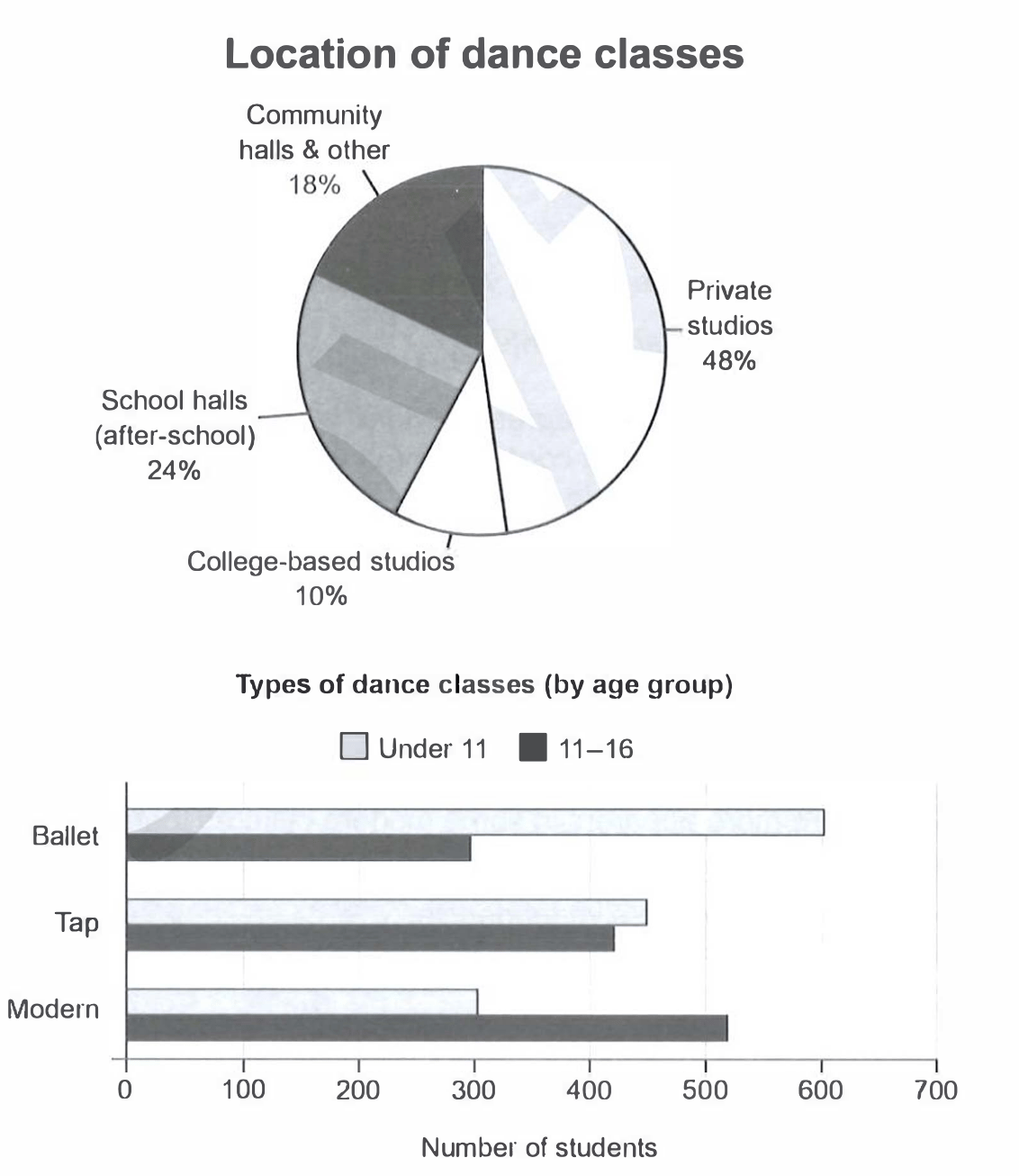
The charts below give information on the location and types of dance classes young people in a town in Australia are currently attending.
Summarise the information by selecting and reporting the main features, and make comparisons where relevant.
Student answer (Band 5.5)
This piechart illustrate the information about the location and type of dance classes people attending in australia.
If we talking about the location, majority of people (approx 48%) go to the private studios and very less people peopel (approx 10%) go to the college-based studio in australia while 18% people go to the community halls and 24% of the people go to the school halls after the school.
Here we also saw that graph have three types of dance classes, in which, first is ballete dance, second is tap and third is modern dance.
Most of the teenager which is under 11 is prefered ballet dance and they give very less priority to modern dance. Teenagers between 11 to 16 is preffered modern dance and ballet dance they preffered less.
Allover, first chart show comparision of location of dance classes which preffered by people and second chart show the comparision of types of dance classes which choose by teenagers which is under 11 and between 11 to 16.
AI examiner evaluation
| Criterion | Band |
|---|---|
| Task Achievement / Task Response | 5.5 |
| Coherence and Cohesion | 5.5 |
| Lexical Resource | 5.0 |
| Grammatical Range and Accuracy | 5.0 |
| Overall | 5.5 |
Task Achievement / Task Response: Band 5.5
You identify both charts and report several accurate location figures, including private studios at about 48%, college-based studios at 10%, community halls at 18%, and school halls at 24%. You also capture the broad contrast that younger children favour ballet while the older group favours modern dance. However, the response does not give the actual student figures for the dance types, and it omits the important comparison that tap is similar across the two age groups. The statement that the charts show what people “preferred” is also stronger than the data supports, which records attendance. A clearer overview of the main patterns, supported by selected figures for all three dance types, would make the report more complete and developed.
Coherence and Cohesion: Band 5.5
The response has a basic sequence: it introduces the charts, describes the locations, then discusses dance types and ends with a summary. This makes the general subject understandable. However, progression is limited because the final paragraph largely repeats that the charts compare locations and dance types rather than synthesising the key findings. Linking phrases such as “If we talking” and “Here we also saw” are awkward and do not clearly connect the information. The dance-type paragraph would be easier to follow if it compared the two age groups directly for each style, using clear references such as “By contrast” or “whereas.” Organising the response into a concise overview followed by focused detail paragraphs would strengthen its flow.
Lexical Resource: Band 5.0
You use some relevant chart vocabulary, including “private studios,” “college-based studio,” “community halls,” and “school halls,” so the reader can identify the categories being described. However, the range is limited and several choices are inaccurate or repetitive: “people” is used repeatedly where “students” would be more precise, and “preferred” suggests a stated preference rather than attendance. There are also noticeable spelling and word-form errors, including “piechart,” “ballete,” “preffered,” and “comparision.” Phrases such as “very less people” and “give very less priority” are not natural English collocations. More precise reporting verbs and comparison language would make the description clearer and more appropriate to an academic chart report.
Grammatical Range and Accuracy: Band 5.0
The response relies mainly on simple sentence patterns, with attempts to add clauses that are often inaccurate. For example, “This piechart illustrate” has subject–verb disagreement, while “If we talking about the location” is missing the auxiliary verb. In “Most of the teenager which is under 11 is prefered,” the singular/plural forms and verb construction are not controlled; “Teenagers between 11 to 16 is preffered” also has agreement and sentence-structure problems. Articles and prepositions are inconsistent, as in “go to the school halls after the school.” These errors sometimes make the intended meaning harder to follow. Practise accurate present-simple reporting sentences and comparisons, such as “Children under 11 attend ballet most, whereas older students attend modern classes most.”
See this exact question answered at other band scores. The same prompt compared across bands.
Browse more IELTS Writing model answers or get your own writing scored by the same AI examiner.