Band 6.0 IELTS Writing Task 1 Model Answer
Overall Band Score: 6.0 · Cambridge IELTS 19 · 2026-11-12
IELTS Writing Task 1 question
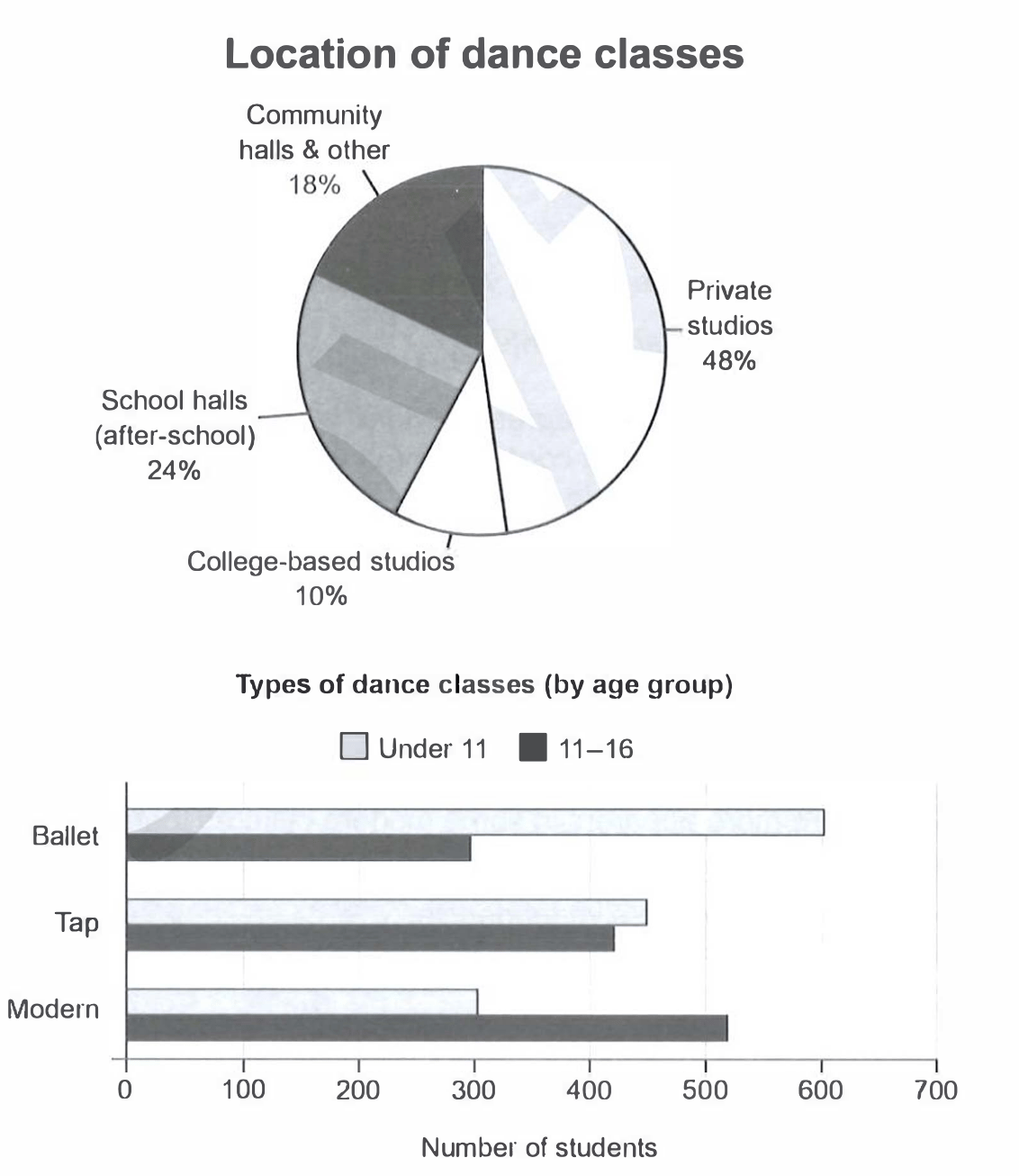
The charts below give information on the location and types of dance classes young people in a town in Australia are currently attending.
Summarise the information by selecting and reporting the main features, and make comparisons where relevant.
Student answer (Band 6.0)
The pie chart shows the location of dance classes taken by Preadolescents and teenagers in an Australian teritory while the bar chart shows genre of dance classes classified by the age group.
Overall, the private studios dominate with almost half of the students taking classes there followed by School halls and college based studios combined.children under 11 mostly opted for classes like Ballet and Tap dances, while modren type of dance practice was most common in early teenagers.
Most of the practicing students opted for private studios composing almost 48% of the total while school halls were used after school hours at second place around by 24%. Community halls and others contribute to another 18% while college based studios with only 10%.Collectively school halls and college based studios account for 34% of the total, making them the 2nd highest after private studios.
Preadolescents (under 11) mostly opted for Ballet type of dance classes with over 600 students followed by Tap with somewhere around 450, while modern genre of dance with the least number around 300.On the other hand, in School aged group(11-16) modern type being the most opted dance class with more than 500 students followed by Tap with a number of around 400,while Ballet being the the least favourite among this age group,less than 300 students opted for this dance class.
AI examiner evaluation
| Criterion | Band |
|---|---|
| Task Achievement / Task Response | 7.0 |
| Coherence and Cohesion | 6.0 |
| Lexical Resource | 6.0 |
| Grammatical Range and Accuracy | 5.5 |
| Overall | 6.0 |
Task Achievement / Task Response: Band 7.0
You cover both charts and give a clear overview: private studios are the leading location, while preferences differ by age group. The main comparisons are supported with relevant figures, including 48% for private studios and the contrast between younger students’ preference for ballet and older students’ preference for modern dance. You also identify the least popular style for each group. The location figures are generally reported accurately, and the approximate bar-chart values are represented appropriately. To make the report more fully developed, avoid the slightly unclear overview phrase “School halls and college based studios combined” and state directly that school halls are the second most common location on their own. You could also make the age-group comparisons more explicit by comparing the same dance style across both groups.
Coherence and Cohesion: Band 6.0
The response has a coherent overall arrangement: an introduction, an overview, a paragraph on locations, and a paragraph comparing dance styles by age. This makes the two charts easy to follow, and transitions such as “On the other hand” help signal the shift between age groups. However, some connections are mechanical or unclear. In the overview, “followed by School halls and college based studios combined” is confusing because the combined share is not the second-largest individual category. The location paragraph also repeats the overview’s ranking before adding the combined percentage. Improve progression by grouping related comparisons more tightly and using clearer references, while checking sentence boundaries and spacing so the reader can follow each point without interruption.
Lexical Resource: Band 6.0
You use an adequate range of vocabulary for describing charts, including “dominate,” “account for,” “opted for,” and “least favourite.” These choices help communicate rankings and preferences, and the meaning is generally clear. There are, however, several inaccurate or awkward choices that limit precision: “Preadolescents” is less natural here than “children under 11,” “genre of dance classes” is awkward, and “composing almost 48%” does not collocate naturally with a share. Spelling errors such as “teritory” and “modren” also detract from control. Aim for standard chart-reporting phrases and consistent spelling; this will make the vocabulary more precise without requiring unnecessarily complex wording.
Grammatical Range and Accuracy: Band 5.5
You attempt both simple and complex sentence forms, including comparisons introduced by “while” and “On the other hand,” and the main information remains understandable. Some grammatical errors persist, particularly in sentence construction and punctuation. For example, “Community halls and others contribute to another 18% while college based studios with only 10%” is not a complete, well-formed sentence, and “while Ballet being the the least favourite” has an incomplete clause and a repeated article. There are also missing spaces after full stops and inconsistent capitalisation. To improve, make sure each sentence has a clear subject and finite verb, and proofread punctuation and articles. More accurate control of these structures would support the range you are already attempting.
See this exact question answered at other band scores. The same prompt compared across bands.
Browse more IELTS Writing model answers or get your own writing scored by the same AI examiner.