Band 5.0 IELTS Writing Task 1 Model Answer
Overall Band Score: 5.0 · Cambridge IELTS 19 · 2026-11-13
IELTS Writing Task 1 question
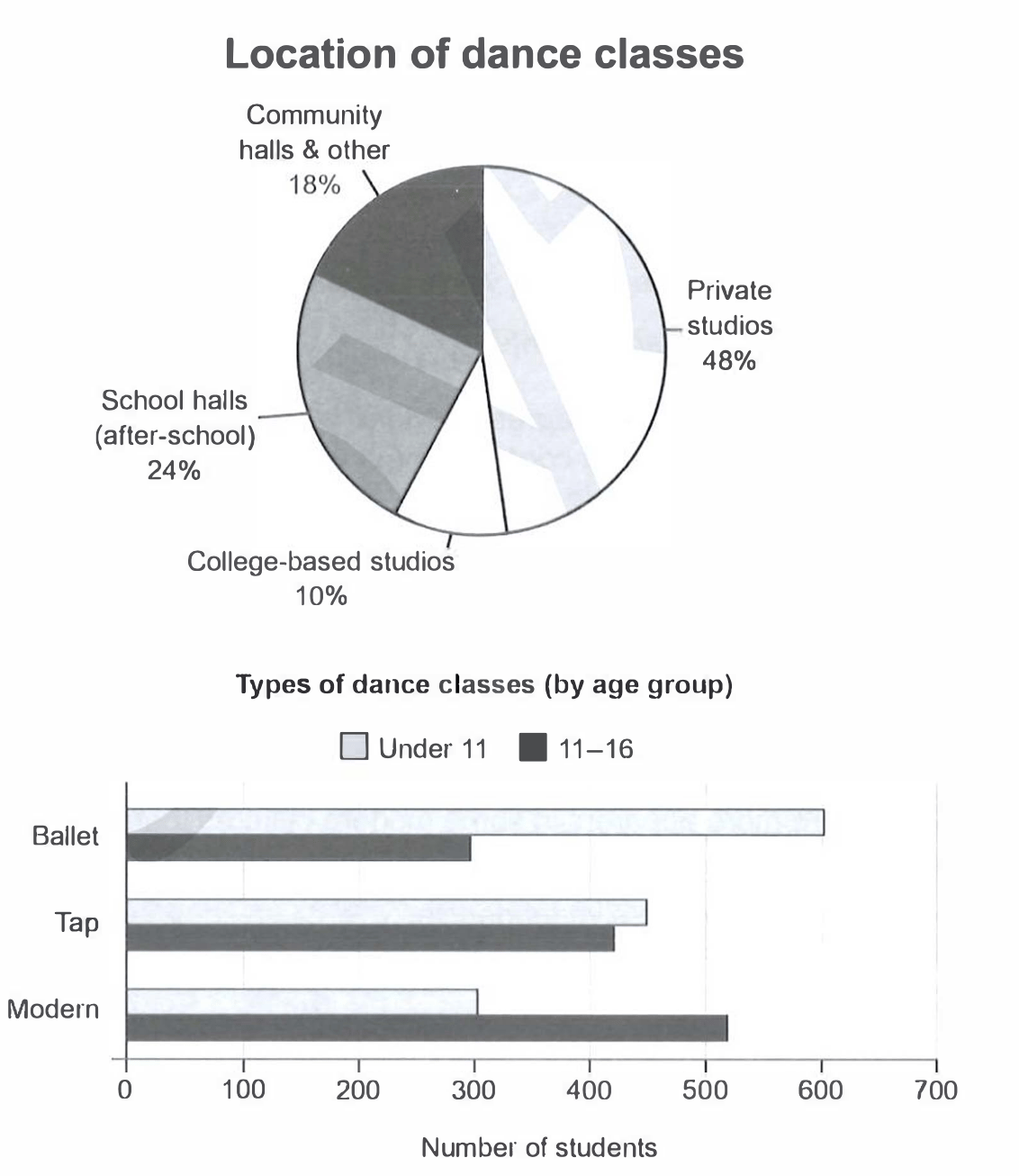
The charts below give information on the location and types of dance classes young people in a town in Australia are currently attending.
Summarise the information by selecting and reporting the main features, and make comparisons where relevant.
Student answer (Band 5.0)
let's first talk abouth the location and percentage of the dance classes, there are 4 mainly places where these classes held, the Provate studios are are covering the largest percentage of dance classes which is 48% and on the other hand School halls (after - School) are the 2nd largest percentage for dance classes that is 24% of the total. Community halls & other holds 18% while college-based studios hold only 10% which is the smallest percentage as compare to the private studios.
On the other hand, if we review the mass of population and age for the dance classes the largest popluation is of Ballet which is 600 students which are under 11 years old that is even larger than the number the students from 11-16 years old modern classes students but the modern and ballet classes share the same number of the student in 11-16 years and under 11 years old students of ballet and modern, respectly. studnets have intermediate attenstions in tap classes. There is not much difference btween under 11 and 11-16 years old student.
AI examiner evaluation
| Criterion | Band |
|---|---|
| Task Achievement / Task Response | 5.0 |
| Coherence and Cohesion | 5.5 |
| Lexical Resource | 5.0 |
| Grammatical Range and Accuracy | 5.0 |
| Overall | 5.0 |
Task Achievement / Task Response: Band 5.0
You report the four location percentages accurately, including the largest share for private studios and the smallest for college-based studios. You also identify several relevant age-group comparisons, such as under-11 ballet being the largest category and the two tap figures being fairly close. However, the response does not give a clear, accurate overview of the main patterns across both charts. The description of the class types becomes difficult to follow: for example, saying modern and ballet “share the same number” is not supported by the figures, and the comparisons between age groups are not consistently explained. To make the report more complete, summarise the key contrast—that younger students favour ballet, while older students favour modern—and support it with the chart values.
Coherence and Cohesion: Band 5.5
The response has a basic two-part structure: it first discusses locations and then turns to age groups and dance styles. Linking phrases such as “On the other hand” signal this shift, and the location figures are presented in a mostly understandable order. However, progression within the second part is unclear, with several comparisons compressed into one long sentence. Phrases such as “the modern and ballet classes share the same number” do not make clear which groups or values are being compared, and “There is not much difference” lacks a precise reference. Use separate sentences for the main comparisons and organise the report around an overview followed by the location details and then the age-group data.
Lexical Resource: Band 5.0
You use some relevant chart vocabulary, including “percentage,” “largest,” “smallest,” “students,” and “classes,” which allows you to communicate the basic subject matter. However, the range is limited and several word choices or collocations are inaccurate or awkward, sometimes making the meaning hard to follow. For instance, “mass of population” is not a natural way to describe student numbers, and “intermediate attentions” does not clearly express the figures for tap. There are also noticeable spelling errors, including “Provate,” “popluation,” and “studnets.” Aim for precise reporting language such as “the number of students,” “accounted for,” and “was slightly higher than,” and check spelling before submitting.
Grammatical Range and Accuracy: Band 5.0
You attempt to combine ideas using relative clauses and comparisons, for example, “which is 48%” and “that is even larger than the number…”. However, the range of sentence structures is limited, and attempts to build longer sentences often lead to faulty grammar or unclear relationships between ideas. Examples include “there are 4 mainly places where these classes held,” where the verb pattern is incomplete, and “Community halls & other holds 18%,” where subject–verb agreement is incorrect. Articles, plurals, and punctuation are also inconsistent, and the long sentence beginning “the modern and ballet classes…” is difficult to parse. Use shorter, complete sentences and check verb forms, agreement, and sentence boundaries.
See this exact question answered at other band scores. The same prompt compared across bands.
Browse more IELTS Writing model answers or get your own writing scored by the same AI examiner.