Band 6.0 IELTS Writing Task 1 Model Answer
Overall Band Score: 6.0 · Cambridge IELTS 19 · 2026-11-14
IELTS Writing Task 1 question
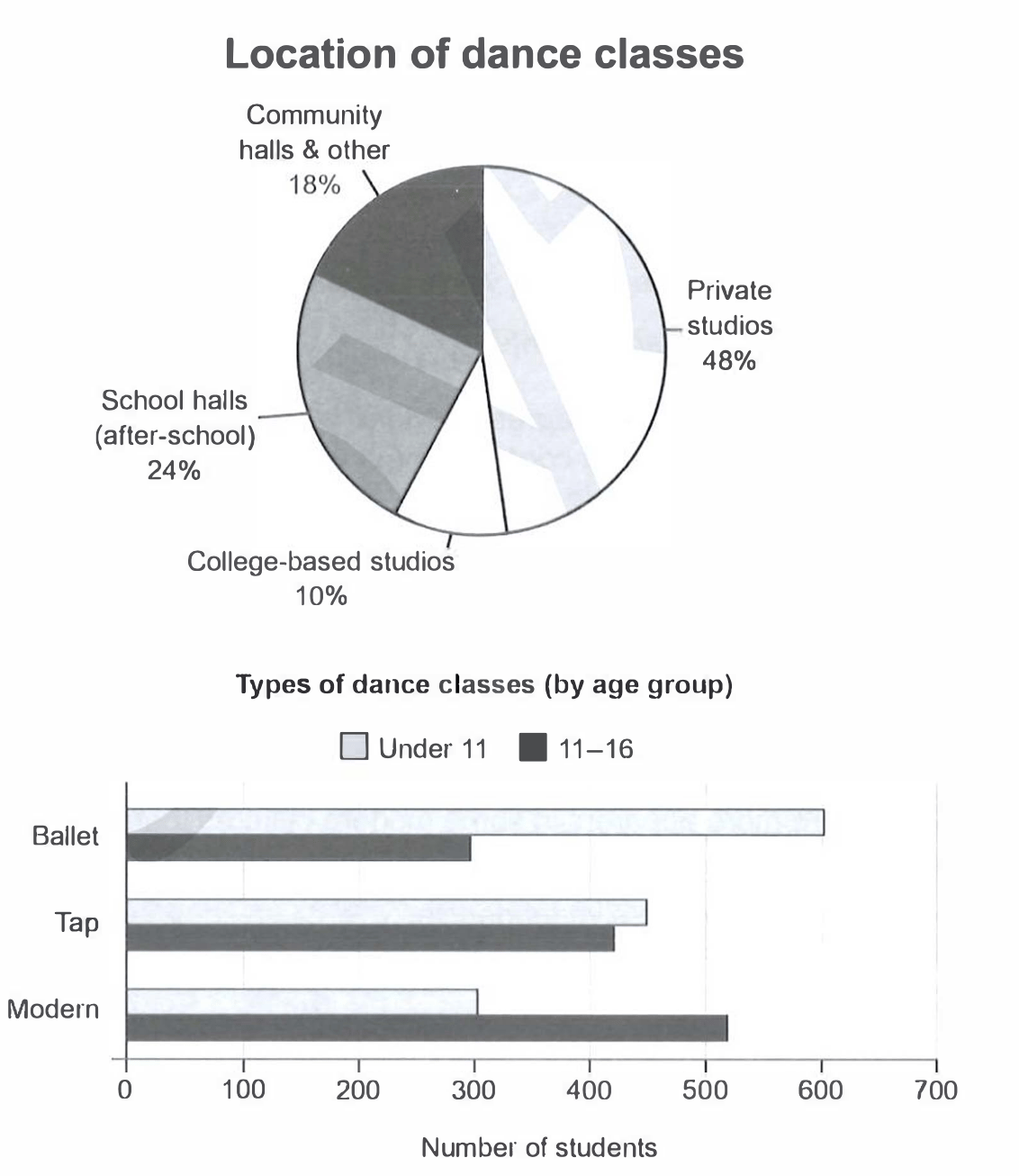
The charts below give information on the location and types of dance classes young people in a town in Australia are currently attending.
Summarise the information by selecting and reporting the main features, and make comparisons where relevant.
Student answer (Band 6.0)
The dance classes have been divided on two main categories depending upon the location and age group refclecting how different locations and age group are engaging in dance classes.
If we talk about the location aspect the majority of dance classes are based in private studios contributing about 46 %. The second major contributors are school halls after school educational activities which are 24 %. The community halls and others showed 18% participation which is placing them on third in que. The lowest involvement is oberved in college based studios which is only 10 %.
If we discuss the types of dance classes by different age groups then under 11 age bracket childrens are showing more interest i Ballet dance approximately 600 students engaged in that. The second type in which this age group showed interest is Tap neraly 500 students involved. The least interested type is modern in which only 300 students of this age group participating.
The age group 11-16 are more attracted by Modern type (exceeding 500 student), then second interest zone is inclined in Tap type and least interest is exhibiated in Ballet type.
This shows that how different loactions and age brackets are shaping the participation and interest in dance classes.
AI examiner evaluation
| Criterion | Band |
|---|---|
| Task Achievement / Task Response | 6.0 |
| Coherence and Cohesion | 6.0 |
| Lexical Resource | 6.0 |
| Grammatical Range and Accuracy | 5.5 |
| Overall | 6.0 |
Task Achievement / Task Response: Band 6.0
You cover both charts and report the main location shares, correctly identifying private studios as the largest category and college-based studios as the smallest. The figures for school halls, community halls and college studios are also accurate; the private-studio figure is slightly understated at 46% rather than 48%. For the age groups, you identify the main patterns: under-11s favour ballet, while 11–16-year-olds favour modern, and ballet is least popular among the older group. Some details are less fully reported: the older group’s ballet and tap figures are omitted, and the under-11 tap figure is given as nearly 500 rather than about 450. A clearer overview comparing the age-group preferences would make the key features more complete and precise.
Coherence and Cohesion: Band 6.0
The response has a coherent overall arrangement: it first discusses class locations, then compares dance types by age group, and ends with a brief concluding statement. Phrases such as “If we talk about the location aspect” and “If we discuss the types” help signal the shift between the two charts. However, these transitions are somewhat formulaic, and the final sentence repeats the general idea without adding a clear overview of the main contrasts. Within the age-group section, the older students’ preferences are described without figures, so the comparison is less developed. Use a concise overview near the beginning and connect the two age groups directly—for example, contrasting their preferred styles—to create a more purposeful progression.
Lexical Resource: Band 6.0
You use an adequate range of vocabulary for describing the charts, including “majority,” “participation,” “least interested,” and “more attracted.” These choices generally make the intended comparisons understandable, and you attempt less common expressions such as “second interest zone.” However, some wording is inaccurate or unnatural for data reporting: “contributors” suggests causes rather than class locations, while “second interest zone is inclined in Tap type” is difficult to interpret. There are also spelling errors, including “refclecting,” “ober ved,” “loactions,” and “exhibiated,” which reduce precision. Prefer standard chart language such as “accounted for,” “was the second most popular,” and “participation was lowest,” and check spelling carefully.
Grammatical Range and Accuracy: Band 5.5
You attempt a mix of simple and more complex sentence forms, including clauses beginning “depending upon” and “which,” and most of the intended meaning remains clear. Some grammatical errors persist, however. For example, “The dance classes have been divided on two main categories” has an incorrect preposition and passive construction; “children are showing more interest i Ballet” has an incomplete phrase; and “only 300 students of this age group participating” lacks a finite verb. There are also agreement and number issues in “exceeding 500 student.” These errors do not generally prevent understanding, but they make several sentences less controlled. Practise complete clause structures and check articles, verb forms, and singular/plural agreement when revising.
See this exact question answered at other band scores. The same prompt compared across bands.
Browse more IELTS Writing model answers or get your own writing scored by the same AI examiner.