Band 6.0 IELTS Writing Task 1 Model Answer
Overall Band Score: 6.0 · Cambridge IELTS 19 · 2026-11-15
IELTS Writing Task 1 question
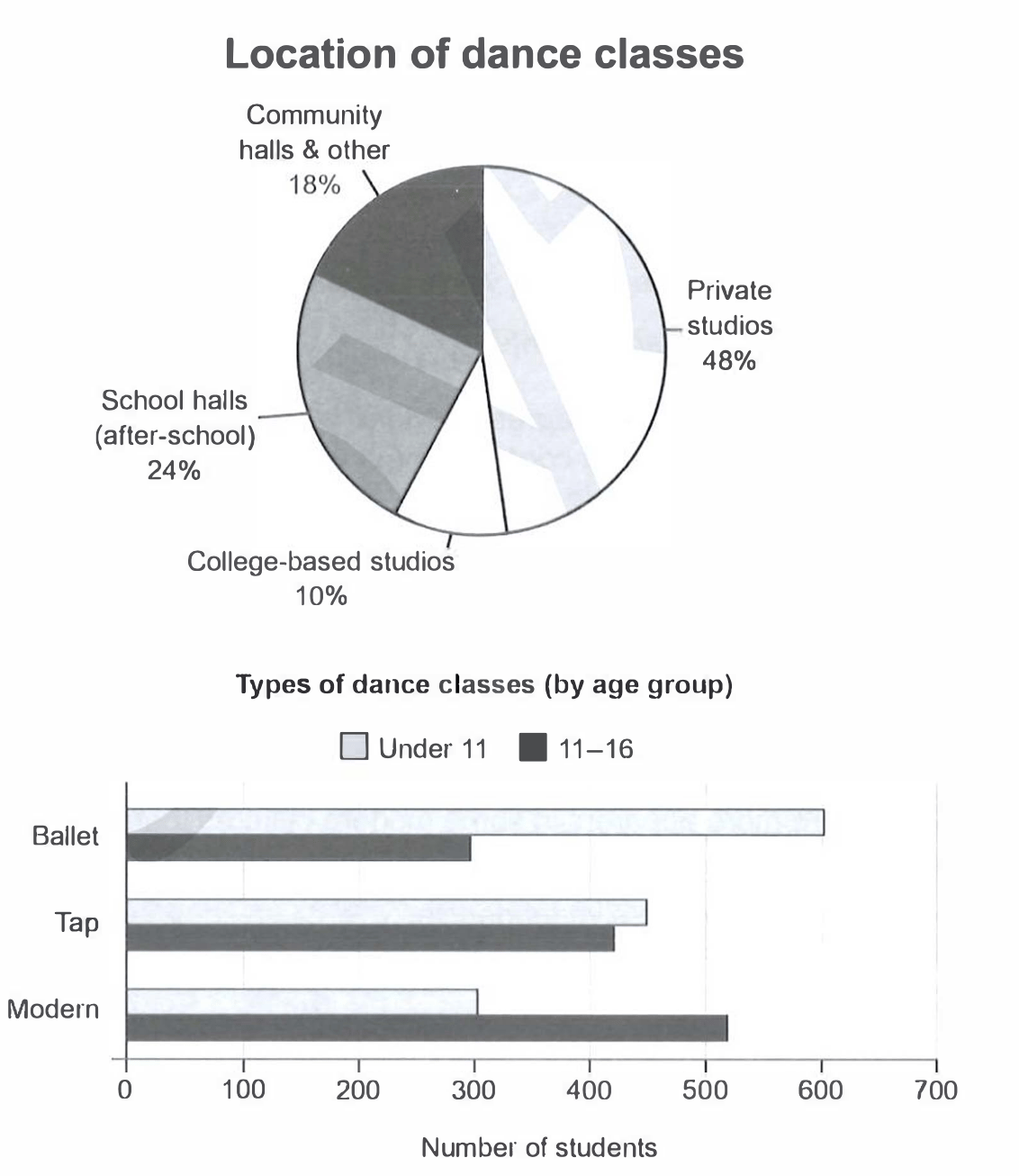
The charts below give information on the location and types of dance classes young people in a town in Australia are currently attending.
Summarise the information by selecting and reporting the main features, and make comparisons where relevant.
Student answer (Band 6.0)
The pie chart shows about the four different location of dance classes for young people in a town and, while the other chart demonstrates the three types of dance classes such as ballet , tap and modern that number of students took according to their age range.
Overall, private studios have the highest number of dance classes compared to other three locations. By observing the second chart , people under age 11 prefers to take ballet dance mostly while modern dance form is more popular among the young people aged 11 to 16.
In terms of location, private studios contains half of the portion of the pie as it have the highest number of dance classes that is around 48%. School halls specially after school dance programs have the facilities of dance classes reflecting the second highest location of dance classes which is 24%. There are community hall and other places which also take the dance classes in that town indicating 18% of the total dance classes. The rest of the portion of the pie is 10% reflecting only 10% location have dance classes in the college based studies which is the lowest number of dance classes.
However, in the secord chart shows ballet dance form is more popular to children specially under 11 age group which is around 600 and young students take ballet as s dance form less specially under 11 to 16 aged students. In contrast to ballet , modern dance form is more popular among the 11 to 16 aged students as 500 students prefer this dance form and only 300 students aged under 11 take modern dance. There is balance approach in tap dancing as both age group take this dance classes that is 450 students under aged 11 take this class and 420 students take this class.
AI examiner evaluation
| Criterion | Band |
|---|---|
| Task Achievement / Task Response | 7.0 |
| Coherence and Cohesion | 6.5 |
| Lexical Resource | 5.5 |
| Grammatical Range and Accuracy | 5.5 |
| Overall | 6.0 |
Task Achievement / Task Response: Band 7.0
You cover both charts and identify the main patterns: private studios are the largest location category, ballet leads among under-11s, and modern is most popular among 11–16-year-olds. Most figures are reported accurately, including the location shares and the approximate student totals. The comparison of tap participation is also useful. This gives the report a clear overview and relevant supporting detail. To make the account more fully precise, avoid describing the percentages as the “number” or “portion” of classes when they represent locations, and clarify that the charts show attendance by location and student numbers by dance type. The phrase “young students take ballet … less” is unclear about which age group has the lower figure; state directly that the older group has about 300 students, compared with 600 younger students.
Coherence and Cohesion: Band 6.5
The response has a recognisable structure: an introduction, an overview, and separate paragraphs for the location and age-group charts. The overview helps readers see the main contrasts before the details, and transitions such as “In terms of location” and “In contrast” generally guide the comparison. This is a coherent overall arrangement. However, some linking is mechanical or awkward, particularly “However, in the secord chart shows,” and repeated references to “the pie” and “dance classes” make parts of the report less smooth. The final paragraph also moves between ballet, modern and tap without consistently framing each comparison by age group. Use clearer topic sentences and concise references to the chart categories to make progression more fluent.
Lexical Resource: Band 5.5
You use relevant chart vocabulary, including “highest,” “lowest,” “popular,” “portion,” and “reflecting,” and the reader can generally understand the comparisons. However, the range is limited by repeated phrases such as “dance classes” and “dance form,” while several combinations are unnatural or imprecise: “contains half of the portion,” “balance approach in tap dancing,” and “college based studies.” Some word forms and spelling also reduce accuracy, including “secord” and “prefers” where a plural subject is intended. Aim for more precise terms for proportions and participation, and vary the language used to describe the figures. More accurate collocations would make the report sound clearer and more natural without requiring unusually advanced vocabulary.
Grammatical Range and Accuracy: Band 5.5
You attempt a mix of simple and longer sentences, including comparisons introduced by “while” and “as,” and the overall meaning is usually recoverable. However, complex sentences are often faulty, and errors recur in agreement, articles, plurals and sentence construction. For example, “private studios contains” should use a plural verb, while “it have” has both an unclear pronoun and incorrect agreement. The opening sentence is difficult to follow because its clauses are not joined cleanly, and “However, in the secord chart shows” lacks a grammatical subject structure. There are also inconsistent spaces before punctuation. Practise building shorter, controlled sentences first, then combine comparisons with accurate clauses and check subject–verb agreement and article use.
See this exact question answered at other band scores. The same prompt compared across bands.
Browse more IELTS Writing model answers or get your own writing scored by the same AI examiner.