Band 6.5 IELTS Writing Task 1 Model Answer
Overall Band Score: 6.5 · Cambridge IELTS 19 · 2026-11-15
IELTS Writing Task 1 question
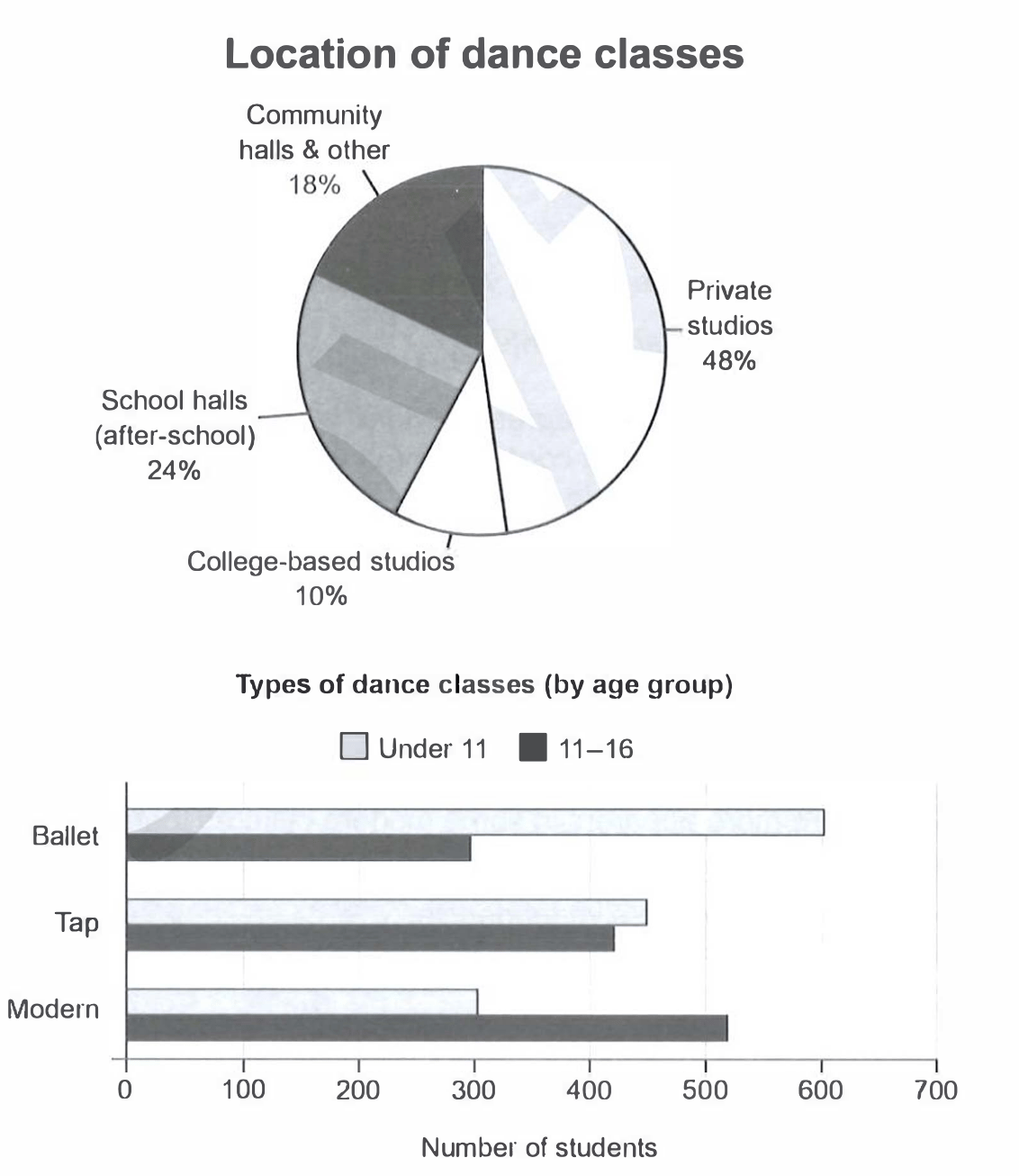
The charts below give information on the location and types of dance classes young people in a town in Australia are currently attending.
Summarise the information by selecting and reporting the main features, and make comparisons where relevant.
Student answer (Band 6.5)
The graphs illustrate the types and location of dance classes people take in a town in Australia currently.
Overall, private studios are the most common and popular places for practising dance, followed by school halls, community halls and college-based studios respectively. Ballet is the popular dance among the children under 11 whereas modern dance is the most liked by the age group 11-16.
Private studios remain the most preferred place for dance classes consisting of nearly a half of places. School halls and Community hallc are in second and third place with 24% and 18% allocation respectively. College based studios are the least preferred location for dancing lessons with only 10%.
Ballet in the most popular type of dance for the children under 11 and almost 600 children are enrolled in this which is almost double than that of the age group 11-16. On contrary, modern dance is more like by the age group 11-16 and nearly 520 students attend this whereas under 11 group has the lowest participants in this section.
Tap dance is liked by the both group moderately.
AI examiner evaluation
| Criterion | Band |
|---|---|
| Task Achievement / Task Response | 7.0 |
| Coherence and Cohesion | 6.5 |
| Lexical Resource | 6.0 |
| Grammatical Range and Accuracy | 6.0 |
| Overall | 6.5 |
Task Achievement / Task Response: Band 7.0
You cover both charts and provide a clear overview, identifying private studios as the leading location and contrasting ballet for under-11s with modern dance for the older group. The location figures are reported accurately, and your comparisons for ballet (about 600 versus 300) and modern (about 300 versus 520) reflect the chart. The main feature that needs more precise reporting is tap: saying both groups like it “moderately” is vague, although the figures are close (about 450 and 420) and tap is not the leading choice for either group. Also, “most common and popular” repeats the same idea, and the overview could compare the age groups more fully by noting the older group’s preference for modern and the younger group’s preference for ballet.
Coherence and Cohesion: Band 6.5
The response has a clear overall arrangement: an introduction, an overview, a paragraph on locations, and a final section comparing dance types. This makes the information easy to follow, and transitions such as “Overall,” “whereas,” and “On contrary” show an attempt to connect comparisons. However, the final paragraph is very brief and leaves the tap comparison underdeveloped; integrating it with the ballet and modern figures would create a more balanced progression. Some linking is also mechanical or imprecise, particularly “On contrary,” and the repeated use of “whereas” could be varied. The overview and detail paragraphs are generally well separated, but clearer links between the two age-group comparisons would make cohesion more flexible.
Lexical Resource: Band 6.0
You use an adequate range of task-related vocabulary, including “enrolled,” “participants,” “preferred,” and “allocation,” and the meaning is generally clear. There are also attempts at varied descriptions such as “most liked” and “most preferred,” though these are repetitive or not always natural in this context. Several word-choice and spelling problems limit precision: “Community hallc” is misspelled, “more like by” should be “more liked by,” and “Ballet in the most popular type” appears to contain a mistaken word. “Places” is also vague when describing the share of classes held at each location. Aim for accurate collocations such as “the largest proportion of classes takes place in private studios” and use “popular” or “preferred” selectively rather than repeating both.
Grammatical Range and Accuracy: Band 6.0
You use a mix of simple and more complex sentence forms, including comparisons with “whereas” and clauses describing the age groups. Most sentences communicate the intended meaning, but some grammatical errors remain. For example, “Ballet in the most popular type” needs the verb “is,” while “almost double than that of” has an incorrect comparative pattern; write “almost double the figure for.” In “Tap dance is liked by the both group,” the article and singular/plural agreement need correction (“both groups”). The sentence beginning “Private studios remain…” also has an unclear grammatical relationship between the location and “consisting of.” Review articles, agreement, and comparative structures, while retaining the range of sentence patterns you already attempt.
See this exact question answered at other band scores. The same prompt compared across bands.
Browse more IELTS Writing model answers or get your own writing scored by the same AI examiner.