Band 6.0 IELTS Writing Task 1 Model Answer
Overall Band Score: 6.0 · Cambridge IELTS 19 · 2026-11-15
IELTS Writing Task 1 question
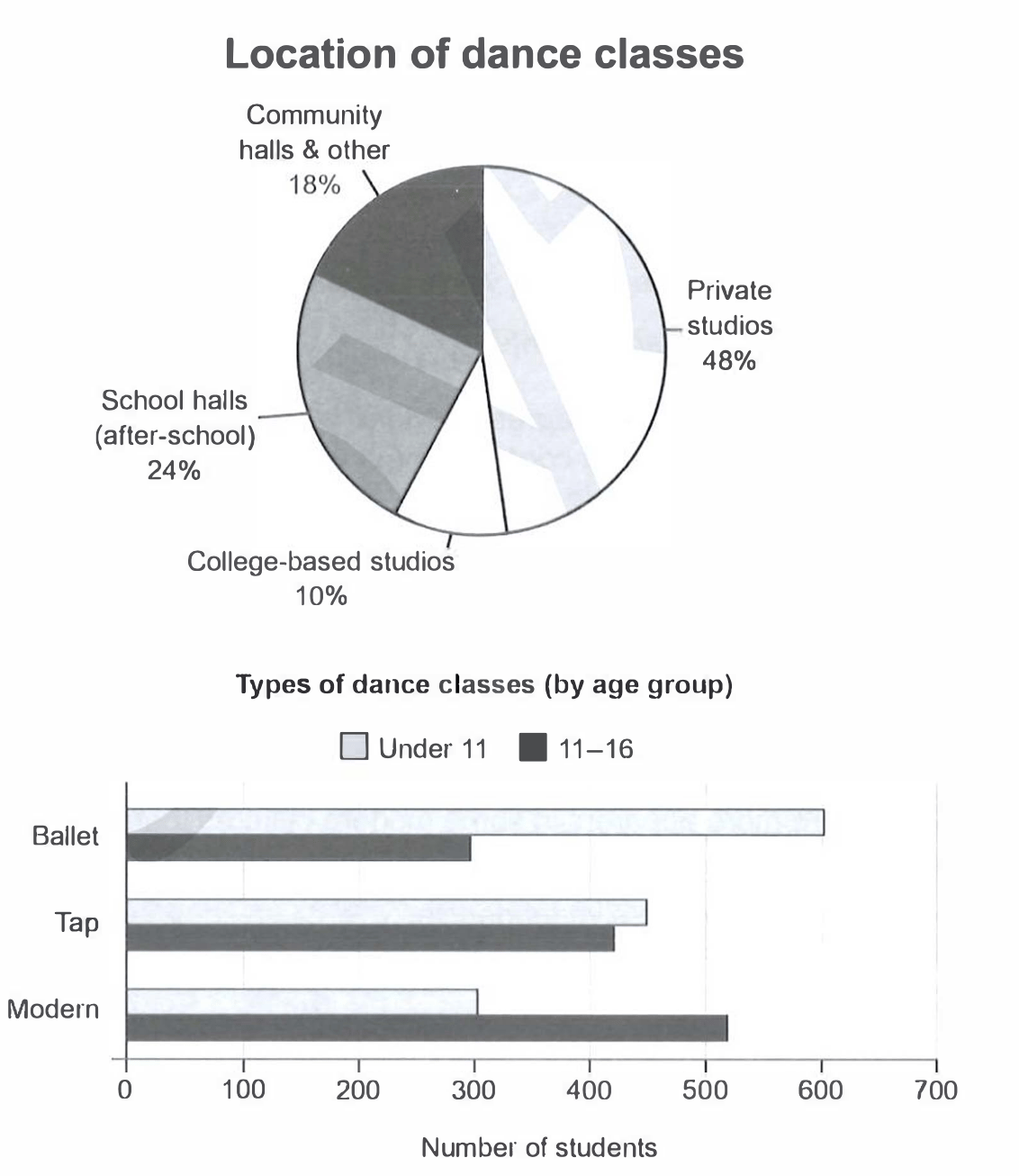
The charts below give information on the location and types of dance classes young people in a town in Australia are currently attending.
Summarise the information by selecting and reporting the main features, and make comparisons where relevant.
Student answer (Band 6.0)
The pie chart illustrates the places and the table represents the three different kinds of dace classes that youngsters are attending in an Australian town.
Overall, private studios are most popular for dance classes among the youth while college-based studios are the least. Children under the age of 11 are more interested in ballet class while those whose age range between 11 to 16 are keen towards modern dance.
Private studios are crowded with 48% of the young people. School hall are also available for dance practice and 24% of people go there. Some people also like to go to community halls or other places and this makes 18% of those who take these classes. The least number of attendents are those of the college based studios with only 10% of people going there.
Age is a factor that determines what type of class to attend. As 600 youngster like ballet classes with only 450 attending tap and 300 going for modern dance classes. On the other hand, those with in the range of 11-16 like modern more with 500 people going there and 420
AI examiner evaluation
| Criterion | Band |
|---|---|
| Task Achievement / Task Response | 6.0 |
| Coherence and Cohesion | 6.0 |
| Lexical Resource | 6.0 |
| Grammatical Range and Accuracy | 5.5 |
| Overall | 6.0 |
Task Achievement / Task Response: Band 6.0
You identify the main location pattern accurately: private studios account for the largest share (48%), while college-based studios are the smallest (10%). You also compare dance preferences by age, correctly noting that ballet leads among under-11s and modern is most popular among 11–16-year-olds. However, the response does not fully report the second chart: it gives the under-11 figures but stops after “420” for the older group, omitting the 300 ballet figure and leaving the tap comparison incomplete. The overview is relevant, but “more interested” and “keen towards” describe preferences rather than clearly summarising the contrasting distributions. Include all key comparisons and complete the final point to make the coverage more balanced.
Coherence and Cohesion: Band 6.0
The response has a clear overall structure: an introduction, an overview, and separate paragraphs for locations and dance types. This makes the two charts easy to distinguish, and phrases such as “Overall” and “On the other hand” help signal relationships. However, the final paragraph ends abruptly after “420,” so the comparison is unfinished and the progression is disrupted. Some links are also mechanical or unclear: “As 600 youngster like ballet classes” is not a complete sentence, and “Age is a factor that determines what type of class to attend” does not connect smoothly to the figures that follow. Use complete sentences and finish each comparison before moving on.
Lexical Resource: Band 6.0
You use an adequate range of task-related vocabulary, including “private studios,” “community halls,” “attending,” and “age range,” and the main meaning is generally clear. There are also attempts to vary wording, such as “most popular” and “keen towards.” However, several choices are inaccurate or unnatural for describing chart data: “crowded with 48%” suggests physical overcrowding, while “keen towards” is not a natural collocation. “Dace” and “attendents” are spelling errors, and “youngster” is used where a plural is needed. Aim for precise reporting language such as “accounted for,” “attended,” and “preferred,” and check spelling and word forms carefully.
Grammatical Range and Accuracy: Band 5.5
You attempt both simple and more complex structures, including the contrast in “while those whose age range between 11 to 16…” and the sentence beginning “As 600 youngster…”. Some grammatical errors remain, though the intended meaning is usually recoverable. For example, “those whose age range between 11 to 16” needs a verb and a more accurate age construction, while “As 600 youngster like…” is a dependent clause used as a sentence fragment. There are also agreement and number issues in “School hall are” and “600 youngster.” Practise forming complete sentences around data and checking subject–verb agreement, articles, and plural forms; this will make your comparisons more controlled.
See this exact question answered at other band scores. The same prompt compared across bands.
Browse more IELTS Writing model answers or get your own writing scored by the same AI examiner.