Band 6.0 IELTS Writing Task 1 Model Answer
Overall Band Score: 6.0 · Cambridge IELTS 19 · 2026-11-15
IELTS Writing Task 1 question
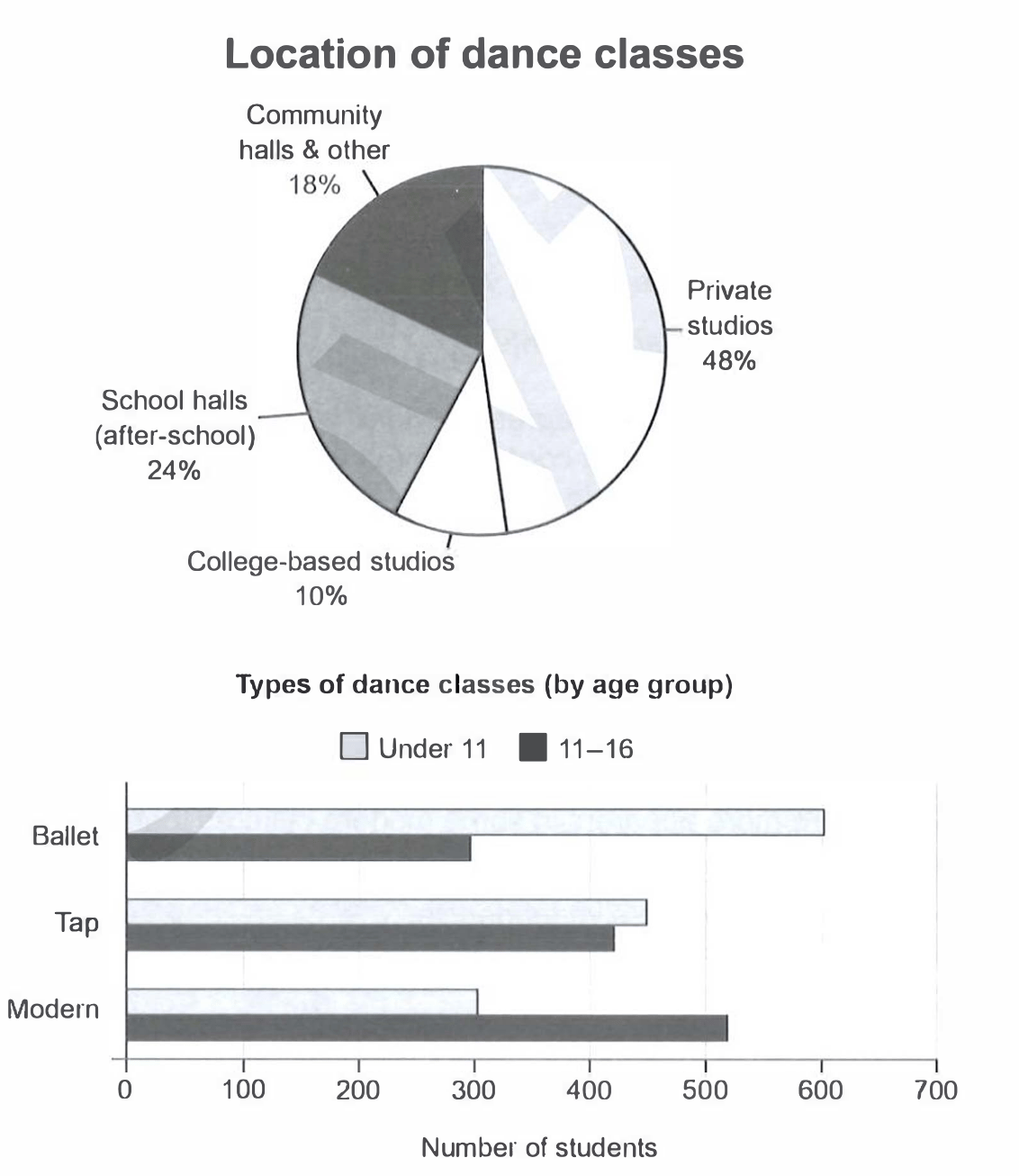
The charts below give information on the location and types of dance classes young people in a town in Australia are currently attending.
Summarise the information by selecting and reporting the main features, and make comparisons where relevant.
Student answer (Band 6.0)
The pie chart illustrates the location of four dance classes and the bar chart compares the age group of students in the three categories of dance classes.
Overall, the private studios comprises the half area of total dance classes, whereas the college-based studios covers minor area. The bar chart shows large number of students who are under 11 in ballet dance classes and the modern classes represents substantial figure of young students.
At location of dance classes, the private studios shows enormous area proportion of 48%. However, the school halls covers half one-third part of classes at 24%. The community halls and the college-based studios have small area of proportions 10% to 18% respectively.
The tap dance class has almost equal number of students who's age are under 11 and 11-16 with a figure 450 to 430 respectively. The ballet class comprises large figure of under 11 age students and small fraction of young students at 300. The modern class shows large number of young students at 500.
AI examiner evaluation
| Criterion | Band |
|---|---|
| Task Achievement / Task Response | 6.0 |
| Coherence and Cohesion | 6.5 |
| Lexical Resource | 6.0 |
| Grammatical Range and Accuracy | 5.5 |
| Overall | 6.0 |
Task Achievement / Task Response: Band 6.0
You cover both charts and identify relevant features, including the dominance of private studios and the age contrast in ballet. However, some comparisons are incomplete or inaccurate. The overview says modern classes represent a substantial figure of “young students,” but does not clarify that modern is most popular among 11–16-year-olds, while ballet leads among under-11s. The tap figures are reported as 450 and 430, whereas the chart shows approximately 450 and 420. You also reverse the community-hall and college-based percentages: they are 18% and 10%, respectively. The response therefore addresses the task, but some key details are unclear or misreported. Prioritise accurate comparisons between age groups and check that each figure is matched to the correct category.
Coherence and Cohesion: Band 6.5
The response has a clear overall arrangement: an introduction, an overview, and separate paragraphs for the location and dance-type charts. This makes the two sources easy to follow, and linking words such as “Overall” and “However” help signal relationships. The progression is generally logical, but some references and comparisons are difficult to interpret. For example, “the community halls and the college-based studios have small area of proportions 10% to 18% respectively” gives the percentages in the opposite order to the categories, making the comparison confusing. The final paragraph also moves between age groups without consistently naming which figure belongs to which group. Use clearer sequencing and repeat category labels where needed; this would make the cohesion more precise and less dependent on the reader inferring your meaning.
Lexical Resource: Band 6.0
You use a reasonable range of task-related vocabulary, including “proportion,” “compares,” “substantial,” and “figure,” and the meaning is generally understandable. There are also attempts to vary expression rather than repeat only basic terms. However, several choices are unnatural or imprecise for describing charts: “comprises the half area,” “enormous area proportion,” and “half one-third part” do not express the data clearly. “Young students” is also vague when the chart distinguishes two specific age groups. Choose standard reporting collocations such as “accounts for,” “makes up,” and “the number of students,” and use the exact age-group labels. More accurate word combinations would improve precision without requiring more elaborate vocabulary.
Grammatical Range and Accuracy: Band 5.5
You attempt a mix of simple and more complex sentences, including clauses introduced by “whereas” and “who,” and the overall message can usually be understood. Some grammatical errors remain, particularly with subject–verb agreement and sentence construction. For example, “the private studios comprises” should use a plural verb, while “the modern classes represents” has the same agreement problem. In “The tap dance class has almost equal number,” an article is needed before “almost equal number,” and “students who's age are” has errors in both the relative form and agreement. These issues do not usually prevent understanding, but they reduce accuracy. Practise checking each subject and verb, and simplify constructions when you are unsure of the correct form.
See this exact question answered at other band scores. The same prompt compared across bands.
Browse more IELTS Writing model answers or get your own writing scored by the same AI examiner.