Band 6.5 IELTS Writing Task 1 Model Answer
Overall Band Score: 6.5 · Cambridge IELTS 19 · 2026-11-15
IELTS Writing Task 1 question
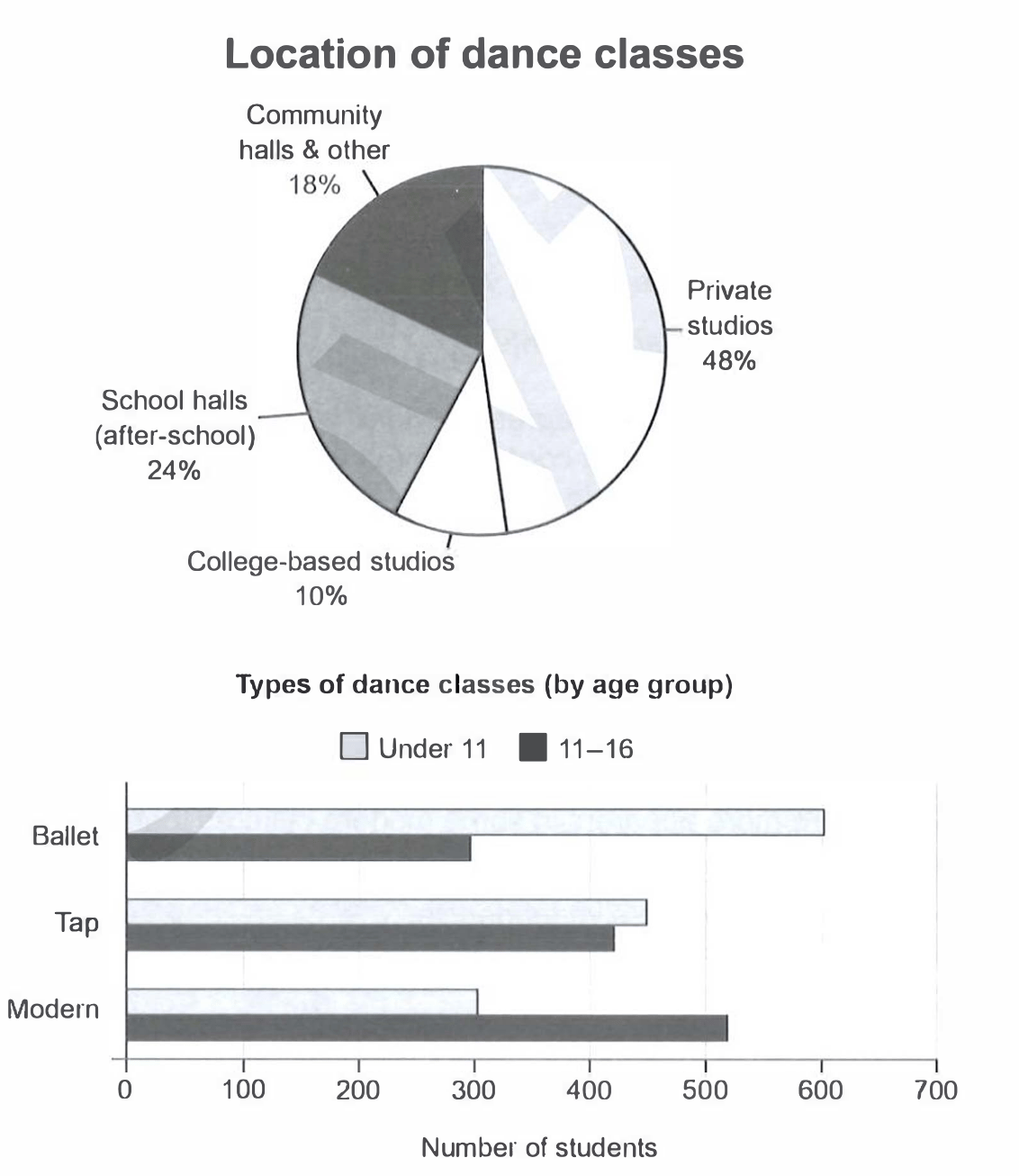
The charts below give information on the location and types of dance classes young people in a town in Australia are currently attending.
Summarise the information by selecting and reporting the main features, and make comparisons where relevant.
Student answer (Band 6.5)
The pie and bar charts present details on the different areas and kinds of dance classes, attended by young people presently in a town in Australia.
Overall, pie chart shows that the highest number of dance classes are being held at private studios and fewer number of dance practices are being done at college-based studios.Futhermore, bar chart is showing, among different kinds of dance classes, ballet is the one highly being performed by under 11 age group, while the teenagers between 11 and 16 are more interested in modern type of dance.
Looking at the pie chart,among all locations; private studios stand tall at 48% for dance practicing followed by school halls after school timings at 24% and community halls and others at 18%, while very fewer classes are being held at college-based studios at 10%. Futhermore, bar chart clealry shows that 600 kids under the age of 11 are interested in ballet dance, while more than 500 teeanagers are interested in modern type of dance and for tap dance the interest of both age groups is almost same.
AI examiner evaluation
| Criterion | Band |
|---|---|
| Task Achievement / Task Response | 7.0 |
| Coherence and Cohesion | 7.0 |
| Lexical Resource | 5.5 |
| Grammatical Range and Accuracy | 5.5 |
| Overall | 6.5 |
Task Achievement / Task Response: Band 7.0
You identify the main location pattern accurately: private studios account for the largest share (48%), while college-based studios are the smallest (10%). You also compare the age groups, correctly noting the strong under-11 preference for ballet and the older group’s higher participation in modern dance. The overview gives the reader a clear summary, and the selected figures are grounded in the charts. However, the bar-chart reporting is selective: the response gives the under-11 ballet figure but not the corresponding older-group figure, and it describes tap interest as “almost same” without reporting the approximate values (450 and 420). Include these comparisons and clarify that the older group’s modern figure is just over 500 to make the key patterns more fully supported.
Coherence and Cohesion: Band 7.0
The response has a clear overall progression: an introduction, an overview, and then details about the pie chart followed by the bar chart. This makes the information easy to follow, and linking expressions such as “Overall,” “while,” and “followed by” help signal comparisons. The two charts are also distinguished clearly. To strengthen the organisation further, give the bar-chart details a more systematic comparison across both age groups and all three dance types, rather than moving from ballet to modern and then briefly to tap. Some transitions are repeated or loosely attached, particularly “Furthermore,” which appears in both the overview and the final paragraph. More precise links between the figures would make the progression smoother and the comparisons easier to track.
Lexical Resource: Band 5.5
You use relevant chart vocabulary, including “private studios,” “college-based studios,” “age group,” and “interest,” so the topic remains clear. There is also some attempt to vary wording with phrases such as “stand tall” and “held.” However, several expressions are unnatural or imprecise for an academic report: “dance practicing,” “dance practices are being done,” and “ballet is the one highly being performed” do not describe participation naturally. “Stand tall” is also too informal, while “interested in” is less precise than reporting student numbers or participation. Spelling slips such as “Futhermore,” “clealry,” and “teeanagers” further limit accuracy. Prefer concise, conventional chart language and check spelling carefully.
Grammatical Range and Accuracy: Band 5.5
You attempt a range of sentence forms, including a complex overview sentence with “while” and a longer comparison using “followed by.” The main meaning is generally recoverable, but grammatical control is inconsistent. For example, “Overall, pie chart shows” is missing an article, and “fewer number” has faulty number agreement. In “bar chart is showing,” the progressive form is awkward for describing chart data; use the present simple. The final sentence also joins several comparisons with commas, making its structure difficult to control. Punctuation and spacing are inconsistent, including missing spaces after commas and a missing space after the full stop before “Furthermore.” Aim for shorter, accurately formed comparisons, with correct articles and sentence boundaries.
See this exact question answered at other band scores. The same prompt compared across bands.
Browse more IELTS Writing model answers or get your own writing scored by the same AI examiner.