Band 6.5 IELTS Writing Task 1 Model Answer
Overall Band Score: 6.5 · Cambridge IELTS 19 · 2026-11-15
IELTS Writing Task 1 question
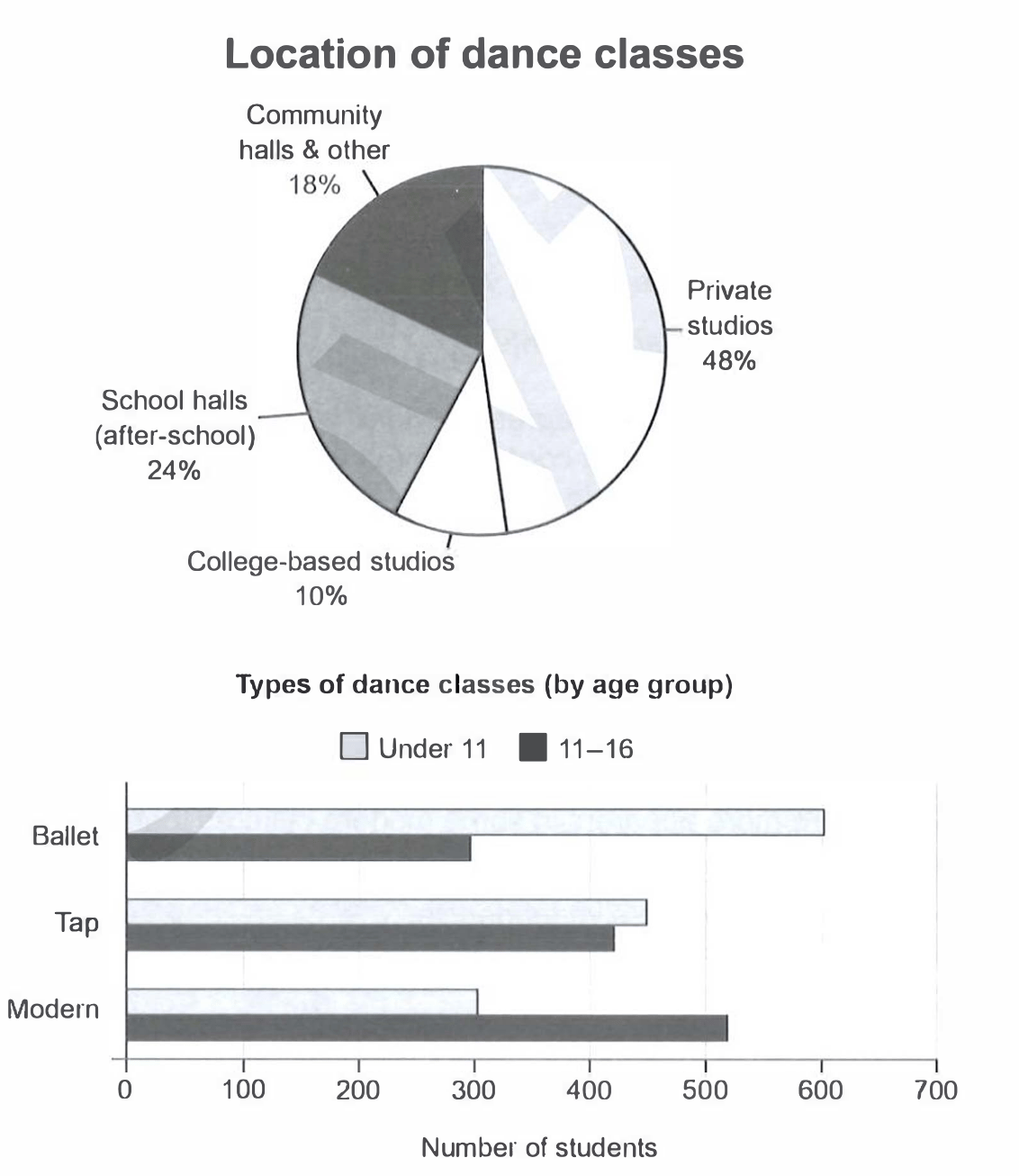
The charts below give information on the location and types of dance classes young people in a town in Australia are currently attending.
Summarise the information by selecting and reporting the main features, and make comparisons where relevant.
Student answer (Band 6.5)
The charts illustrates data on different places and types of dance classes in an australian town young people are attending. Overall, the private studios constituted the highest proportion of booking, while the college based studios were the least one in the first chart. Modern dance type is the most preferred type by the students between 11-16 years, while the Ballet is the most popular among under 11 years students.
In the first pie chart, Private studios are the most used location with 48% for the dance classes by the students, while the studios which are in the college are the least one with 10%. Community halls and some other locations constituted for 18%, while School halls for 24%.
In the second one, more than 600 students under the age of 11 years are doing the Ballet dance, while in Modern dance only 300 students have participated. In the Tap type, almost 450 students take part for dance classes. More than 500 students between the age of 11-16 years participated in the Modern dance, while only 300 students took part in Ballet dance. In the Tap dance type, students of both age groups almost equally participated.
AI examiner evaluation
| Criterion | Band |
|---|---|
| Task Achievement / Task Response | 7.0 |
| Coherence and Cohesion | 7.0 |
| Lexical Resource | 6.0 |
| Grammatical Range and Accuracy | 6.0 |
| Overall | 6.5 |
Task Achievement / Task Response: Band 7.0
The response covers both charts and gives a clear overview of the main contrasts: private studios account for the largest share of locations, college-based studios the smallest, and the leading dance style differs by age group. The location percentages are reported accurately, and the comparisons for ballet and modern are also well selected. The account of tap is less precise: the figures are about 450 students under 11 and 420 aged 11–16, so “almost equally” is reasonable, but giving both values would make the comparison better supported. Also, “more than 600” for under-11 ballet slightly overstates the chart’s approximate value of 600. Overall, the key features are addressed and supported, with only minor imprecision.
Coherence and Cohesion: Band 7.0
The information is organised clearly into an introduction and overview followed by separate paragraphs for the two charts. This gives the reader a logical progression, and linking expressions such as “Overall,” “while,” and “In the second one” help connect comparisons. The response also groups related figures effectively, particularly the location percentages and the age-group comparisons. To make the flow more polished, replace the vague reference “the second one” with “the bar chart,” and use more consistent phrasing when moving between age groups and dance styles. Some repeated sentence patterns, such as “while only…” and “In the… type,” make the cohesion slightly predictable, but the overall organisation remains clear.
Lexical Resource: Band 6.0
The vocabulary is adequate for describing the charts, with useful terms such as “proportion,” “constituted,” “participated,” and “popular.” Meaning is generally clear, but several word choices or collocations are awkward: “highest proportion of booking” does not naturally describe the share of class locations, and “the least one” is imprecise. “Take part for dance classes” is also less idiomatic than “take part in dance classes.” The response relies on repeated general terms such as “students,” “dance type,” and “participated,” so a wider range of accurate chart language would improve flexibility. Check spelling and capitalisation too, including “Australian” and the consistent use of “ballet.”
Grammatical Range and Accuracy: Band 6.0
The response uses a mix of simple and complex sentences, including comparisons with “while” and a relative clause in “locations … young people … are attending.” Most sentences are understandable, and errors rarely obscure the intended meaning. However, some grammatical inaccuracies remain. The opening should be “The charts illustrate,” because the plural subject requires a plural verb. In “the college based studios were the least one,” the construction is incomplete; a clearer form is “college-based studios had the smallest share.” The phrase “students between the age of 11-16 years” also needs a more accurate grammatical structure, such as “students aged 11–16.” More consistent control of agreement, articles, and sentence phrasing would strengthen accuracy.
See this exact question answered at other band scores. The same prompt compared across bands.
Browse more IELTS Writing model answers or get your own writing scored by the same AI examiner.