Band 6.5 IELTS Writing Task 1 Model Answer
Overall Band Score: 6.5 · Cambridge IELTS 19 · 2026-11-15
IELTS Writing Task 1 question
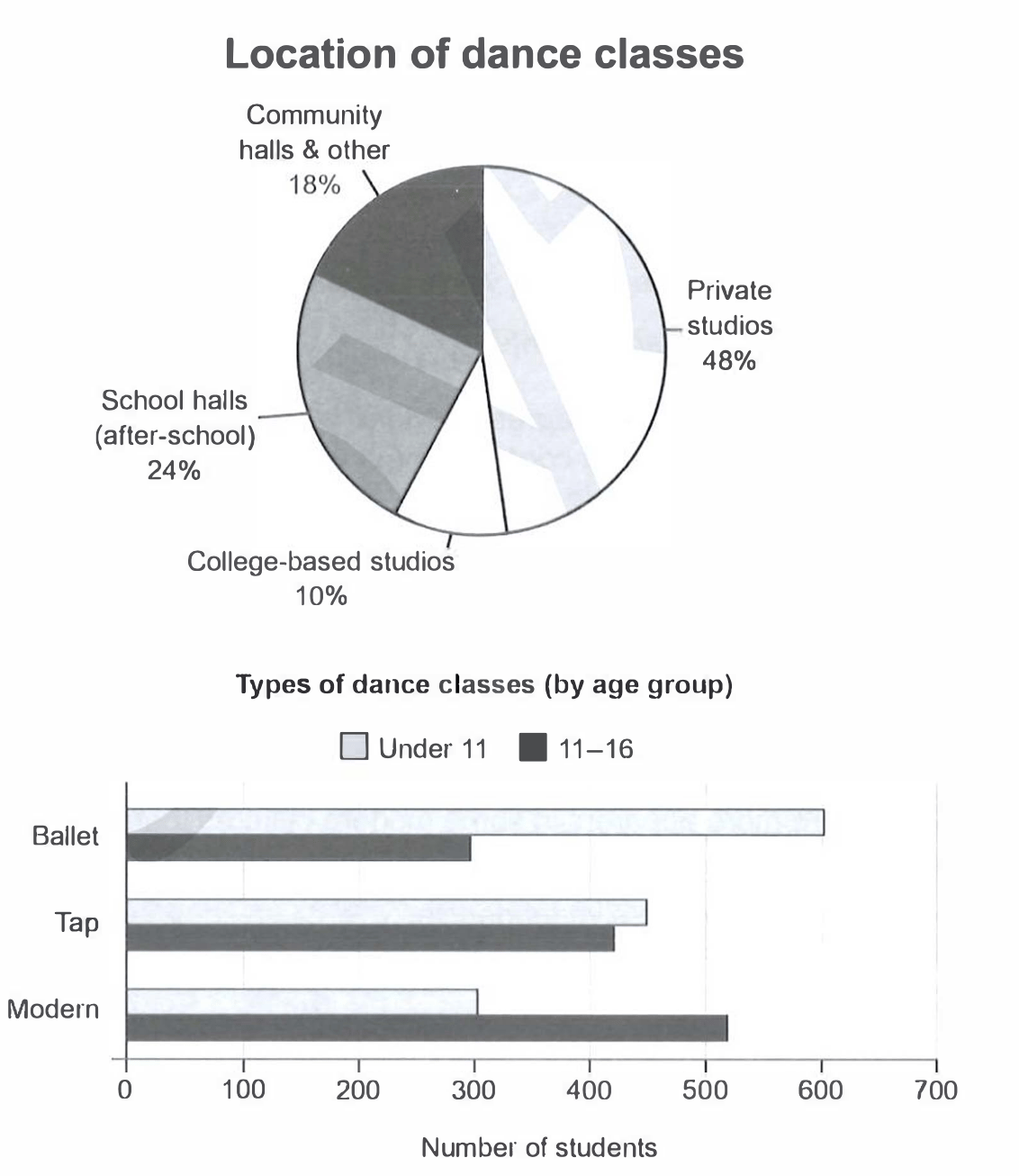
The charts below give information on the location and types of dance classes young people in a town in Australia are currently attending.
Summarise the information by selecting and reporting the main features, and make comparisons where relevant.
Student answer (Band 6.5)
The pie chart illustrates the location and the bar chart depicts the type of dance class attended by the youth of an Australian town.
Overall, private studios were preferred the most while college-based studios were the least preferred. Younger children participated the most in ballet dance and fewer took modern classes while the situation with the older children was opposite who enjoyed modern more than ballet.
Private studios accounted for 48% of the youngsters. The second most populated area was the school halls. Children would go there after the school hours. This region hosted 24% of the children. Some would prefer to take their classes at community halls and others which made 18% and college-based studio had only 10% of the youth.
Younger children showed the highest participation in ballet dance with around 600 people. This dance was the least partcipated by the older children with only 300 participants. Over 500 youngsters ranging between 11-16 years would attend modern with only 300 children below the age of 11. The only dance class that was liked some how the same was the Tap.
AI examiner evaluation
| Criterion | Band |
|---|---|
| Task Achievement / Task Response | 6.5 |
| Coherence and Cohesion | 6.5 |
| Lexical Resource | 6.0 |
| Grammatical Range and Accuracy | 6.0 |
| Overall | 6.5 |
Task Achievement / Task Response: Band 6.5
You identify the main patterns accurately: private studios are the largest location share (48%), college-based studios the smallest (10%), and the age groups show contrasting preferences for ballet and modern. The overview gives the reader a useful summary, and the supporting figures for ballet and modern are broadly consistent with the chart. However, some features are less fully reported: the tap figures are not stated, and “liked some how the same” does not clearly explain that participation is similar at about 450 for under-11s and 420 for 11–16s. The claim that older children “enjoyed modern more than ballet” is supported, but could be made more precise with both figures. More complete, clearly expressed comparisons would strengthen the report.
Coherence and Cohesion: Band 6.5
The response has a clear overall arrangement: an introduction, an overview, and separate paragraphs for location and dance types. This makes the two charts easy to follow, and phrases such as “Overall” and “while” help signal summary and contrast. The progression is generally logical, but some links are awkward or unclear. For example, “The second most populated area was the school halls” shifts from locations to an imprecise description of attendance, while “The only dance class that was liked some how the same” does not clearly connect the tap comparison to the preceding figures. Use more precise referencing and transitions, such as “For tap, participation was similar in both age groups,” to make cohesion smoother and less dependent on vague wording.
Lexical Resource: Band 6.0
You use an adequate range of vocabulary for describing charts, including “accounted for,” “participated,” “highest participation,” and “participants.” These choices help communicate the main comparisons. However, some expressions are imprecise or unnatural for an academic report: “the second most populated area” refers unclearly to a class location, “This region hosted” is an awkward collocation, and “liked some how the same” is informal and difficult to interpret. There is also a spelling error in “partcipated.” Aim for precise chart language such as “the second most common venue,” “accounted for,” and “participation was similar.” This would improve accuracy and formality while retaining the useful range already shown.
Grammatical Range and Accuracy: Band 6.0
You use both simple sentences and more complex structures, including the contrast in “Younger children participated the most in ballet dance … while the situation with the older children was opposite.” Most of the message remains understandable, but some grammatical errors and awkward constructions reduce control. In “the situation with the older children was opposite who enjoyed modern,” the relative clause is attached unclearly; a separate clause would be clearer. “Children would go there after the school hours” uses an unnecessary article, and “college-based studio had only 10%” needs an article or plural form. The final sentence also lacks clear sentence structure around the tap comparison. Check clause boundaries, articles, and punctuation when combining comparisons.
See this exact question answered at other band scores. The same prompt compared across bands.
Browse more IELTS Writing model answers or get your own writing scored by the same AI examiner.