Band 6.0 IELTS Writing Task 1 Model Answer
Overall Band Score: 6.0 · Cambridge IELTS 19 · 2026-11-16
IELTS Writing Task 1 question
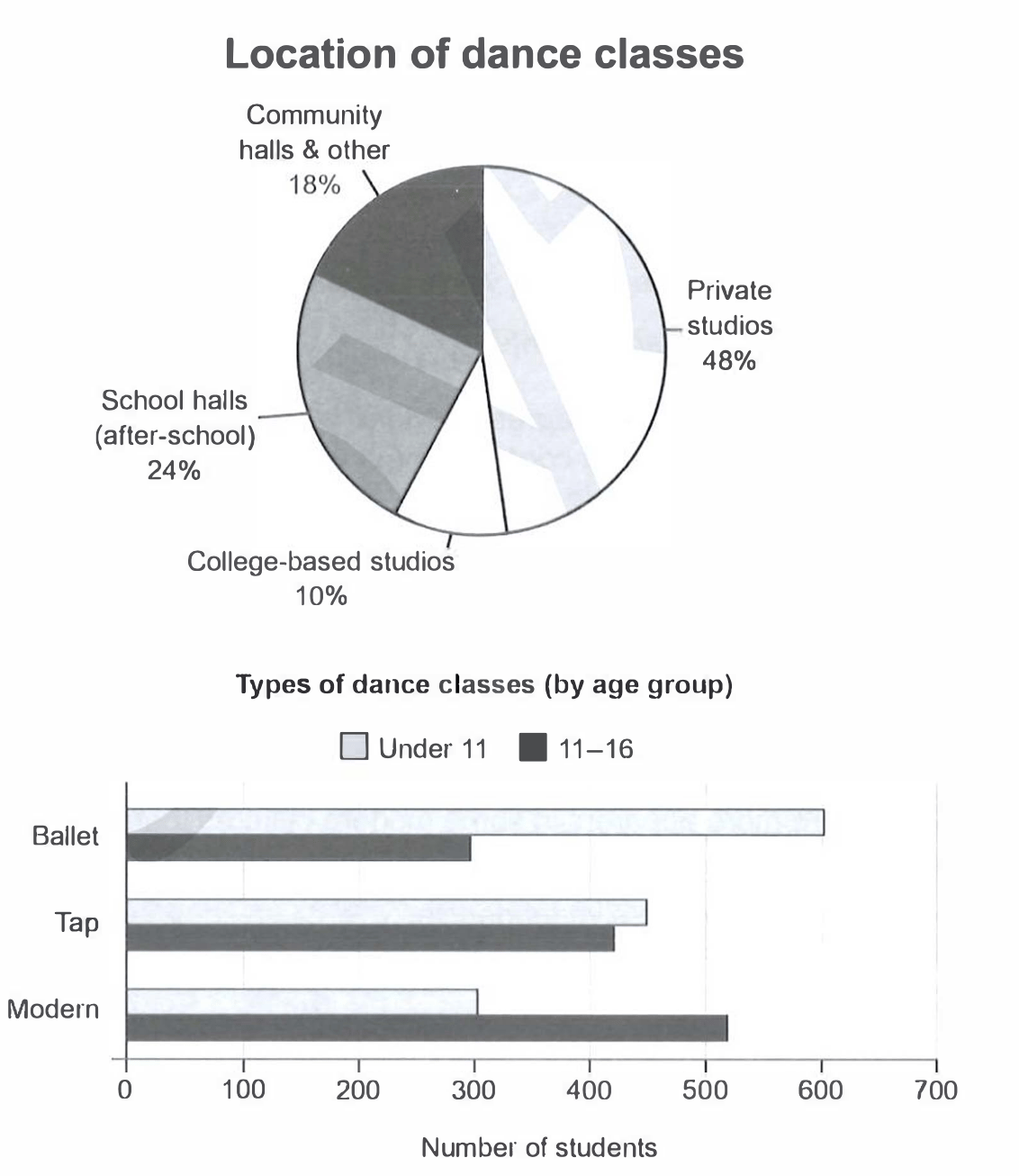
The charts below give information on the location and types of dance classes young people in a town in Australia are currently attending.
Summarise the information by selecting and reporting the main features, and make comparisons where relevant.
Student answer (Band 6.0)
The pie chart and bar graph depicts the information of the place and type of dance training centres youth in a town in australia are nowadays pursuing .
Overall, pie chart shows most of the young generation taking dance classes at private studios and least in College-based studios. While bar graph illustrates age group of people taking dance classes where youngsters that were under 11 mostly prefering ballet but age between 11-16 preferring modern dance.
Firstly, people taking classes mostly in private studios around 48% of total percentage and followed by 24% who prefering school halls after school for dance training . Similarly, college based studios used around 10 % and community halls and other locations used 18% by youth.
Furhtermore, Ballet was the most trending dance type in the youth who is under 11 around 610 sudents while its is least by students between 11-16 of figures of 300. Conversely, modern was least learned by under 11 of 300 students and most by 11-16 of around 520 students .Tap was around same for both age group of figures 420 and 450 of under 11 and between 11-16 age group respectively.
AI examiner evaluation
| Criterion | Band |
|---|---|
| Task Achievement / Task Response | 7.0 |
| Coherence and Cohesion | 6.5 |
| Lexical Resource | 5.5 |
| Grammatical Range and Accuracy | 5.5 |
| Overall | 6.0 |
Task Achievement / Task Response: Band 7.0
The response covers both charts and gives a clear overview: private studios are identified as the most common location, while college-based studios are the least common, and the age-group preferences are compared. Most figures are accurately reported, including the location percentages and the approximate student totals. The key comparisons between ballet and modern are also grounded in the chart. However, the overview says under-11s “mostly” prefer ballet and 11–16-year-olds prefer modern, which is a useful summary but could be more precise by noting that the older group’s modern figure is highest while the younger group’s ballet figure is highest. The tap comparison is included, and the response selects relevant features throughout; a sharper overview of the main contrasts would make the reporting more fully developed.
Coherence and Cohesion: Band 6.5
The response has a clear overall structure: an introduction, an overview, and separate paragraphs for location and dance-type data. Information generally progresses logically, and linking expressions such as “Overall,” “Firstly,” “Furthermore,” and “Conversely” help signal relationships. This gives the report a coherent arrangement. Some connections are less smooth, however: “Similarly” does not clearly express the relationship between the location figures, and the final sentence combines both tap values in a way that makes the comparison slightly harder to follow. The overview also repeats information that is then detailed below. To strengthen cohesion, use more precise comparison links and keep each sentence focused on one clear comparison, while retaining the effective paragraph structure.
Lexical Resource: Band 5.5
The response uses relevant vocabulary for describing charts, including “percentage,” “age group,” “least,” “most,” and “Conversely,” so the main information is understandable. However, the range and control are limited by repeated or imprecise expressions such as “taking dance classes,” “dance training,” and “dance type.” Several choices are unnatural for this context: “trending” suggests popularity in a current fashion sense, while “pursuing” does not fit the description of where classes are held. There are also spelling errors, including “Furhtermore” and “sudents,” and inconsistent capitalisation of “Australia.” Aim for more precise chart language and check spelling and word forms carefully; this would make the report more fluent and appropriately formal.
Grammatical Range and Accuracy: Band 5.5
The response attempts a mixture of simple and more complex sentences, including contrasts introduced by “while” and “but.” Meaning is usually recoverable, but grammatical control is uneven, with errors in agreement, verb forms, articles, and sentence construction. For example, “The pie chart and bar graph depicts” has a plural subject with a singular verb, and “youngsters that were under 11 mostly prefering ballet” is not a complete, correctly formed clause. The opening sentence also lacks a clear grammatical structure, while “people taking classes mostly in private studios around 48%” is missing a finite verb. Work on complete sentence patterns and consistent tense, and proofread subject–verb agreement and articles. More accurate complex sentences would improve clarity without requiring more elaborate structures.
See this exact question answered at other band scores. The same prompt compared across bands.
Browse more IELTS Writing model answers or get your own writing scored by the same AI examiner.