Band 5.5 IELTS Writing Task 1 Model Answer
Overall Band Score: 5.5 · Cambridge IELTS 19 · 2026-11-17
IELTS Writing Task 1 question
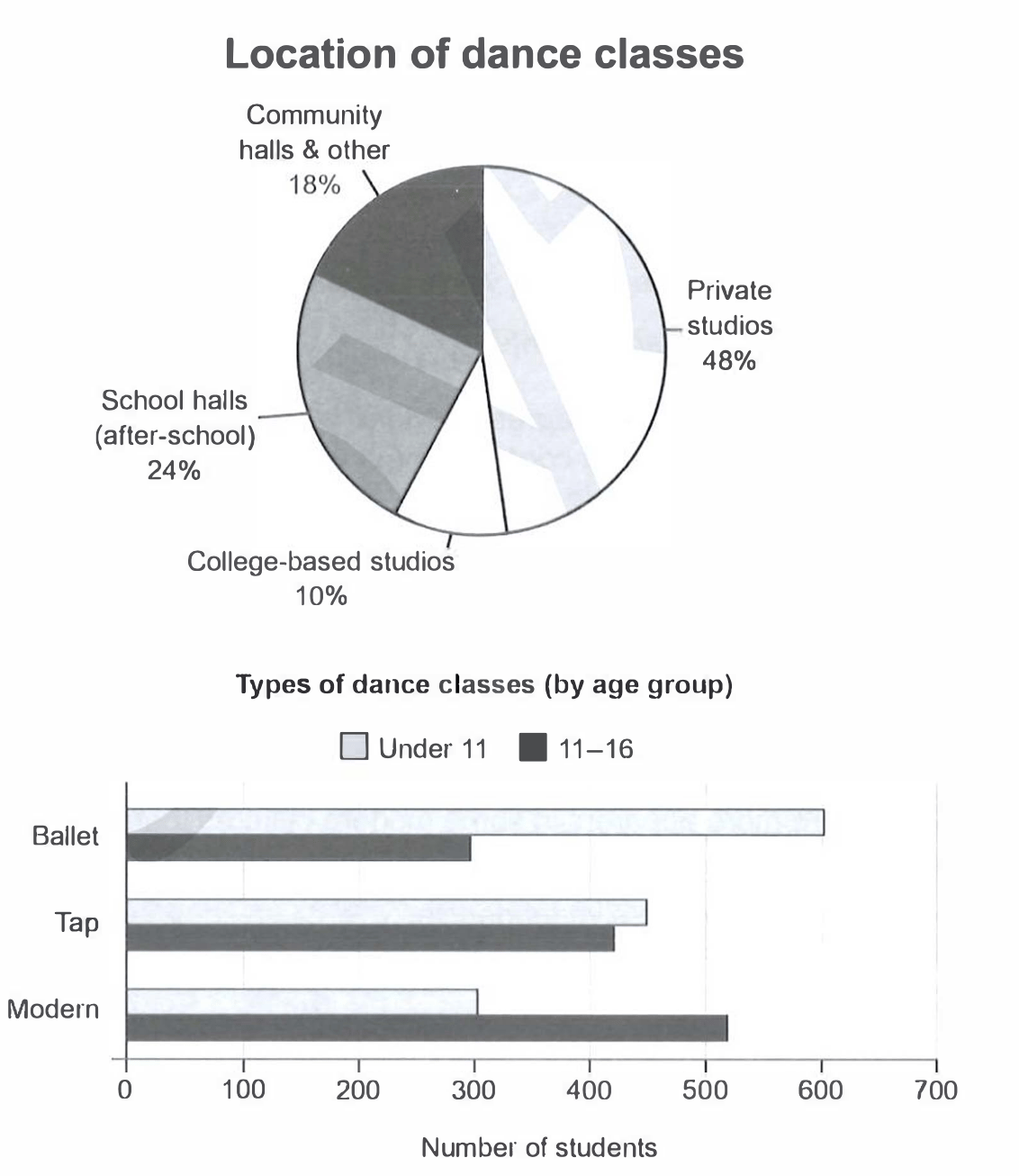
The charts below give information on the location and types of dance classes young people in a town in Australia are currently attending.
Summarise the information by selecting and reporting the main features, and make comparisons where relevant.
Student answer (Band 5.5)
The given chart gives information on the location and types of dance classes young people in a town in Australia are currently attending.
Starting with the highest percentage of people, around 48% of people in Australia are taking dance classes in private studios and about 24 % of people in school halls (after school) and the other 18% of people at community halls and other places and the rest of the percent at college-based studios.
Now, heres the types of dances attended by the number of students. Around 600 students who are under the age of 11 attends the classes of ballet while only 300 students who are at the age of 11-16 attends this ballet dance and about the tap dance around 450 students who are under the age of 11 attend the classes of this dance on the other hand around 420 students at the age of 11-16 attends these classes . As for the modern dance around 300 stundents under the age of 11 attend the classes of this dnace while more than 500 students at the age of 11-16 attedns the classes of this dance.
In conclusion, most of the people of Australia learns dances at private studios and dance classes of ballet and tap are mostly attended by students under the age of 11 while the modern dance classes are majorly attended by students at the age of 11-16.
AI examiner evaluation
| Criterion | Band |
|---|---|
| Task Achievement / Task Response | 5.5 |
| Coherence and Cohesion | 5.5 |
| Lexical Resource | 5.0 |
| Grammatical Range and Accuracy | 5.0 |
| Overall | 5.5 |
Task Achievement / Task Response: Band 5.5
You cover both charts and identify the main contrasts in dance styles: ballet and tap attract more under-11s, while modern is more popular among 11–16-year-olds. The figures for the dance types are generally close to the chart, and you correctly identify private studios as the largest location category. However, the location summary is incomplete: the college-based figure is left as “the rest” rather than reported as 10%, and the opening claim that these percentages are “of people in Australia” overgeneralises data about young people in one town. The conclusion repeats the main patterns but does not add a clear overview of the location categories. Report the key figures directly and frame the data precisely to make the summary more complete.
Coherence and Cohesion: Band 5.5
The response has a basic overall structure: an introduction, a paragraph on locations, a paragraph on dance types, and a concluding sentence. This helps the reader distinguish the two charts, and phrases such as “while” and “on the other hand” signal comparisons. However, progression within the dance-types paragraph is difficult to follow because several comparisons are joined into one long sentence, with repeated wording such as “attend the classes.” The informal transition “Now, heres” also does not create a clear report-style link. Use separate, balanced sentences to compare the age groups for each dance, and organise the location figures in a clear sequence. This would make the relationships between details easier to follow.
Lexical Resource: Band 5.0
You use relevant chart vocabulary, including “percentage,” “private studios,” “community halls,” and “attended,” so the topic is generally clear. However, the range is limited and several expressions are repetitive or imprecise: “people” is used repeatedly where “students” or “young people” would be more accurate, and “the rest of the percent” is not a natural way to report a figure. There are also noticeable spelling errors, including “stundents,” “dnace,” and “attedns,” which reduce the accuracy of the report. Aim for concise, standard data-reporting language and check spelling carefully. More precise verbs such as “accounted for” and “enrolled in” would help vary the wording.
Grammatical Range and Accuracy: Band 5.0
The response attempts some longer sentences to compare figures, but control is inconsistent, and errors sometimes make the information harder to process. For example, “600 students who are under the age of 11 attends” has a subject–verb agreement error; the plural subject requires “attend.” Similar agreement problems occur in “students … attends” and “people … learns.” The long sentence beginning “around 600 students” also joins several comparisons without clear sentence boundaries, while “heres” lacks the apostrophe in “here’s.” Build accuracy first with shorter comparison sentences, then combine ideas using controlled clauses. Check agreement whenever the subject is plural and use punctuation to separate each dance-style comparison.
See this exact question answered at other band scores. The same prompt compared across bands.
Browse more IELTS Writing model answers or get your own writing scored by the same AI examiner.