Band 6.5 IELTS Writing Task 1 Model Answer
Overall Band Score: 6.5 · Cambridge IELTS 19 · 2026-11-17
IELTS Writing Task 1 question
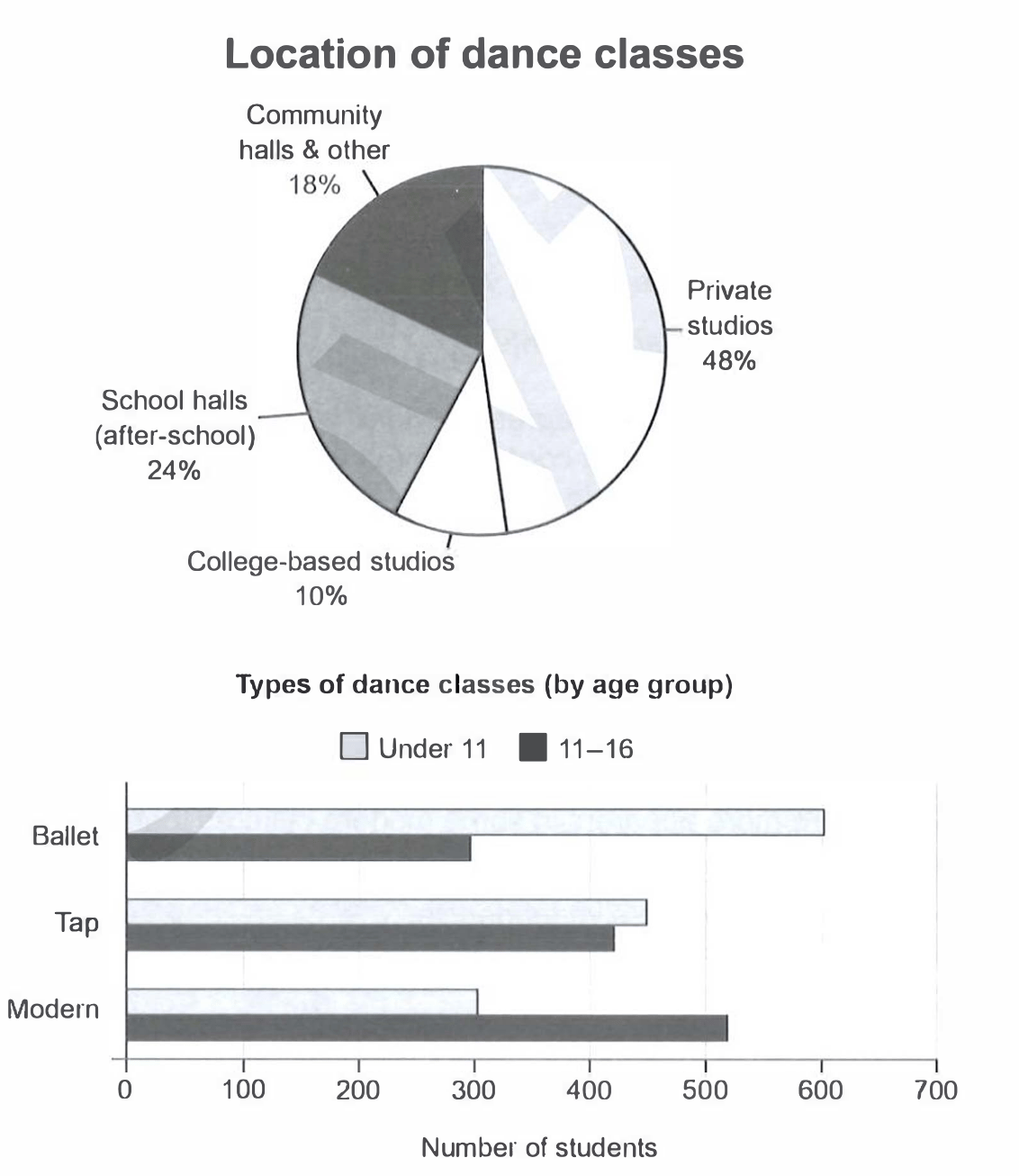
The charts below give information on the location and types of dance classes young people in a town in Australia are currently attending.
Summarise the information by selecting and reporting the main features, and make comparisons where relevant.
Student answer (Band 6.5)
The pie chart illusrates the locations of dance classes, while the line graph shows the type of dance classes attented by young people in different age groups in a town in Australia.
Overall, the pie chart demonstrates that the largest proportion of location of dance classes is occupated by private studios, while the smallest share is for college-based studios. Furthermore, the line graph provide information that the ballet and modern dance classes have the largest number of students.
On one hand, the chart presents that the biggest share of location of dance classes goes to the private studios with 48% of the total, 24% is for school halls ( after-school). Community halls and other has 18% of the dance classes. While the smallest proportion is for college-based studios ( 10%).
On the other hand, the graph explains that the ballet has the largest number of students under 11 years old ( 600 students) and 300 students between 11 and 16. The modern dance occupates the largest number of students between 11 and 16 ( 500 students) and only 300 students under 11. In addition, the tap has almost the same number of students under 11 and below.
AI examiner evaluation
| Criterion | Band |
|---|---|
| Task Achievement / Task Response | 6.5 |
| Coherence and Cohesion | 6.5 |
| Lexical Resource | 6.0 |
| Grammatical Range and Accuracy | 6.0 |
| Overall | 6.5 |
Task Achievement / Task Response: Band 6.5
You cover both visuals and identify the main location pattern accurately: private studios account for 48%, while college-based studios are the smallest category at 10%. You also report the key ballet and modern figures correctly. However, the overview says ballet and modern have the largest numbers overall, which is unclear because the leading style differs by age group: ballet for under-11s and modern for 11–16s. The tap comparison is also left incomplete; the groups have about 450 and 420 students, rather than simply “almost the same number ... under 11 and below.” A clearer overview of the contrasting age-group preferences, supported by the tap figures, would make the report more fully developed.
Coherence and Cohesion: Band 6.5
The response has a coherent overall arrangement: an introduction, an overview, and separate paragraphs for the two visuals. The signposting phrases “On one hand” and “On the other hand” help distinguish the chart descriptions, and the information is generally easy to follow. Some cohesion is mechanical, however, and the overview does not clearly connect the two age groups to their preferred dance styles. The final sentence, “the tap has almost the same number of students under 11 and below,” is difficult to interpret because “below” does not identify the second group. Use more precise referencing and link each comparison explicitly—for example, compare the under-11 and 11–16 figures in the same sentence.
Lexical Resource: Band 6.0
You use an adequate range of task-related vocabulary, including “largest proportion,” “smallest share,” “private studios,” and “school halls (after-school).” These terms make the main categories understandable, and the response attempts some variation with “share,” “proportion,” and “number.” However, several word choices or collocations are inaccurate or unnatural: “occupated by” and “occupates” should be replaced with “accounted for” or “had”; “the biggest share ... goes to” is informal; and “the graph explains” is less suitable than “shows.” There are also spelling errors in “illusrates” and “attented.” More precise reporting verbs and accurate spelling would improve control and make the description sound more academic.
Grammatical Range and Accuracy: Band 6.0
You use a mix of simple and complex sentence forms, including a contrast clause beginning “while” and sentences that compare figures across age groups. Most meanings remain clear, but some grammatical errors recur. For example, “the line graph provide” needs subject–verb agreement (“provides”), and “Community halls and other has” should take “have” or be recast as “the category ... has.” The phrase “the largest proportion of location” also needs a clearer grammatical construction, such as “the largest proportion of classes is held in private studios.” Punctuation spacing around brackets is inconsistent, and the final comparison lacks a clear grammatical reference. Check agreement, sentence construction, and punctuation while retaining your attempts at complex sentences.
See this exact question answered at other band scores. The same prompt compared across bands.
Browse more IELTS Writing model answers or get your own writing scored by the same AI examiner.