Band 5.5 IELTS Writing Task 1 Model Answer
Overall Band Score: 5.5 · Cambridge IELTS 19 · 2026-11-17
IELTS Writing Task 1 question
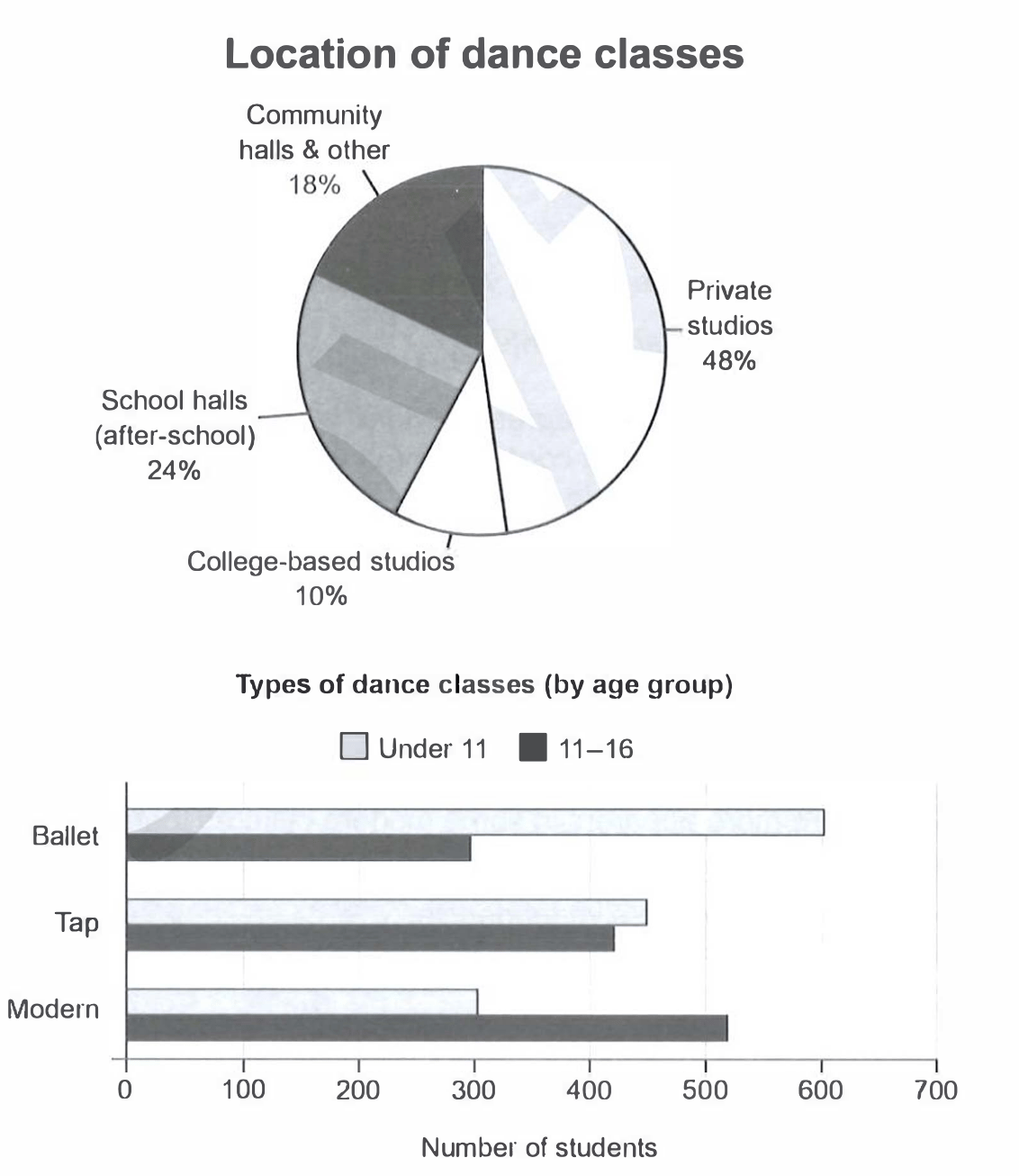
The charts below give information on the location and types of dance classes young people in a town in Australia are currently attending.
Summarise the information by selecting and reporting the main features, and make comparisons where relevant.
Student answer (Band 5.5)
The circular chart represents the location of dance classes and the bar chart represents the types of dace classes in a town of Australia young people are attending .
Overall , most of the youngsters prefers to learn from private studious rather than college based studios or communty hall . Pupils under the age of 11 are intrested in ballet dance classes while most of the individuals between the age of 11 to 16 attend modern dance classes .
Majority of the dance classes are private studious and second highest are school halls after the school hours , private studious are 48% and school halls are 24% . community halls and college based studioud are very less in compare to other 2 , they are 10% and 18% respectively .
Under the age of 11 around 600 students are learning ballet dance , 450 students are learning tap dance and only 300 students which is half of ballet dance are learning modern dace while situation is quite opposite in the age between 11 to 16 , most of the students are attending modern dance casses around 550
AI examiner evaluation
| Criterion | Band |
|---|---|
| Task Achievement / Task Response | 6.0 |
| Coherence and Cohesion | 6.0 |
| Lexical Resource | 5.0 |
| Grammatical Range and Accuracy | 5.0 |
| Overall | 5.5 |
Task Achievement / Task Response: Band 6.0
You cover both charts and identify the main location pattern: private studios are the largest share (48%), followed by school halls (24%). You also compare dance preferences by age, correctly noting that ballet is most popular among under-11s and modern among 11–16-year-olds. However, the overview says younger students are interested in ballet without contrasting the older group’s preference clearly, and the final comparison is incomplete: it gives the older group’s modern figure but omits its ballet and tap numbers. The older modern figure is also reported as around 550, whereas the chart indicates approximately 520. Include the remaining age-group figures and make the key contrasts explicit to report the data more fully.
Coherence and Cohesion: Band 6.0
The response has a recognisable structure: an introduction, an overview, and separate discussion of location and age-group data. This gives the reader a generally coherent route through the charts. Linking phrases such as “Overall,” “while,” and “whereas” help signal summary and contrast. However, the final sentence is unfinished in its comparison: it introduces the older group’s modern figure but does not complete the comparison with ballet and tap, and the long sentence beginning “Majority of the dance classes” combines several figures without clear separation. Use shorter, more controlled sentences and organise the age-group figures into a complete comparison. This would make the progression clearer and reduce the occasional mechanical or unclear connection.
Lexical Resource: Band 5.0
You use relevant chart vocabulary, including “private studios,” “school halls,” “students,” “ballet,” and “modern dance,” so the topic remains understandable. There are also attempts at comparison through phrases such as “second highest” and “quite opposite.” However, spelling and word-choice errors are noticeable, including “dace,” “studious,” “communtiy,” and “intrested.” Some expressions are also unnatural or imprecise: “learn from private studios” and “very less in compare to” do not describe the data idiomatically. Choose accurate chart language and check spelling carefully; for example, say that students “attend classes at” a location and that a category “accounts for” a percentage. More precise phrasing would improve clarity and control.
Grammatical Range and Accuracy: Band 5.0
You attempt both simple statements and longer sentences with contrast, as in “while situation is quite opposite…,” showing some range. The main information is usually understandable, but errors in agreement, articles, and sentence construction recur. For example, “most of the youngsters prefers” should use a plural verb, and “in a town of Australia young people are attending” has an awkwardly arranged clause. The final sentence also runs together several ideas and ends without completing the comparison. Use a clear subject–verb structure, check singular and plural agreement, and punctuate longer comparisons as separate sentences. These changes would make your varied sentence attempts more accurate and easier to follow.
See this exact question answered at other band scores. The same prompt compared across bands.
Browse more IELTS Writing model answers or get your own writing scored by the same AI examiner.