Band 5.5 IELTS Writing Task 1 Model Answer
Overall Band Score: 5.5 · Cambridge IELTS 19 · 2026-11-18
IELTS Writing Task 1 question
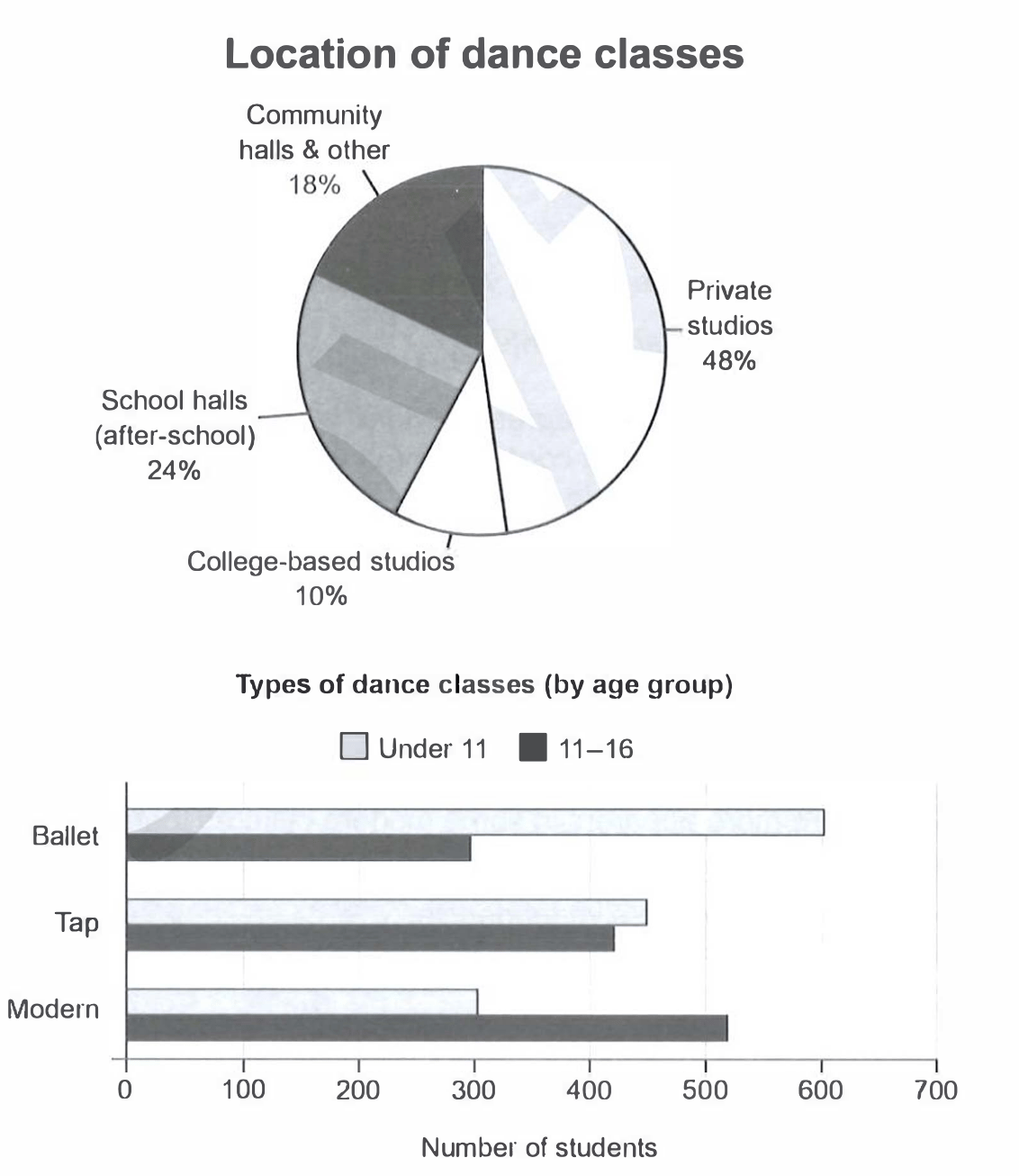
The charts below give information on the location and types of dance classes young people in a town in Australia are currently attending.
Summarise the information by selecting and reporting the main features, and make comparisons where relevant.
Student answer (Band 5.5)
The charts below give information on the location and types of dance classes young people in a town in Australia are currently attending. Summarise the information by selecting and reporting the main features, and make comparisons where relevant.
Overall, there are two graph are given about dance classes. First paragraph is about location of dance classes and the second one is about types of dance classes (by age group). Private studio is the largest studio in the dance classes. While, Ballet has the largest under 11 students and the Modern has the largest 11-16 students.
Location of dance classes is like this, 18% area covered by Community halls and others, 24% area covered by School halls (after-school), 10% area is covered by college-based studios and the the largest 48% area is covered by private studios.
So, types of dance classes. 600 under 11 students are in the ballet class and 300 11-16 students are in the ballet class. 450 under-11 studens are in the tap class and 420 11-16 students are in the tap class. 300 under-11 students are in the Modern class and 520 11-16 students are in the Modern class.
AI examiner evaluation
| Criterion | Band |
|---|---|
| Task Achievement / Task Response | 6.0 |
| Coherence and Cohesion | 6.0 |
| Lexical Resource | 5.5 |
| Grammatical Range and Accuracy | 5.0 |
| Overall | 5.5 |
Task Achievement / Task Response: Band 6.0
You cover both charts and report the main figures accurately: private studios account for 48%, and the student numbers for ballet, tap and modern match the visual data. Your overview also identifies ballet as most popular among under-11s and modern among 11–16-year-olds. However, the overview is not fully precise: “Private studio is the largest studio” describes a location category, not a type of studio, and the comparison between age groups is not clearly summarised. You could strengthen the response by highlighting that younger students favour ballet, while older students favour modern, and that tap enrolments are similar in both groups. The location figures are reported, but their relative importance is not discussed beyond naming the largest category.
Coherence and Cohesion: Band 6.0
The response has a recognisable structure: an overview is followed by a paragraph on locations and one on dance types. This makes the two charts easy to distinguish, and the figures are generally presented in a sensible order. However, progression within the overview is weakened by the meta-commentary “First paragraph is about…” rather than a direct summary of the data. Transitions such as “So, types of dance classes” are mechanical, while “While” is used as a sentence fragment before the next point. The final paragraph lists each class separately, so comparisons between age groups are less clear than they could be. Grouping the figures by age group or by the largest differences would create a more connected account.
Lexical Resource: Band 5.5
You use enough topic vocabulary to communicate the chart information, including “private studios,” “community halls,” “after-school,” and the dance styles. The labels are mostly recognisable, and the repeated use of percentages and student numbers is clear. However, the range is limited and some choices are imprecise or unnatural: “area covered by” suggests physical space rather than the proportion of classes, and “largest studio” does not accurately name the largest location category. There are also spelling and form slips, including “studens,” and inconsistent forms such as “under 11” and “under-11.” Use concise reporting language such as “accounted for,” “enrolments,” and “the most popular style” to improve precision and variety.
Grammatical Range and Accuracy: Band 5.0
Your sentences communicate the figures, and you attempt some variation, including the contrast introduced by “While.” However, the range is mostly simple, and several sentence structures are inaccurate. For example, “there are two graph are given” has faulty agreement and passive construction; “Private studio is the largest studio” is missing an article; and “the the largest 48% area is covered” contains repetition and an awkward structure. “While, Ballet…” is not a complete sentence, and punctuation around this transition is incorrect. These errors do not prevent the reader from understanding the data, but they limit grammatical control. Practise accurate overview sentences and use a mix of simple comparisons and correctly formed complex sentences.
See this exact question answered at other band scores. The same prompt compared across bands.
Browse more IELTS Writing model answers or get your own writing scored by the same AI examiner.