Band 6.0 IELTS Writing Task 1 Model Answer
Overall Band Score: 6.0 · Cambridge IELTS 19 · 2026-11-18
IELTS Writing Task 1 question
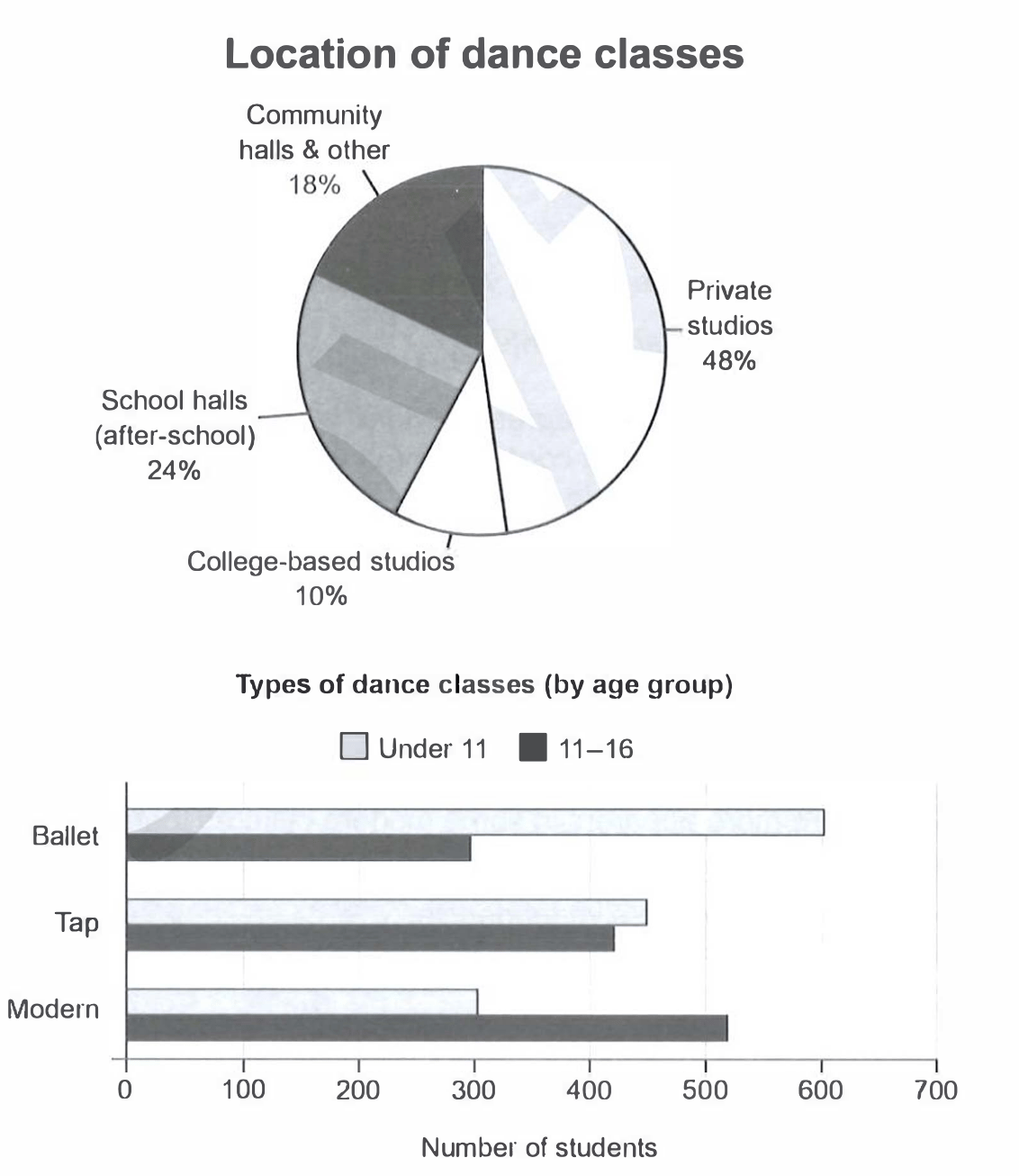
The charts below give information on the location and types of dance classes young people in a town in Australia are currently attending.
Summarise the information by selecting and reporting the main features, and make comparisons where relevant.
Student answer (Band 6.0)
The pie provide information about the location and types of dance classes among the youg people in a town in Australia are currently attending.
Overall, most people who attending the classes in private studio. and leas popular for location for people was college-based studios. In ballet class under 11 age children figure is high as compared to 11 to 16 age. while, In modern class the people who attending the Modern class under 11 figure is lower as compared to 11 to 16 age children.
Looking at details, location of dance classes. The private studios location was most popular 48 percent people attending class there. followed by school halls was 24. In Community halls and other 18 percent people attending class there and lowest poular was College- based Studios 10percent.
Types of dance classes by age. In ballet class, under 11 age children 600 students taking in ballet class and 11 to 16 age were 300. in Tap class, 11 to 16 age children little bit lower than under age 11 however, in Modern class the figure of 11 to 16 was high 500 students taking the class instead of under 11 age childer who attending were 300 students
AI examiner evaluation
| Criterion | Band |
|---|---|
| Task Achievement / Task Response | 6.5 |
| Coherence and Cohesion | 6.0 |
| Lexical Resource | 5.5 |
| Grammatical Range and Accuracy | 5.0 |
| Overall | 6.0 |
Task Achievement / Task Response: Band 6.5
You cover both charts and give a clear overview of key contrasts: private studios are the most common location, college-based studios the least common, and ballet and modern show different age-group patterns. The location percentages are reported accurately, and the ballet and modern figures are broadly consistent with the chart. However, the overview omits the notable tap comparison, and the detail says 11–16-year-olds in tap are “a little bit lower” than under-11s, whereas the chart shows about 420 compared with 450. The modern figure for older students is also approximately 520, rather than 500. This addresses the task well overall, but some features are less fully and precisely reported; adding the tap trend to the overview and checking comparisons would strengthen it further.
Coherence and Cohesion: Band 6.0
The response has a recognisable structure: an introduction, an overview, and separate detail sections for location and dance types. This makes the main categories easy to follow. You also use basic linking expressions such as “Overall,” “followed by,” and “while” to connect information. However, some links are awkward or incomplete, including “Overall, most people who attending…” and the abrupt transition “Looking at details, location of dance classes.” The final paragraph combines several comparisons in a long, loosely connected sentence, so the reader has to work to follow the figures. Use complete topic sentences and organise the age-group comparisons consistently by dance type to make progression clearer and cohesion less mechanical.
Lexical Resource: Band 5.5
You use relevant vocabulary for describing charts, including “private studios,” “school halls,” “percentage,” “figure,” and “followed by.” This gives you enough topic-specific language to communicate the main information. However, the range is limited and several choices or forms are inaccurate or repetitive: “most popular” and “figure” recur, while “little bit lower” is informal and imprecise for an academic report. Spelling errors such as “youg,” “leas,” “poular,” and “childer” also reduce accuracy. Aim for more precise comparison language and check spelling carefully; varied terms such as “accounted for,” “stood at,” and “was higher than” would make the description more natural and exact.
Grammatical Range and Accuracy: Band 5.0
You attempt both simple statements and more complex comparisons, for example, “while, In modern class…” and “under 11 age children figure is high as compared to 11 to 16 age.” However, many sentences contain errors in verb forms, articles, agreement, or sentence boundaries. Examples include “The pie provide,” “most people who attending,” and “The private studios location was most popular 48 percent people attending class there.” Capitalisation and punctuation are also inconsistent, with sentence fragments after full stops and commas. These errors sometimes make relationships between figures unclear. Practise building accurate comparison sentences with a subject and verb, such as “The figure for under-11s was higher than that for 11–16-year-olds,” before adding more complex clauses.
See this exact question answered at other band scores. The same prompt compared across bands.
Browse more IELTS Writing model answers or get your own writing scored by the same AI examiner.