Band 6.5 IELTS Writing Task 1 Model Answer
Overall Band Score: 6.5 · Cambridge IELTS 19 · 2026-11-19
IELTS Writing Task 1 question
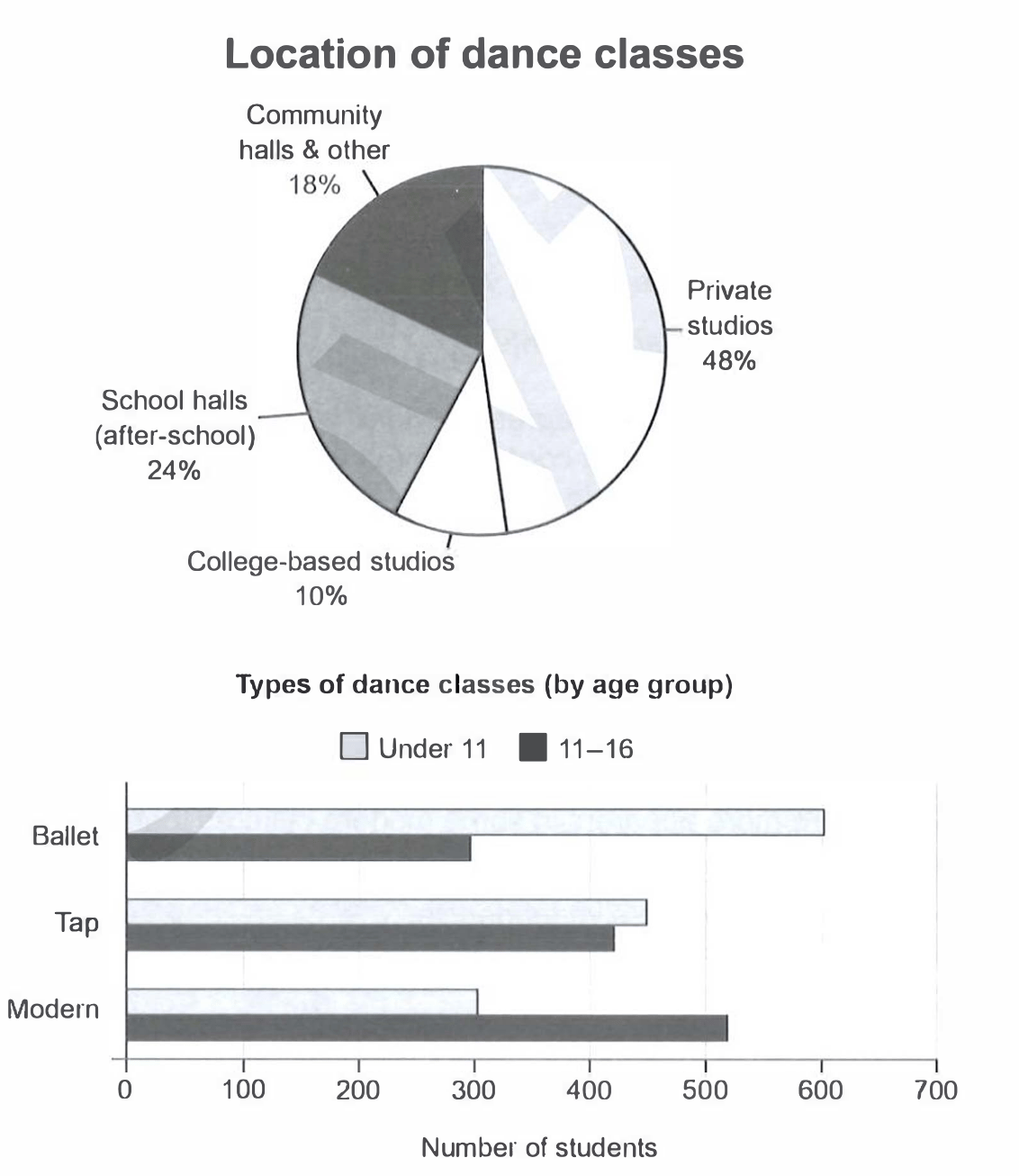
The charts below give information on the location and types of dance classes young people in a town in Australia are currently attending.
Summarise the information by selecting and reporting the main features, and make comparisons where relevant.
Student answer (Band 6.5)
The pie and the bar chart illustrate information about location and types of dance classes, which are attended by young people of a town in Australia.
Overall, nearly half of the young people attends dance classes in private studios, while only one-tenth goes to the college-based studios. The under-11 kids attend ballet dance classes the most, and modern classes the least.
By location wise, the dance classes are proportioned as, only one-tenth of young people go to college-based studios, which is the least visited location , while the private studios represents the largest number of class attendents, next come school halls, community halls/other venue which account for 24% and 18%, respectively.
The types of dance classes by age group of under-11 illustrates, that 600 kids go to the ballet dance, which is the most attended type of dance class, while approximately 450 kids go to tap dance and a least number of 300 kids go to modern classes. The age group of 11-16 represents the opposite to under-11 group, because most of the attendents in this group go to modern dance classes next come tap classes and at the last they go to the ballet dance classes.
AI examiner evaluation
| Criterion | Band |
|---|---|
| Task Achievement / Task Response | 7.0 |
| Coherence and Cohesion | 6.5 |
| Lexical Resource | 6.0 |
| Grammatical Range and Accuracy | 5.5 |
| Overall | 6.5 |
Task Achievement / Task Response: Band 7.0
You cover both charts and provide a clear overview, identifying private studios as the most common location and college-based studios as the least common. You also accurately describe the under-11 group’s preference for ballet and its lower figure for modern, and you compare the older group with the younger one. These are relevant, well-selected features. However, the overview is incomplete because it does not identify the older group’s leading style, modern, or the reversal in ballet’s popularity between the age groups. In the details, you give no figures for the 11–16 group, even though the chart shows useful comparisons: about 520 for modern, 420 for tap and 300 for ballet. Including these would make the comparison more fully supported.
Coherence and Cohesion: Band 6.5
The response has a clear overall structure: an introduction, an overview, a paragraph on locations and a paragraph on dance types. The information generally progresses in a sensible order, and linking expressions such as “while,” “next” and “because” help connect comparisons. This gives the report a coherent overall arrangement. Some connections are less smooth, however: “By location wise” is an awkward paragraph opening, and the final sentence strings together several comparisons with “next come” and “at the last,” making the sequence harder to follow. The reference to the older group as “the opposite” is also broad rather than clearly specifying which styles reverse. Use more precise transitions and organise the age-group comparisons in parallel.
Lexical Resource: Band 6.0
You use an adequate range of task-related vocabulary, including “private studios,” “college-based studios,” “proportioned” and “attended,” and the main meaning remains clear. There are also attempts to vary expressions, such as “the most attended type” and “the least visited location.” However, several choices are unnatural or imprecise for describing chart data: “class attendents,” “go to the ballet dance,” and “the types … illustrates.” Repetition of “go to” and “dance classes” also limits flexibility. Choose standard collocations such as “attend classes,” “the number of students,” and “the most popular style.” Check spelling and word forms, especially “attendants,” which is not the intended term for people taking classes; “students” or “participants” is more suitable.
Grammatical Range and Accuracy: Band 5.5
You attempt a mix of sentence forms, including a complex comparison with “while” and a longer explanation beginning “because.” The meaning is usually understandable, but errors in agreement, articles and sentence construction recur. For example, “nearly half … attends” should use a plural verb, while “the private studios represents” has a singular verb with a plural subject. In “the types … illustrates,” the subject and verb also do not agree. Several clauses are awkwardly joined or punctuated, as in “By location wise, the dance classes are proportioned as, only one-tenth…,” and commas interrupt the sentence unnecessarily. Aim for shorter, controlled comparisons, checking subject–verb agreement and punctuation before adding more complex clauses.
See this exact question answered at other band scores. The same prompt compared across bands.
Browse more IELTS Writing model answers or get your own writing scored by the same AI examiner.