Band 6.0 IELTS Writing Task 1 Model Answer
Overall Band Score: 6.0 · Cambridge IELTS 19 · 2026-11-20
IELTS Writing Task 1 question
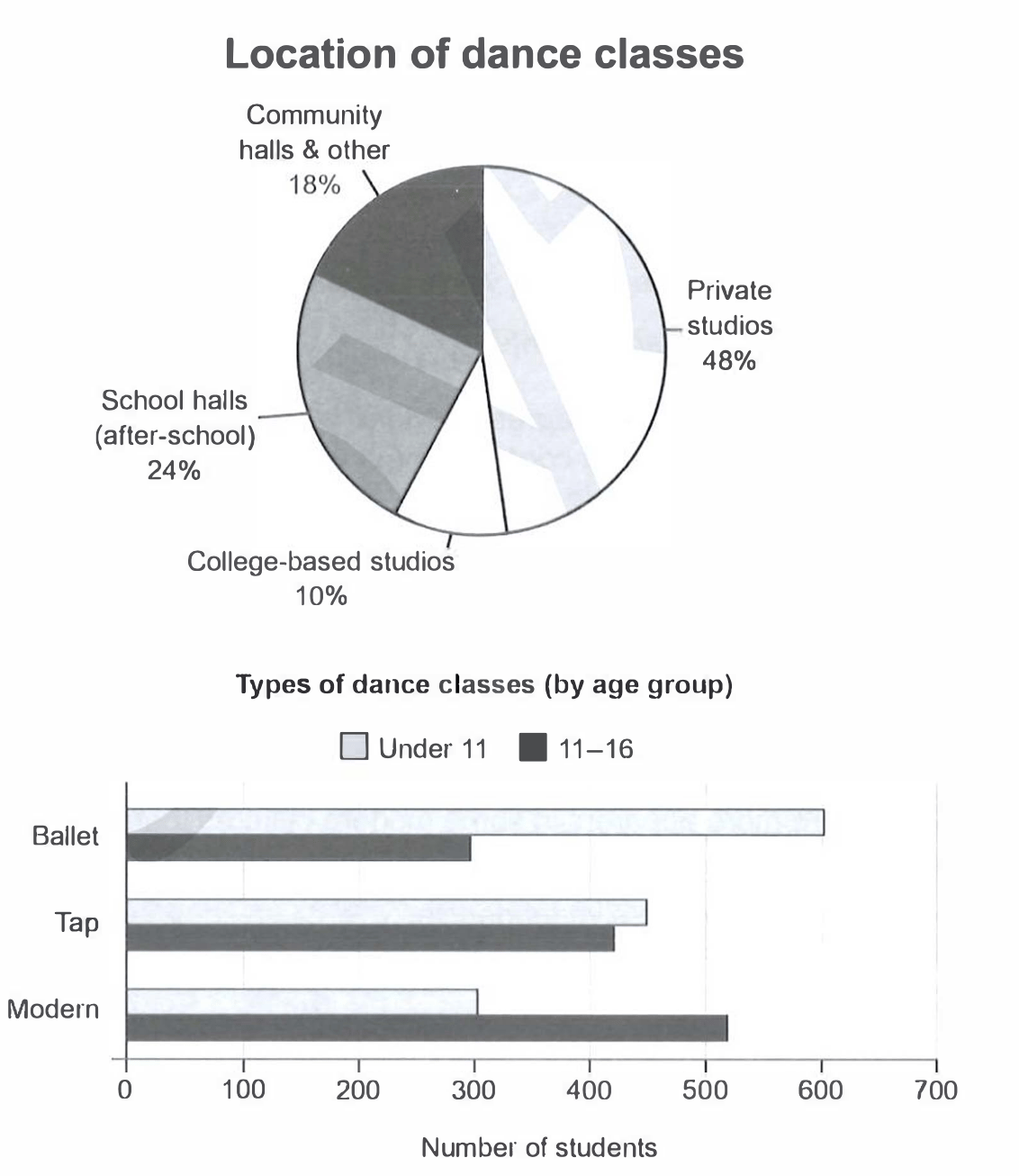
The charts below give information on the location and types of dance classes young people in a town in Australia are currently attending.
Summarise the information by selecting and reporting the main features, and make comparisons where relevant.
Student answer (Band 6.0)
The pie and bar charts illustrate that the young people who currently attend dance classes in term of place and type in a town in Australia.
Overall, the private studios has the largest share of dance classes, while the college based studios has the least proportion. Largest number of under 11 are inlvolved in ballet dance. In contrast, 11-16 have high interest in modern dance.
In term of location, private studios have the biggest percentage of 48% followed by school hall which is half of the private studios, accounted for 24%. Community halls and other have 6% smaller share than school halls. While, the college based studios represent the smallest portion which is just 10%.
600 young people which are under 11 are involved in ballet dance, followed by tap dance where approxiemately 450 participents under 11, like to participate. By contrast, under 11 which are involved in modern dance are half than ballet dance. In term of 11-16 age group students are moslty interested in modern dance which are just above 500 students. On the other hand just 300 students like ballet dance class.
AI examiner evaluation
| Criterion | Band |
|---|---|
| Task Achievement / Task Response | 6.0 |
| Coherence and Cohesion | 6.0 |
| Lexical Resource | 5.5 |
| Grammatical Range and Accuracy | 5.5 |
| Overall | 6.0 |
Task Achievement / Task Response: Band 6.0
You cover both charts and give a clear overview: private studios are the most common location, college-based studios the least common, and ballet leads among under-11s while modern is most popular among 11–16-year-olds. Most figures are reported accurately, including 48%, 24%, 18%, 10%, and the under-11 ballet and tap totals. However, the overview says older students have a high interest in modern dance without comparing it with tap, which is also substantial at about 420. More importantly, the final paragraph omits the 11–16 tap figure and gives no direct comparison of the age groups’ preferences across all three styles. Include these key contrasts to make the coverage more complete and precise.
Coherence and Cohesion: Band 6.0
The response has a sensible overall structure: an introduction, an overview, and separate paragraphs for location and dance types. This makes the two charts easy to distinguish, and linking phrases such as “Overall,” “In contrast,” and “On the other hand” help signal comparisons. Some connections are less clear or repetitive, however. The dance paragraph moves from under-11 figures to the older group without reporting the older group’s tap result, so the comparison feels incomplete. Phrases such as “In term of” are also repeated, and the sentence beginning “Community halls and other…” is joined awkwardly to the preceding point. Use clearer transitions and organise the dance figures by age group or style to create a more consistent progression.
Lexical Resource: Band 5.5
You use a reasonable range of task-related vocabulary, including “largest share,” “smallest portion,” “followed by,” and “involved in,” so the main information is generally understandable. There are also attempts at varied phrasing, such as “high interest” and “participate.” However, several word choices and collocations are inaccurate or unnatural: “in term of place and type,” “has the largest share,” and “half than ballet dance” do not express the intended ideas smoothly. Spelling errors such as “inlvolved,” “approxiemately,” “participents,” and “moslty” also reduce accuracy. Aim for precise chart language and check spelling; for example, use “accounted for” or “represented” consistently when describing proportions.
Grammatical Range and Accuracy: Band 5.5
You attempt both simple and more complex sentence forms, including contrast clauses with “while” and “where,” and most of the chart information remains understandable. Some grammatical errors nevertheless recur. Subject–verb agreement is incorrect in “the private studios has” and “the college based studios has”; plural subjects require “have.” The construction “600 young people which are under 11” is also faulty: use “who are under 11” or “600 under-11s.” In “under 11 which are involved,” the relative pronoun should refer to people, and “are half than” needs a different comparative structure, such as “half as many as.” Improve agreement, relative clauses, and comparison patterns while retaining your attempts at complex sentences.
See this exact question answered at other band scores. The same prompt compared across bands.
Browse more IELTS Writing model answers or get your own writing scored by the same AI examiner.