Band 6.0 IELTS Writing Task 1 Model Answer
Overall Band Score: 6.0 · Cambridge IELTS 19 · 2026-11-20
IELTS Writing Task 1 question
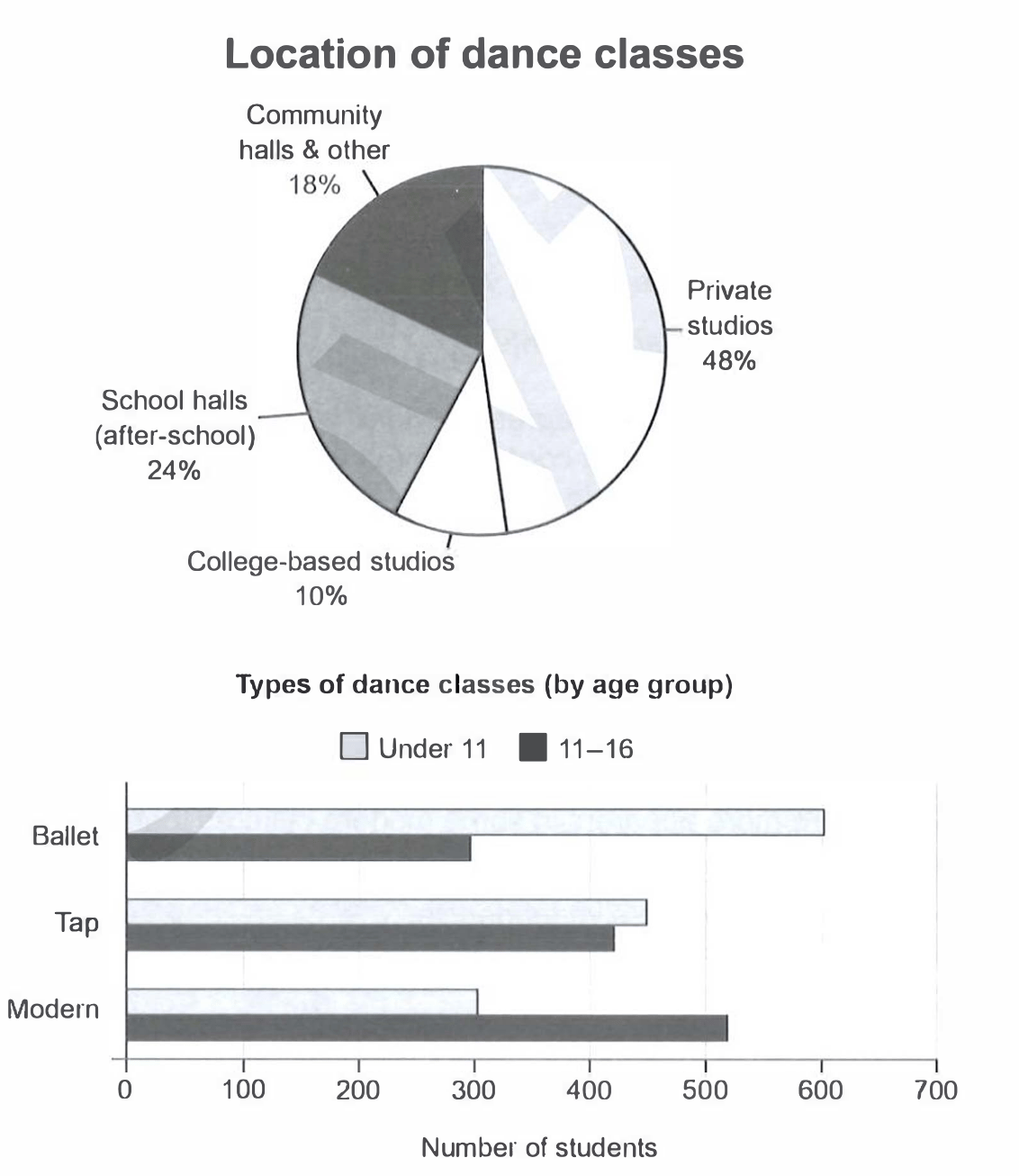
The charts below give information on the location and types of dance classes young people in a town in Australia are currently attending.
Summarise the information by selecting and reporting the main features, and make comparisons where relevant.
Student answer (Band 6.0)
The given pie chart and bar graph displays the data on the address of dance classes and the types of dance classes that the young generation in a city in Australia are currently having.
Overall, most of the dance classes are held in private studios followed by school halls. Mostly children under 11 are more keen into ballet dancing while children in the age group of 11-16 prefers modern dancing.
In Australia, 48% of dance classes are organized in private studios. School halls are also being used after the completion of schooling hours and 24% of dance classes are held in school halls followed by community halls & other with 18%. Furthermore, remaining all the classes are organized in college-based studios.
The students who are below 11 are more interested in ballet dancing than any other types of dancing, around 600 children are learing ballet dancing while children above 11 and less than 17 are almost half of the children below 11. Similarly, learners in the age range of 11-16 likes modern dancing more as there are more than 500 of them learing it whereas children bellow 11 are 200 less than them. Likewise, there are puipils that learn tap dancing as well.There are almost [redacted phone] children learning tap dancing in both the age groups.
AI examiner evaluation
| Criterion | Band |
|---|---|
| Task Achievement / Task Response | 6.5 |
| Coherence and Cohesion | 6.5 |
| Lexical Resource | 5.5 |
| Grammatical Range and Accuracy | 5.5 |
| Overall | 6.0 |
Task Achievement / Task Response: Band 6.5
You cover both charts and provide a clear overview: private studios are the most common venue, and the preferred dance style differs by age group. Several comparisons are supported with relevant figures, including 48% for private studios, 24% for school halls, and about 600 under-11 ballet students. However, some details are inaccurate or imprecise: the 11–16 group has about 300 ballet students, not “almost half” of 600; under-11 modern is about 300, not 200 fewer than the older group; and tap figures are approximately 450 and 420, rather than a broad 400–450 for both. The overview also omits the notable contrast in tap participation. More precise reporting of these comparisons would make the coverage more complete and developed.
Coherence and Cohesion: Band 6.5
The response has a recognisable structure, moving from an introduction and overview to venue details and then age-group comparisons. This gives the reader a coherent overall route through the two charts. Linking expressions such as “Overall,” “Furthermore,” “Similarly,” and “Likewise” help connect points, though some transitions feel mechanical, and “Likewise” does not introduce a particularly parallel comparison. The final paragraph also combines ballet, modern, and tap information in a long sequence, making the comparisons less easy to follow. Separate the age-group comparisons more clearly and use references such as “the younger group” and “their older counterparts” consistently. This would strengthen progression and cohesion while retaining the clear basic organisation already present.
Lexical Resource: Band 5.5
You use enough topic vocabulary to describe the charts, including “private studios,” “school halls,” “age group,” and “organized.” There are also attempts at more varied phrasing, such as “more interested in” and “held in.” However, several choices are unnatural or imprecise for an academic report: “address of dance classes” should be “locations of dance classes,” “currently having” is unsuitable for classes, and “more keen into” is not idiomatic. Spelling errors such as “learing,” “bellow,” and “puipils” are noticeable, while repeated use of “children” and “dance” limits flexibility. Aim for accurate chart-reporting collocations and check spelling carefully; this will make the meaning more precise and fluent.
Grammatical Range and Accuracy: Band 5.5
You attempt a mix of simple and more complex sentences, including a comparison with “while” and a clause beginning “whereas.” The main ideas are generally understandable, but some grammatical errors recur. For example, “the pie chart and bar graph displays” has a plural subject with a singular verb, and “children in the age group of 11-16 prefers” also needs plural agreement. In “learners … likes modern dancing,” the verb form is again incorrect, while “there are more than 500 of them learning it” would be clearer with a direct subject and verb. Some sentences are long and joined with several clauses, which makes control less secure. Review subject–verb agreement and build comparisons in shorter, well-controlled sentences; this would improve accuracy without sacrificing structural variety.
See this exact question answered at other band scores. The same prompt compared across bands.
Browse more IELTS Writing model answers or get your own writing scored by the same AI examiner.