Band 6.0 IELTS Writing Task 1 Model Answer
Overall Band Score: 6.0 · Cambridge IELTS 19 · 2026-11-20
IELTS Writing Task 1 question
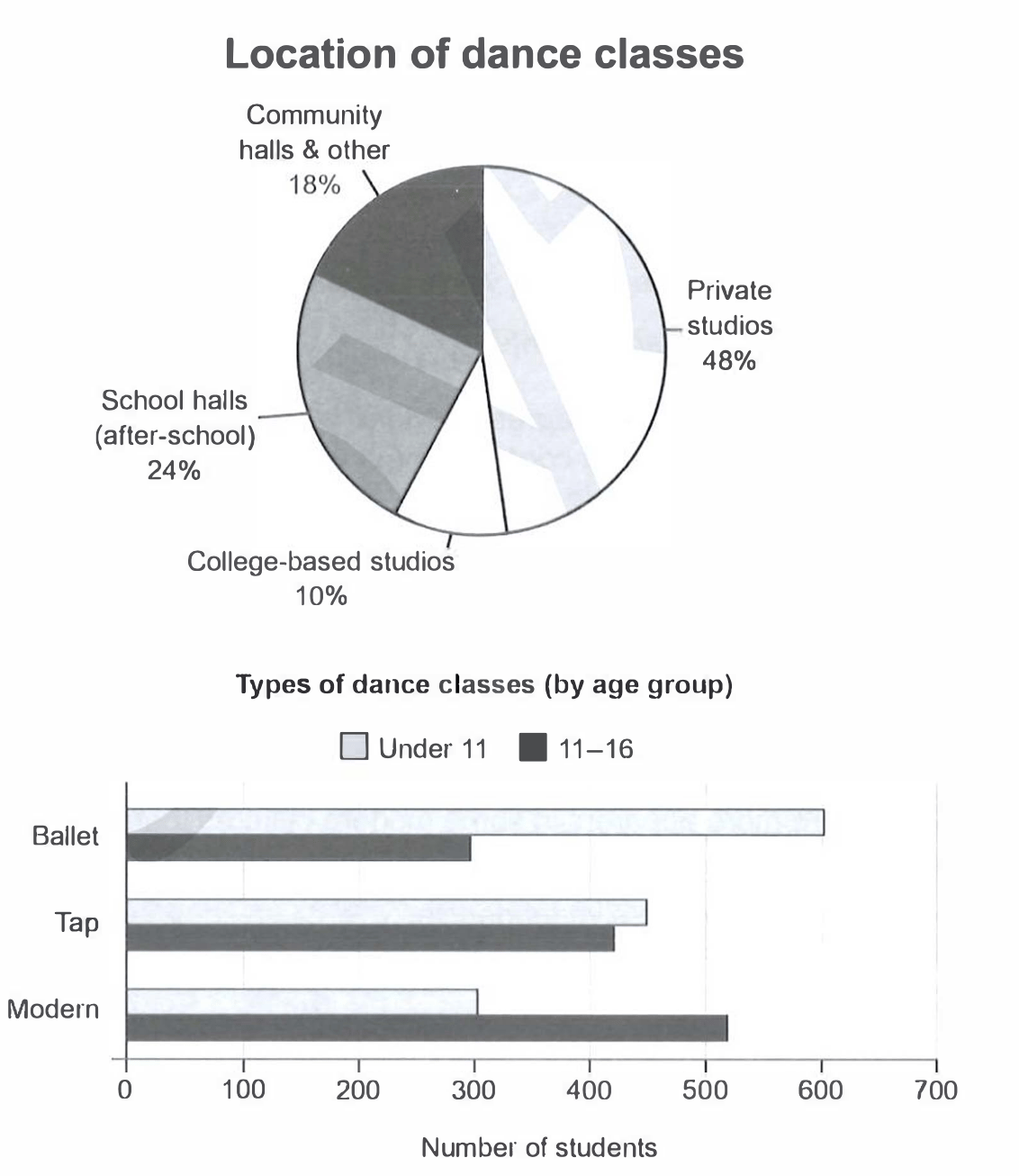
The charts below give information on the location and types of dance classes young people in a town in Australia are currently attending.
Summarise the information by selecting and reporting the main features, and make comparisons where relevant.
Student answer (Band 6.0)
The chart provides data of different locations and types of dances classes that young individuals in a town in australia are presently attending.
Overall, Most of the dances classes held in the private studios almost doubled of the school halls .In contrast majority of the inviduals which are under 11 shows highest intrest in the ballest classes and those who are from 11-16 years old shows great presence in the modern. Least classes are attended in the communuity halls&others and college based studios.On the other hand tap represents a minor difference of attendance between both indiciduals of given ages.
As we can see most of the dance classes are arranged in the private studios its ranges almost (48%) which is almost double of the school halls (24%).18% of classes are programmed in community halls and fewest classes are located in college based studios it is only 10%.
Moreover, under 11 youngsters shows the highest attendance in a ballet dance classes.600 of youth attend this class makes its ranking at first.On the other hand only 300 of 11-16 youngsters attend this class. Modern is the most favourite class of 11-16 individuals almost 500 of them takes part in this class and 300 of under 11 are recorded in this class. Tap is the class in which no bigger difference is noted nearly 450 of under 11 shows their interest and 11-16 group almost at 410.
AI examiner evaluation
| Criterion | Band |
|---|---|
| Task Achievement / Task Response | 7.0 |
| Coherence and Cohesion | 6.5 |
| Lexical Resource | 5.5 |
| Grammatical Range and Accuracy | 5.5 |
| Overall | 6.0 |
Task Achievement / Task Response: Band 7.0
You cover both charts and identify the main contrasts: private studios account for the largest share of locations, while college-based studios are the smallest; ballet is most popular among under-11s, whereas modern leads for the older group. The comparisons are generally supported with relevant figures, including 48% versus 24% and 600 versus 300 for ballet. Your overview also notes the relatively small difference in tap attendance. A few details are imprecise: the older group’s modern figure is about 520 rather than “almost 500,” and tap attendance is about 420 rather than 410. The statement that the youngest group has the “highest interest” in ballet would be clearer as a comparison of its figures across dance types. More precise reporting and a sharper overview would strengthen an otherwise well-covered response.
Coherence and Cohesion: Band 6.5
The response has a clear overall structure: an introduction, an overview, and separate paragraphs describing location and dance-type data. This makes the two charts easy to follow, and linking phrases such as “Overall,” “Moreover,” and “On the other hand” help signal comparisons. The overview also brings together the main patterns rather than simply listing figures. However, some connections are awkward or repetitive, particularly the repeated use of “On the other hand,” and the overview’s shift from location to age-group preferences could be more smoothly organised. A few references, such as “this class” and “those who,” are less precise than naming the age group or dance type. More controlled transitions and clearer referencing would make the progression more fluent.
Lexical Resource: Band 5.5
You use a relevant range of vocabulary for describing charts, including “attendance,” “represents,” “difference,” “arranged,” and “recorded.” These choices show an attempt to vary language beyond basic repetition. However, noticeable spelling and word-choice problems reduce precision: “dances classes,” “ballest,” “intrest,” “inviduals,” and “communuity” are misspelled, while phrases such as “great presence” and “no bigger difference” are not natural in this context. “Programmed” is also an unsuitable choice for classes being held at a location. These errors do not prevent the reader from understanding the main comparisons, but they make the description less fluent and sometimes obscure the intended meaning. Prioritise accurate chart collocations and careful spelling.
Grammatical Range and Accuracy: Band 5.5
You attempt both simple and more developed sentence forms, including comparisons with “whereas” and “On the other hand,” and the overall meaning is usually recoverable. However, errors in agreement, articles, and sentence construction occur repeatedly. For example, “Most of the dances classes held” lacks a clear verb, “youngsters shows” should use a plural verb, and “600 of youth attend this class makes its ranking at first” joins ideas in an ungrammatical way. There are also problems with sentence boundaries and punctuation, such as the missing space after “halls.” and the run-on structure in the overview. These patterns limit accuracy and make some sentences difficult to process. Build reliable subject–verb agreement and use shorter, correctly punctuated sentences before adding complexity.
See this exact question answered at other band scores. The same prompt compared across bands.
Browse more IELTS Writing model answers or get your own writing scored by the same AI examiner.