Band 6.5 IELTS Writing Task 1 Model Answer
Overall Band Score: 6.5 · Cambridge IELTS 19 · 2026-11-20
IELTS Writing Task 1 question
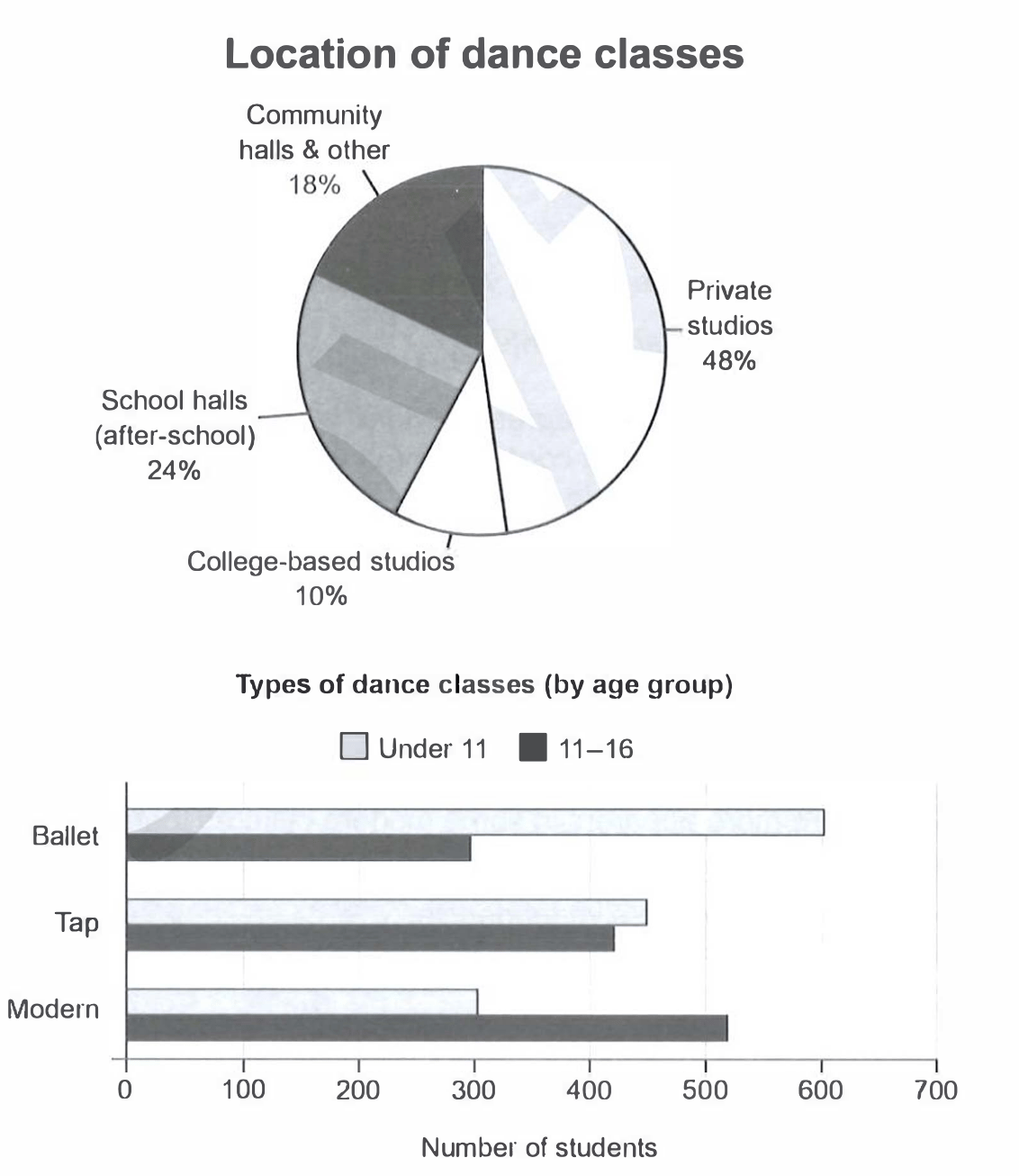
The charts below give information on the location and types of dance classes young people in a town in Australia are currently attending.
Summarise the information by selecting and reporting the main features, and make comparisons where relevant.
Student answer (Band 6.5)
The pie chart shows the location where dance classses are held and the propotions of classes in each category, whereas the bar char illustrates the number of students in three different types of dance classes (ballet, tap and modern), across two age groups: those under 11 and those aged 11–16.
Overall, private studios are where most of dance classes are held, while college-based studios represent the smallest propotion. Regarding the types of dance classes, ballet is the most popular type of dance among younger children. In constrast, teenagers prefer modern dance.
Private studios make up 48% of all dance classes, which is twice the figure for shool halls (24%). Community halls and other categories account for only 18%. Finally, college-based studios rank as the lowest proportion among all the four locations with only 10% of class held on them.
Younger children prefer ballet where 600 students are currently attending it. After it, tap is the second common danse type among children with about 450 students. At the end, Modern dance is the least popular type with only 300 children. Concerning the teenagers between 11 and 16 years old, modern dance is the most common type that has approximatively 520 students, followed by tap which is attended by roughly 420 students, and finally ballet rank as the least favourite type amoung teenagers with just 300 students attending it.
AI examiner evaluation
| Criterion | Band |
|---|---|
| Task Achievement / Task Response | 7.5 |
| Coherence and Cohesion | 6.5 |
| Lexical Resource | 6.0 |
| Grammatical Range and Accuracy | 6.0 |
| Overall | 6.5 |
Task Achievement / Task Response: Band 7.5
The response selects and reports the main features of both charts, with a clear overview contrasting the largest and smallest class locations and the leading dance styles for each age group. The figures are generally accurate: for example, private studios are given as 48%, and the student counts for ballet, tap and modern match the chart. Comparisons such as private studios being twice the share of school halls also help support the description. This is a well-focused account, though the overview could be more complete by noting the broader age-group contrast: younger students favour ballet, while the older group favours modern, and tap is relatively similar in popularity across the two groups. More precise phrasing about what the location percentages represent would also strengthen the report.
Coherence and Cohesion: Band 6.5
The response has a clear overall structure: an introduction, an overview, a paragraph on locations and a paragraph comparing dance types by age. This makes the information easy to follow, and sequencing terms such as “Overall,” “Regarding,” “followed by” and “finally” guide the reader through the comparisons. The progression within each chart is mostly logical. However, some linking is mechanical or imprecise: “After it” and “At the end” are less natural ways to introduce rankings, while “Concerning the teenagers” creates a somewhat abrupt transition. The overview also repeats the main contrast without connecting it to the detailed comparisons. More varied, precise referencing and smoother links between the age groups would make cohesion more flexible.
Lexical Resource: Band 6.0
There is adequate vocabulary for describing charts, including “account for,” “rank as,” “most common” and “least popular,” and the writer uses relevant terms for locations and dance styles. Meaning remains clear throughout. However, several spelling errors and awkward word choices limit precision: “classses,” “propotions,” “shool,” “danse” and “amoung” should be corrected, while “the second common danse type” and “the lowest proportion among all the four locations” are not natural collocations. “Classes held” is also less precise than “classes take place” when describing locations. Greater control of spelling and more idiomatic comparative language would make the vocabulary more accurate and flexible.
Grammatical Range and Accuracy: Band 6.0
The response uses a mix of simple and complex sentence forms, including a clear contrast structure in “whereas the bar chart illustrates…” and a relative clause in “which is twice the figure for school halls.” Most sentences communicate the intended comparisons, and errors rarely obstruct understanding. Some grammatical inaccuracies remain, however. In “most of dance classes,” the article is missing; “only 10% of class held on them” has an unclear and incomplete construction; and “ballet rank as the least favourite type” does not maintain correct subject–verb agreement. The long final sentence also combines several rankings in a way that would benefit from more controlled punctuation and sentence boundaries. More consistent articles, agreement and clause construction would improve accuracy.
See this exact question answered at other band scores. The same prompt compared across bands.
Browse more IELTS Writing model answers or get your own writing scored by the same AI examiner.