Band 5.5 IELTS Writing Task 1 Model Answer
Overall Band Score: 5.5 · Cambridge IELTS 19 · 2026-11-21
IELTS Writing Task 1 question
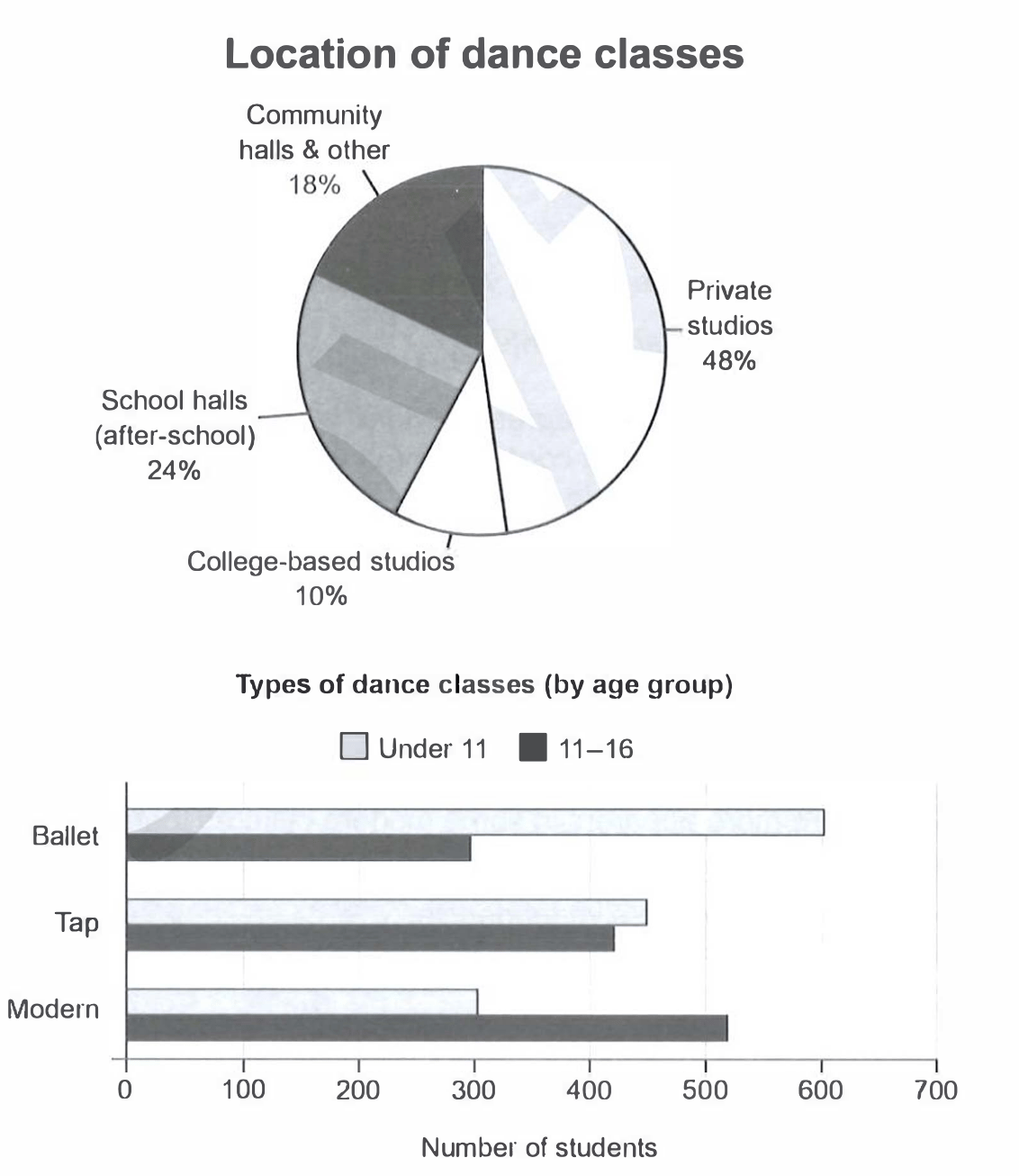
The charts below give information on the location and types of dance classes young people in a town in Australia are currently attending.
Summarise the information by selecting and reporting the main features, and make comparisons where relevant.
Student answer (Band 5.5)
The provided pie chart and bar graph depicts the number of people who attending the dance classes according to the location and type of dance classes by age in Australia.
There are four different location for classes such as private studio, community halls & other, school halls and college-based studios. There are 48% people joing the classes in private-studios and 24% are in school halls after-school time. some peolpe are attending the classes in community-halls whic are 18% and only 10% are in college-based studios.
There are 3 various type of classes by age group. First of all, the class name is ballet in which number of students under 11 are almost 600 and number of students from 11 to 16 years old are 300. In Tap class, the number of learners of both types have minor differance which are in between 400 to 500. The 3rd type of class anme is Modern, in this class, the number of students of 11 to 16 years old are more than 500 and under 11 years old students are 300.
AI examiner evaluation
| Criterion | Band |
|---|---|
| Task Achievement / Task Response | 5.0 |
| Coherence and Cohesion | 6.5 |
| Lexical Resource | 5.5 |
| Grammatical Range and Accuracy | 5.0 |
| Overall | 5.5 |
Task Achievement / Task Response: Band 5.0
You report the main categories in both charts and give several relevant figures, including the 48% share for private studios and the age-group figures for ballet and modern. However, the response is mainly a list of details rather than a summary of the most important patterns. It does not provide a clear overview, such as private studios being the most common location and college-based studios the least common, or the contrast between younger students favouring ballet and older students favouring modern. The tap comparison is also vague: the figures are about 450 and 420, so the under-11 group is slightly higher. Select these key comparisons and state them clearly to make the task coverage more complete.
Coherence and Cohesion: Band 6.5
The response has a coherent overall arrangement: it introduces the charts, discusses locations in one paragraph, and then moves to dance types. Sequencing phrases such as “First of all” and “In Tap class” help the reader follow the categories, and the information is generally presented in a sensible order. To strengthen progression further, add a distinct overview after the introduction and organise the body around the main comparisons rather than treating each category as a separate item. Some linking is mechanical, particularly “There are 3 various type” and “The 3rd type,” while the final paragraph would benefit from clearer links between the two age groups and their contrasting preferences.
Lexical Resource: Band 5.5
You use relevant chart vocabulary, including “percentage,” “number of students,” “age group,” and the names of the dance styles and venues. This gives you enough language to communicate the basic information, but the range is limited and several word-choice, collocation, and spelling errors make the report less precise. For example, “people joining the classes” is less suitable than describing the proportion of classes or students, and “minor difference” does not clearly express the small gap between the tap figures. There are also misspellings such as “peolpe,” “whic,” and “differance.” Use accurate comparison language such as “accounted for,” “slightly higher,” and “whereas” to report the data more naturally.
Grammatical Range and Accuracy: Band 5.0
You attempt both simple sentences and longer structures, including “In Tap class, the number of learners of both types have minor differance,” but control is inconsistent. Errors occur in agreement and verb forms: “the pie chart and bar graph depicts” should use a plural verb, and “people who attending” needs a finite verb form. Other examples include “There are four different location” and “the number of students … are,” where number agreement is faulty. Sentence structures are mostly basic, and attempts to combine ideas do not consistently produce accurate clauses. Practise subject–verb agreement, articles and plural forms, then build comparisons with controlled clauses such as “while” or “whereas.”
See this exact question answered at other band scores. The same prompt compared across bands.
Browse more IELTS Writing model answers or get your own writing scored by the same AI examiner.