Band 6.0 IELTS Writing Task 1 Model Answer
Overall Band Score: 6.0 · Cambridge IELTS 19 · 2026-11-23
IELTS Writing Task 1 question
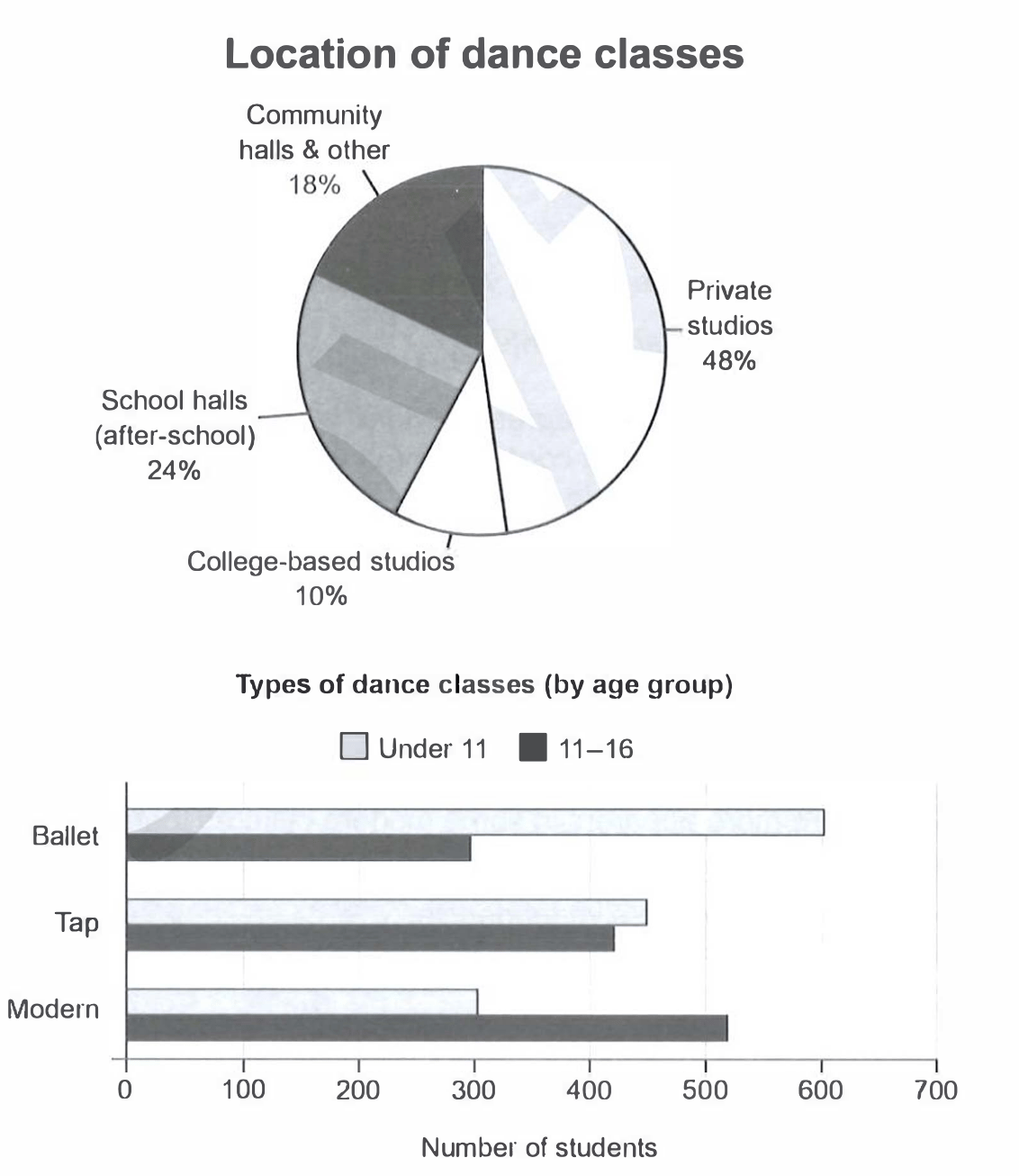
The charts below give information on the location and types of dance classes young people in a town in Australia are currently attending.
Summarise the information by selecting and reporting the main features, and make comparisons where relevant.
Student answer (Band 6.0)
The pie chart describes the location of dance classes and the graph illustrates the various dance classes young people in a city in Australia are taking on.
Firstly, location of dance classes is divided into four major groups where private studios has the majority with 48% whereas college-based studios is least which accounts for 10% on the other hand, school halls (after-school) and community halls & other is almost 24% and 18% respectively.
Additionly, types of dance classes has three types which are ballet, tap and modern where ballet has around 600 students which are under the age of 11 and 300 stundets which are age group from 11-16. Adding on, tap has almost 450 under 11 age group students and 400 11-16 age group students and also modern has more number of 11-16 age group students which are almost 500 and only 300 students under 11 age group.
To conclude, the private studios have majority of students coming in whereas under 11 age group prefer ballet dance and age group from 11-16 prefers modern dance classes.
AI examiner evaluation
| Criterion | Band |
|---|---|
| Task Achievement / Task Response | 6.5 |
| Coherence and Cohesion | 6.5 |
| Lexical Resource | 5.5 |
| Grammatical Range and Accuracy | 5.5 |
| Overall | 6.0 |
Task Achievement / Task Response: Band 6.5
You cover both charts and identify the main location pattern: private studios are the largest share at 48%, while college-based studios are the smallest at 10%. You also compare the age groups across ballet, tap and modern, and your concluding observation that younger students favour ballet while older students favour modern is supported by the figures. Some details are less precise: tap for the 11–16 group is about 420, rather than 400, and the overview would be stronger if it explicitly highlighted the contrasting age-group preferences as the key pattern. The phrase “majority of students coming in” also overstates what the pie chart shows, which is the proportion of class locations, not student numbers. Overall, the task is addressed, though some features are reported more fully and accurately than others.
Coherence and Cohesion: Band 6.5
The response has a clear overall sequence: it introduces the charts, discusses locations, compares dance types, and ends with a summary. This makes the information easy to follow at a general level. However, progression within paragraphs is sometimes mechanical, particularly through repeated transitions such as “Firstly,” “Adding on,” and “To conclude.” The second paragraph combines several figures in a long sentence, so the comparisons are less easy to scan. Some linking is also awkward: “on the other hand” does not clearly connect the smallest share to the other two categories. Grouping the age-group comparisons more deliberately and using simpler, more precise links would make cohesion more flexible and the overview more prominent.
Lexical Resource: Band 5.5
You use relevant chart vocabulary, including “accounts for,” “age group,” “students,” and “majority,” and the reader can generally understand the comparisons. However, the range is limited and several choices are imprecise or unnatural for describing data. For example, “students coming in” is vague, while “has more number of” is an awkward way to compare quantities. “Various dance classes … are taking on” is also an unnatural collocation. There are noticeable spelling errors, including “Additionly” and “stundets,” and repeated use of “almost” and “around” reduces precision. Aim for accurate reporting verbs and comparison phrases, and check spelling carefully; this would make the vocabulary more controlled and appropriate to an academic summary.
Grammatical Range and Accuracy: Band 5.5
You attempt both simple and more extended sentence forms, and the main comparisons are usually understandable. However, some errors in agreement, articles and sentence construction remain. For example, “private studios has” and “college-based studios is” use singular verbs with plural subjects; “location of dance classes” needs an article in this context. The sentence beginning “Firstly” runs several comparisons together, with “whereas” and “on the other hand” not joined cleanly. In “students which are under the age of 11,” the relative clause is not formed appropriately for people. These issues do not usually prevent understanding, but they reduce accuracy. Use shorter sentences for separate comparisons and check subject–verb agreement and clause structure.
See this exact question answered at other band scores. The same prompt compared across bands.
Browse more IELTS Writing model answers or get your own writing scored by the same AI examiner.