Band 6.0 IELTS Writing Task 1 Model Answer
Overall Band Score: 6.0 · Cambridge IELTS 19 · 2026-11-23
IELTS Writing Task 1 question
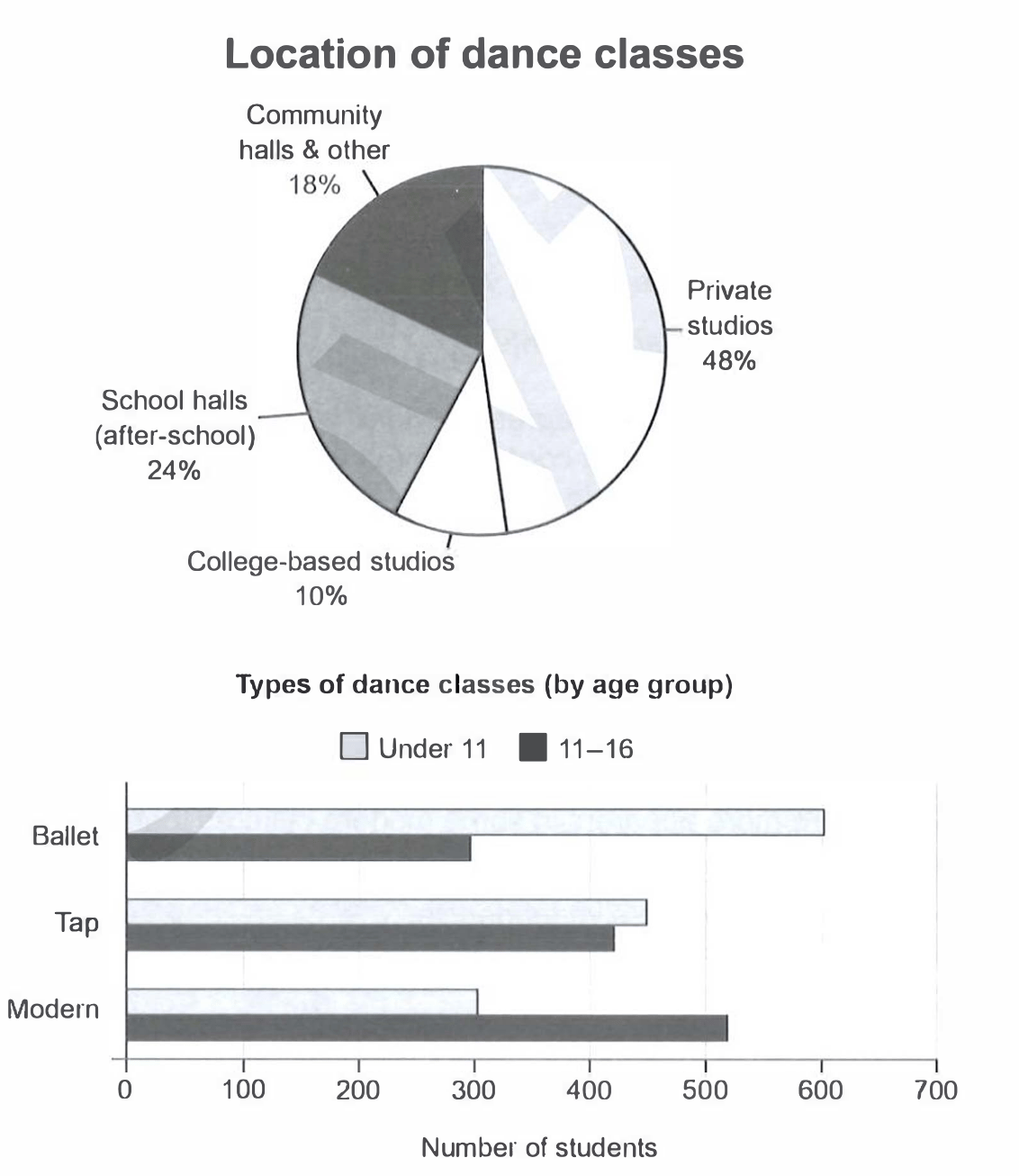
The charts below give information on the location and types of dance classes young people in a town in Australia are currently attending.
Summarise the information by selecting and reporting the main features, and make comparisons where relevant.
Student answer (Band 6.0)
The pie chart represents the four locations in a town in Australia where dance classes are held. The bar graph illustrates the number of young people from two age groups taking part in three different types of dance.
Overall, private studios, community halls, school halls, and college-based studios are used for the dance classes. Among these, the maximum number of classes take place in private studios. Three types of dance ballet, tap, and modern dance, are practised by the children in two age groups, i.e., under 11s and 11-16.
By looking into detail, the pie chart depicts that college-based studios are least used for dance classes. However, 24% of classes are scheduled after school in school halls. 18% of them also take place in community halls and other venues. Private studios host the remaining 48% of dance classes.
In terms of types of dance, ballet is most popular among the young under 11, resulting in 600 students. Tap comes the second and modern is having lowest number of students.
Whereas, modern in more famous among age group 11-16, so more then 500 student enrooled in this class. The tap comes second and ballest at the last.
AI examiner evaluation
| Criterion | Band |
|---|---|
| Task Achievement / Task Response | 6.5 |
| Coherence and Cohesion | 6.5 |
| Lexical Resource | 6.0 |
| Grammatical Range and Accuracy | 5.5 |
| Overall | 6.0 |
Task Achievement / Task Response: Band 6.5
You cover both charts and give a clear overview, identifying private studios as the leading location and describing the main age-related preferences. Several figures are accurately reported, including 48%, 24% and 18%, and the under-11 ballet figure of 600. The comparisons for the dance types are also broadly correct. However, some details are incomplete: you do not give the college-based share of 10%, and you omit figures for most dance categories, making the comparisons less fully supported. The statement that the “maximum number of classes” take place in private studios is also imprecise, since the chart shows the proportion of locations, not a count of classes. More precise reporting and fuller numerical comparisons would strengthen the response.
Coherence and Cohesion: Band 6.5
The response has a coherent overall structure: an introduction, an overview, and separate paragraphs for location and dance-type details. This makes the two charts easy to follow, and transitions such as “In terms of types of dance” help signal a change in focus. The progression is generally logical, but some linking is mechanical or unclear. For example, “Whereas” begins a sentence without a clear contrasting clause, and “However” does not express a strong contrast between the least-used venue and the school-hall figure. The final paragraph also presents preferences without a clear comparison of the two age groups. Use more precise links and organise the dance figures in parallel comparisons to make the progression smoother.
Lexical Resource: Band 6.0
You use an adequate range of task-related vocabulary, including “locations,” “age groups,” “practised,” “least used,” and “most popular.” These choices make the main information understandable, and you attempt some variation rather than repeating the chart labels throughout. However, several word choices and collocations are imprecise, such as “maximum number of classes take place,” “modern in more famous,” and “the tap comes second.” There are also spelling errors, including “enrooled” and “ballest,” which reduce accuracy. Choose standard chart-reporting phrases such as “accounted for,” “was more popular,” and “ranked second,” and check spelling carefully. This would make the vocabulary more precise and natural.
Grammatical Range and Accuracy: Band 5.5
You use a mix of simple and more developed sentence forms, including introductory clauses such as “By looking into detail” and comparisons between the age groups. Most of the meaning remains clear, but some grammatical errors recur. For example, “modern is having lowest number” has an awkward verb form and lacks an article, while “more then 500 student” has errors in comparison, spelling-related form, and number agreement. “Whereas, modern…” is also an incomplete or poorly connected construction, and “ballet at the last” lacks a clear grammatical structure. Aim for complete sentences with consistent present-tense verbs, correct articles and plural forms, and accurate punctuation around contrast clauses.
See this exact question answered at other band scores. The same prompt compared across bands.
Browse more IELTS Writing model answers or get your own writing scored by the same AI examiner.