Band 6.5 IELTS Writing Task 1 Model Answer
Overall Band Score: 6.5 · Cambridge IELTS 19 · 2026-11-24
IELTS Writing Task 1 question
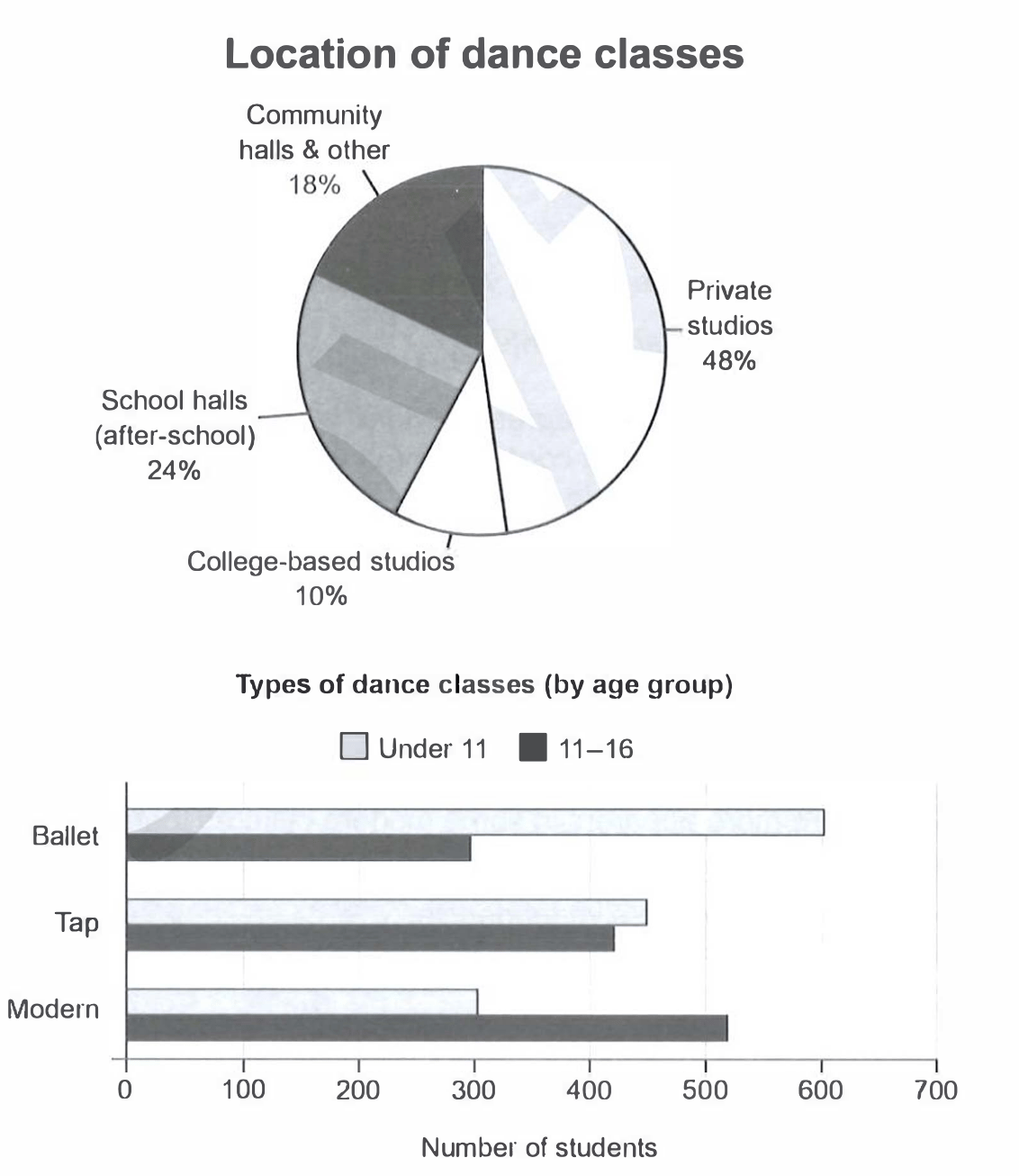
The charts below give information on the location and types of dance classes young people in a town in Australia are currently attending.
Summarise the information by selecting and reporting the main features, and make comparisons where relevant.
Student answer (Band 6.5)
The pie chart compares four locations- private studios, school halls, college-based studios and community halls & other- while the horizontal bar chart compares three types of dance classes young people are currently attending in a town in Australia.
Overall, the main location of dance classes is private studios, whereas the least location of dance classes is collage-based studios. Ballet dance classes are favoured for under 11 year, while modren dance classes for age group between 11 and 16.
Almost half of the dance classes for young people are held in private studios. Schol halls which are used after school classes are next at 24%. The community halls and other halls also are held a considerable number of dance classes, which is about 18% and the least share of dance classes are located in collage-based studios.
Ballet is the most favourite type of dance classes for under 11 years which is attending almost 600 students , whereas modern dance classes is attending mostly by 11-16 age groub in about 550 students. Tab dance classed is attend almost same number for both group with at about 450 students.
AI examiner evaluation
| Criterion | Band |
|---|---|
| Task Achievement / Task Response | 7.0 |
| Coherence and Cohesion | 7.0 |
| Lexical Resource | 5.5 |
| Grammatical Range and Accuracy | 5.5 |
| Overall | 6.5 |
Task Achievement / Task Response: Band 7.0
You identify the main features of both charts and provide a clear overview: private studios are the largest location category, college-based studios the smallest, and the leading dance style differs by age group. The location figures are reported accurately, and your comparisons of ballet and modern are broadly grounded in the chart. However, the account of the class types is incomplete: you omit the under-11 modern figure and the 11–16 ballet figure, and the tap comparison is described as “almost same” despite a noticeable difference (about 450 versus 420). The modern figure for older students is also closer to 520 than 550. Including these comparisons more precisely would make the coverage more fully supported.
Coherence and Cohesion: Band 7.0
The response has a clear four-paragraph structure: an introduction, an overview, and separate detail paragraphs for the two charts. The progression is easy to follow, and linking expressions such as “Overall,” “whereas,” and “which” help connect comparisons. The location paragraph moves logically from the largest share to the smaller categories. In the final paragraph, however, the figures for the age groups and dance styles are compressed together, and the tap comparison would be clearer if each group’s value were stated explicitly. Some phrasing also makes relationships less smooth, such as “which is about 18%.” More consistent parallel phrasing and clearer links between each figure and its category would strengthen the flow.
Lexical Resource: Band 5.5
You use relevant chart vocabulary, including “compares,” “favoured,” “share,” and “held,” and you make an effort to vary wording rather than simply repeat the chart labels. However, several noticeable spelling and word-choice problems limit precision: “collage-based,” “modren,” “Schol,” “groub,” and “Tab” obscure otherwise clear reporting. Some collocations are also unnatural, such as “the least location” and “dance classes is attending mostly by.” Use standard forms such as “smallest proportion” and “most popular,” and check spelling carefully. More precise terms for describing proportions and student numbers would help you report the data with greater control.
Grammatical Range and Accuracy: Band 5.5
You attempt a mix of simple and more complex sentences, including comparisons with “whereas” and clauses introduced by “which.” The overall meaning is generally recoverable, but errors recur in sentence structure and agreement. For example, “Ballet dance classes are favoured for under 11 year” has an incomplete age-group expression, while “modern dance classes is attending mostly by” has incorrect agreement and a faulty passive construction. “Tab dance classed is attend” also combines incorrect verb forms, and the final sentence lacks a clear grammatical link between the figures. Aim for accurate patterns such as “about 600 students attend ballet classes” and “modern is the most popular style among 11–16-year-olds.”
See this exact question answered at other band scores. The same prompt compared across bands.
Browse more IELTS Writing model answers or get your own writing scored by the same AI examiner.