Band 6.0 IELTS Writing Task 1 Model Answer
Overall Band Score: 6.0 · Cambridge IELTS 19 · 2026-11-24
IELTS Writing Task 1 question
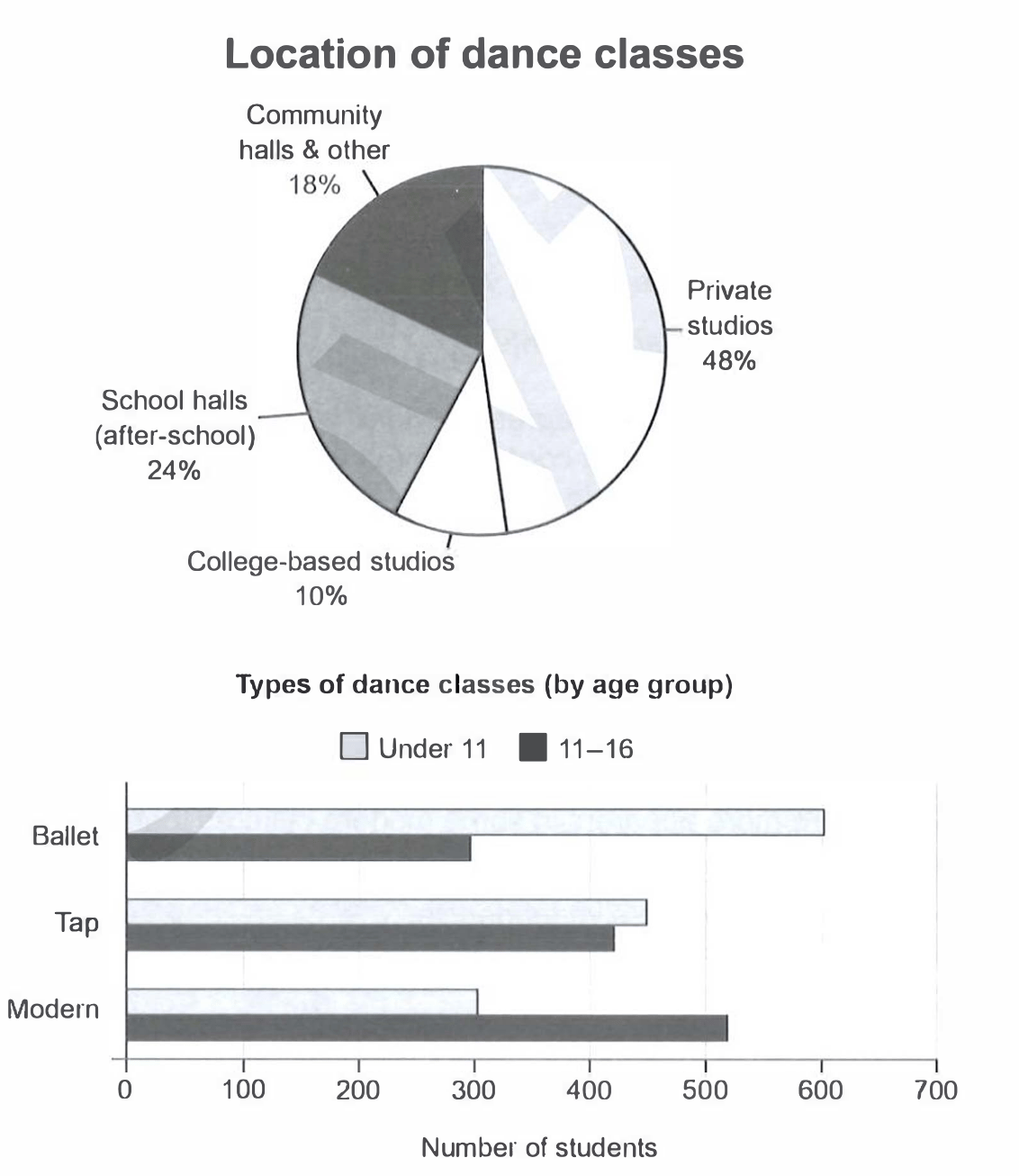
The charts below give information on the location and types of dance classes young people in a town in Australia are currently attending.
Summarise the information by selecting and reporting the main features, and make comparisons where relevant.
Student answer (Band 6.0)
The pie chart and the bar chart compare the data on the location and type of dance classes for youth in a town in Australia are attending now.
Overall, privete studios are the common places which youth prefare to attend, while college-base studios are the less common. In terms of types of dance classes, young people under 11 years old like ballet dance, whilst modern dance is prefered between young people (11-16) years old.
Private studios are a high shares by 48%, college- based studios are a less shares by 10% which is around the half of community halls & other, at 18%.
The young people group under 11 years old who are attending modern dance are less than who are attending ballet dance by 300 students. Youth (11-16) years old practice modern dance with number more than 500 students, whereas ballet dance is the less common type by 300 students.
AI examiner evaluation
| Criterion | Band |
|---|---|
| Task Achievement / Task Response | 6.0 |
| Coherence and Cohesion | 6.0 |
| Lexical Resource | 5.5 |
| Grammatical Range and Accuracy | 5.5 |
| Overall | 6.0 |
Task Achievement / Task Response: Band 6.0
You identify the two chart topics and give a relevant overview: private studios are the most common location, college-based studios the least common, and preferences differ by age group. Several figures are also reported accurately, including the 48% and 10% location shares and the under-11 gap of 300 students between ballet and modern. However, the overview is not fully precise: modern is the most popular style among 11–16-year-olds, but tap (about 420) is also more popular than ballet (about 300), so ballet is not simply the “less common type” without specifying the comparison. The response also omits useful comparisons, such as the under-11 ballet figure and the older group’s tap figure. Select and compare the main data more fully to make the report clearer and better supported.
Coherence and Cohesion: Band 6.0
The response has a clear overall arrangement: an introduction, an overview, and separate paragraphs for location and class-type details. This makes the main topics easy to follow, and linking expressions such as “Overall,” “while,” and “whereas” help signal comparisons. However, the final paragraph combines several age-group comparisons without consistently presenting the figures in a balanced way, and “the less common type” is unclear because it does not specify whether this refers to the older group or both groups. Some phrasing also makes relationships harder to follow, such as “less than who are attending ballet dance.” Organise the class data by age group or by dance style, and use clear references and parallel comparisons to strengthen progression.
Lexical Resource: Band 5.5
You use relevant task vocabulary, including “pie chart,” “bar chart,” “private studios,” “community halls,” and “students,” and you attempt comparison language such as “common,” “less common,” and “whereas.” This gives you enough vocabulary to communicate the main points, but several word-choice, collocation, and spelling problems reduce precision. For example, “high shares” and “less shares” are not natural ways to describe proportions; “the most common location” and “a smaller share” would be clearer. There are also spelling errors in “privete,” “prefare,” and “prefered,” and “college-base” is not the correct form. Aim for accurate chart-reporting collocations and check spelling, especially in repeated key terms.
Grammatical Range and Accuracy: Band 5.5
You use a mixture of simple statements and more complex comparisons, including “while,” “whilst,” and “whereas,” and the overall meaning is generally understandable. Some grammatical errors remain, particularly in sentence construction and comparison patterns. The introduction’s phrase “the type of dance classes … are attending now” does not form a clear grammatical relationship between the charts and the young people. In “the young people group … who are attending modern dance are less than who are attending ballet,” the comparison lacks a clear noun phrase after “less than.” The sentence about the 11–16 group also needs a clearer structure to compare student numbers. Use complete, parallel clauses—for example, “The number attending modern was lower than the number attending ballet”—and check agreement and article use.
See this exact question answered at other band scores. The same prompt compared across bands.
Browse more IELTS Writing model answers or get your own writing scored by the same AI examiner.