Band 6.0 IELTS Writing Task 1 Model Answer
Overall Band Score: 6.0 · Cambridge IELTS 19 · 2026-11-25
IELTS Writing Task 1 question
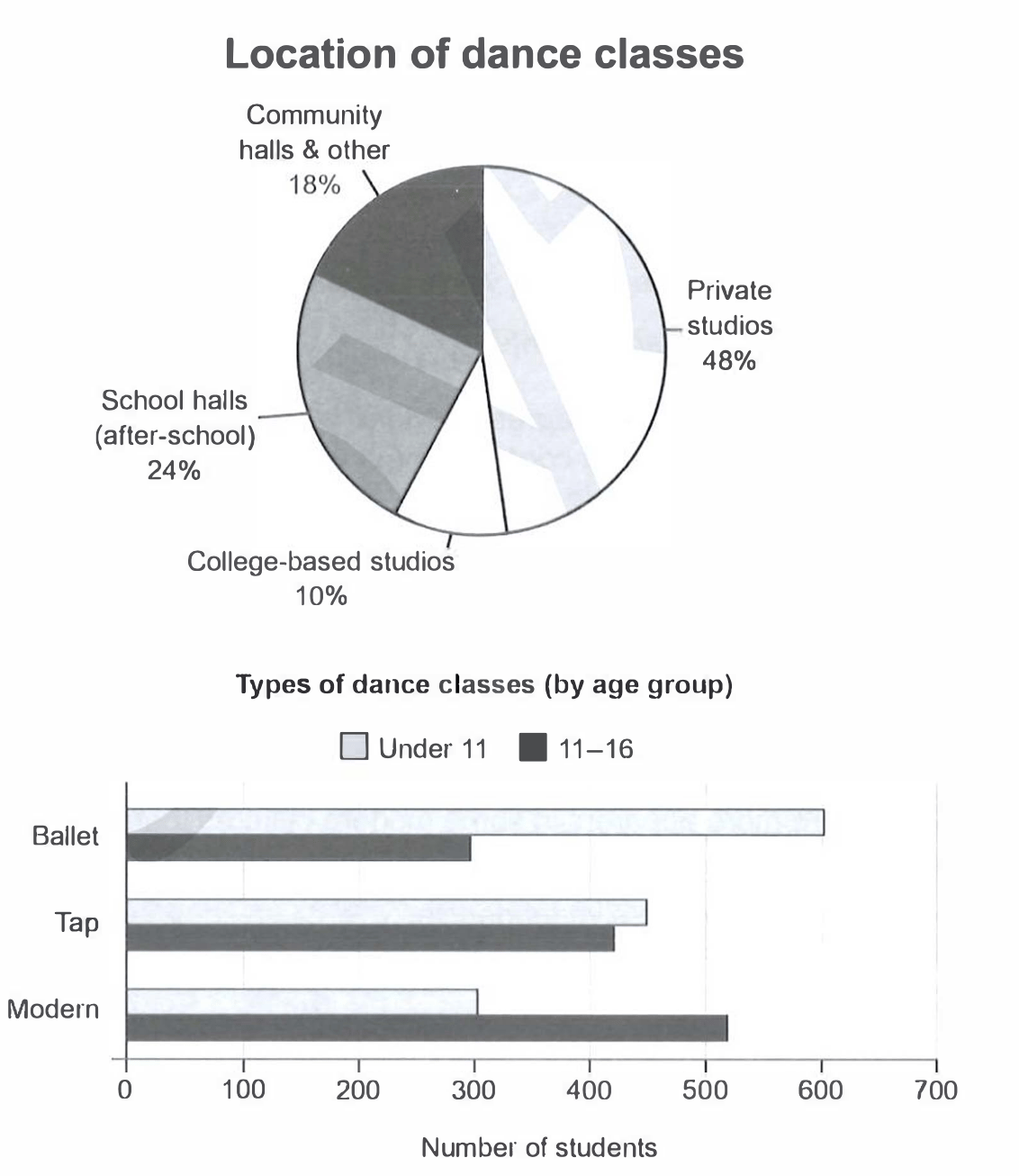
The charts below give information on the location and types of dance classes young people in a town in Australia are currently attending.
Summarise the information by selecting and reporting the main features, and make comparisons where relevant.
Student answer (Band 6.0)
The charts give data about the location and types of dance classes that young people attending in a town in Australia.
Overall, nearly half of the total are attending classes in a private studios, and just one-ten contribute in college-base studios. Furthermore, in ballet class under 11 age are two time more than 11-16 age, which reduce by almost to half in modern class.
According to the pie chart, private studios are dominant with nearly half 48% of the total attenders, followed by school halls 24 percent of people attend dance classes in school halls after-school. Community halls and other cover 18 percent, college-based studios has just 10%.
Types of dance classes contribution by age group, In ballet, more than 600 students are under 11, and 300 from 11-16. Similarly, In tap, nearly 450 students are under 11, around 430 are from 11-16 age. However, More than 500 learners are 11-16 age, and just 300 are under 11, in modern type dance class.
AI examiner evaluation
| Criterion | Band |
|---|---|
| Task Achievement / Task Response | 6.5 |
| Coherence and Cohesion | 6.5 |
| Lexical Resource | 6.0 |
| Grammatical Range and Accuracy | 5.5 |
| Overall | 6.0 |
Task Achievement / Task Response: Band 6.5
You cover both charts and report the main location proportions and all three dance styles, with relevant comparisons such as ballet attracting more under-11s and modern more 11–16-year-olds. The overview also identifies private studios as the leading venue and college-based studios as the least common. Most figures are consistent with the chart, although “more than 600” for under-11 ballet slightly overstates the approximate 600, and the overview’s claim that ballet numbers “reduce by almost to half in modern class” is unclear: it does not accurately explain the contrasting age-group pattern across styles. To strengthen the response, make the overview more precise and compare the age groups across all three styles, rather than leaving the key pattern partly implicit.
Coherence and Cohesion: Band 6.5
The response has a clear overall arrangement: an introduction, an overview, and separate discussion of the venue and class-type charts. This makes the information easy to locate, and connectors such as “Overall,” “According to,” “Similarly,” and “However” help signal relationships. However, some linking is mechanical or does not express the comparison clearly. For example, “Furthermore” introduces a point that is not smoothly connected to the first overview statement, while “Similarly” before the tap figures suggests a similarity that is not explained. The final comparison is also compressed into one sentence. Use more precise links and organise the age-group comparisons consistently, so the progression between the charts and between dance styles feels more deliberate.
Lexical Resource: Band 6.0
You use an adequate range of task-related vocabulary, including “private studios,” “community halls,” “dominant,” “followed by,” and “learners.” These choices generally make the chart information understandable, and you attempt to vary how proportions and numbers are described. Some word choices and collocations are inaccurate or awkward, however: “attending in a private studios,” “college-base studios,” “contribute in,” and “types of dance classes contribution by age group” do not sound natural. “Total attenders” is also less suitable than a clear reference to students or participants. Aim for precise reporting phrases such as “account for,” “are based in,” and “the number of students taking each class”; this would improve naturalness and accuracy without requiring more elaborate vocabulary.
Grammatical Range and Accuracy: Band 5.5
You attempt a mix of simple statements and more complex comparisons, including “However, more than 500 learners are 11–16 age, and just 300 are under 11.” The main information remains understandable, but some grammatical errors recur in articles, agreement, and sentence construction. For example, “a private studios” has an article–plural mismatch, “college-based studios has” needs plural agreement, and “under 11 age are two time more” is not a well-formed comparison. Capitalisation after commas is also inconsistent, as in “In ballet” and “However, More.” To improve, check singular and plural forms, use complete comparison patterns such as “the figure for under-11s was twice that for…,” and proofread sentence openings and punctuation.
See this exact question answered at other band scores. The same prompt compared across bands.
Browse more IELTS Writing model answers or get your own writing scored by the same AI examiner.