Band 5.5 IELTS Writing Task 1 Model Answer
Overall Band Score: 5.5 · Cambridge IELTS 19 · 2026-11-26
IELTS Writing Task 1 question
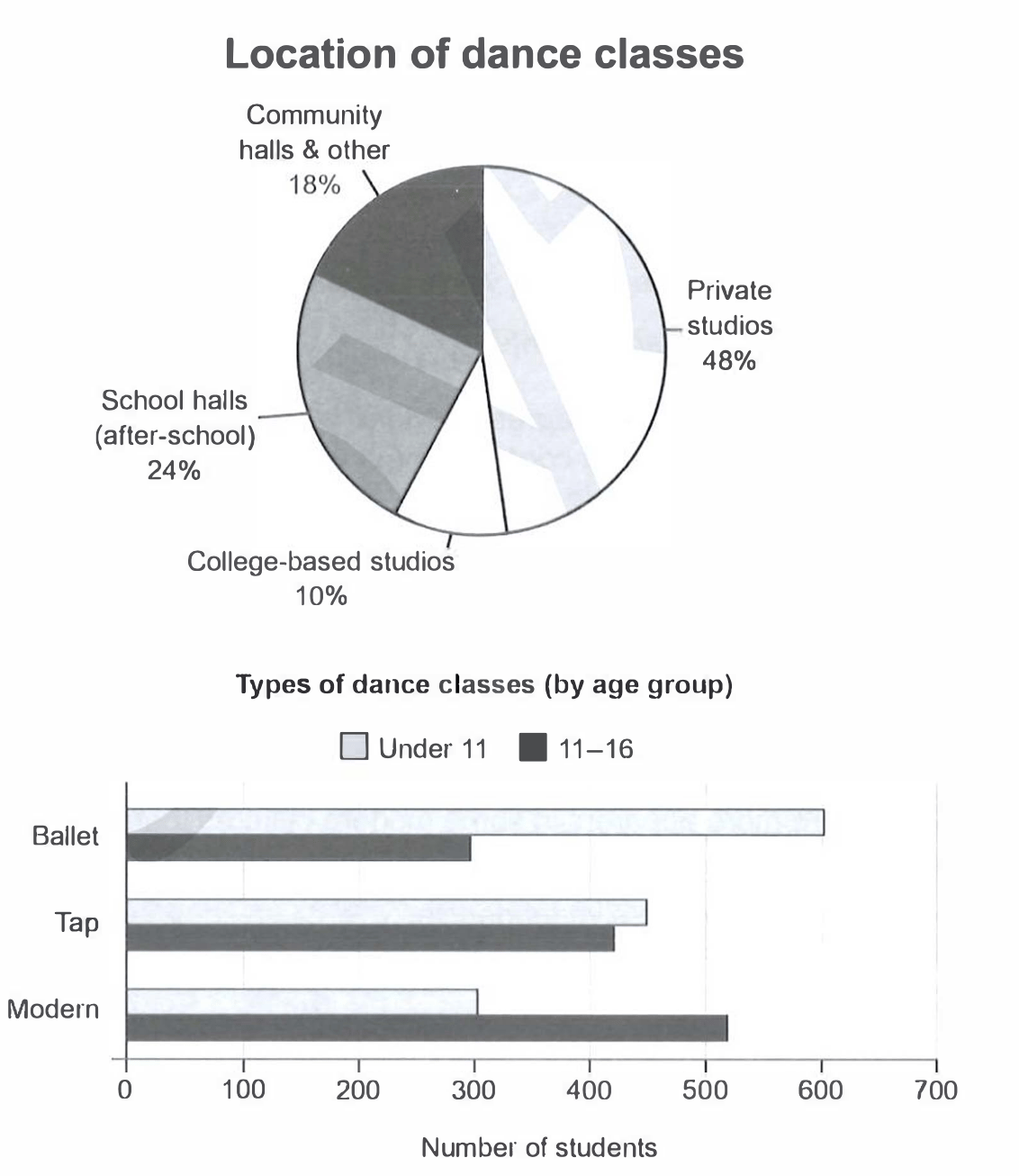
The charts below give information on the location and types of dance classes young people in a town in Australia are currently attending.
Summarise the information by selecting and reporting the main features, and make comparisons where relevant.
Student answer (Band 5.5)
The given pie and bar charts illustrate that in Austarlia the location and kinds of dance classes of youngsters are currently attending.
Overall, it can be seen that the ratio of dance classes are higher in location in private studios as comparison to collage based studios.Also students attending the ballet dance class are higher in number in contrast to modern dance class.
The location of dance classes hit the peak in private studios with ratio of 48% and collage basesd studios is at bottom with ratio of 10%.Moreover, the location of dance classes in school halls after school has ratio of 24% and community halls and other having dance classes has ratio of 18%.
Furthermore, learners under age of 11 attending ballet classes reached the top with the number of 600 and modern dance class learners under 11 are 300 in numner which is half of ballet class.Also the individuals of under age 11 are 400 in number in tap class.
AI examiner evaluation
| Criterion | Band |
|---|---|
| Task Achievement / Task Response | 5.5 |
| Coherence and Cohesion | 6.0 |
| Lexical Resource | 5.5 |
| Grammatical Range and Accuracy | 5.5 |
| Overall | 5.5 |
Task Achievement / Task Response: Band 5.5
You identify the main location pattern accurately: private studios are the largest share at 48%, while college-based studios are the smallest at 10%, and you also report the school and community figures correctly. However, the overview is incomplete and partly misleading: saying ballet attendance is higher than modern does not hold across both age groups, since modern is highest among 11–16-year-olds. The response also omits all figures for that older group and gives the under-11 tap figure as 400 rather than approximately 450. To strengthen the report, summarise the contrasting age-group patterns and include the key comparisons from both charts, while checking figures against the visual.
Coherence and Cohesion: Band 6.0
The response has a recognisable structure: an introduction, an overview, and paragraphs reporting location and dance-type details. This makes the information reasonably easy to follow, and connectors such as “Overall,” “Moreover,” and “Furthermore” signal progression. However, the final paragraph covers only the under-11 group, so the discussion of the bar chart feels unfinished, and the overview does not clearly preview the main age-group contrast. Some linking is mechanical, with repeated “Also” and “Moreover,” while the long final sentence combines several figures without a clear comparison. Organise the body around the two charts or age groups, and use linking phrases to show contrasts, such as “whereas” and “by comparison.”
Lexical Resource: Band 5.5
You use relevant vocabulary for describing charts, including “ratio,” “peak,” “location,” and “attending,” and the reader can generally understand the intended comparisons. However, several choices are imprecise or unnatural for this task: “the ratio … are higher in location” and “hit the peak” do not express the data clearly, while “collage basesd” and “numner” contain spelling errors. “Individuals” is also an awkward label for students in this context. The range is adequate to communicate basic information, but repeated use of “number” and “dance classes” limits precision. Choose standard chart language such as “proportion,” “accounted for,” and “attendance,” and proofread spelling and collocations.
Grammatical Range and Accuracy: Band 5.5
You attempt both simple and more developed sentence forms, including a relative clause in “which is half of ballet class,” and the overall meaning is usually recoverable. However, errors in agreement, articles, and sentence construction recur. For example, “the ratio … are higher” has a subject–verb agreement problem, and “the location … has ratio of 24%” needs an article before “ratio.” The opening overview sentence also joins ideas awkwardly, and missing spaces after full stops make punctuation less controlled. These issues sometimes make comparisons harder to interpret. Build accuracy with clear subject–verb patterns and complete sentences, then check articles, punctuation, and agreement during revision.
See this exact question answered at other band scores. The same prompt compared across bands.
Browse more IELTS Writing model answers or get your own writing scored by the same AI examiner.