Band 6.0 IELTS Writing Task 1 Model Answer
Overall Band Score: 6.0 · Cambridge IELTS 19 · 2026-11-26
IELTS Writing Task 1 question
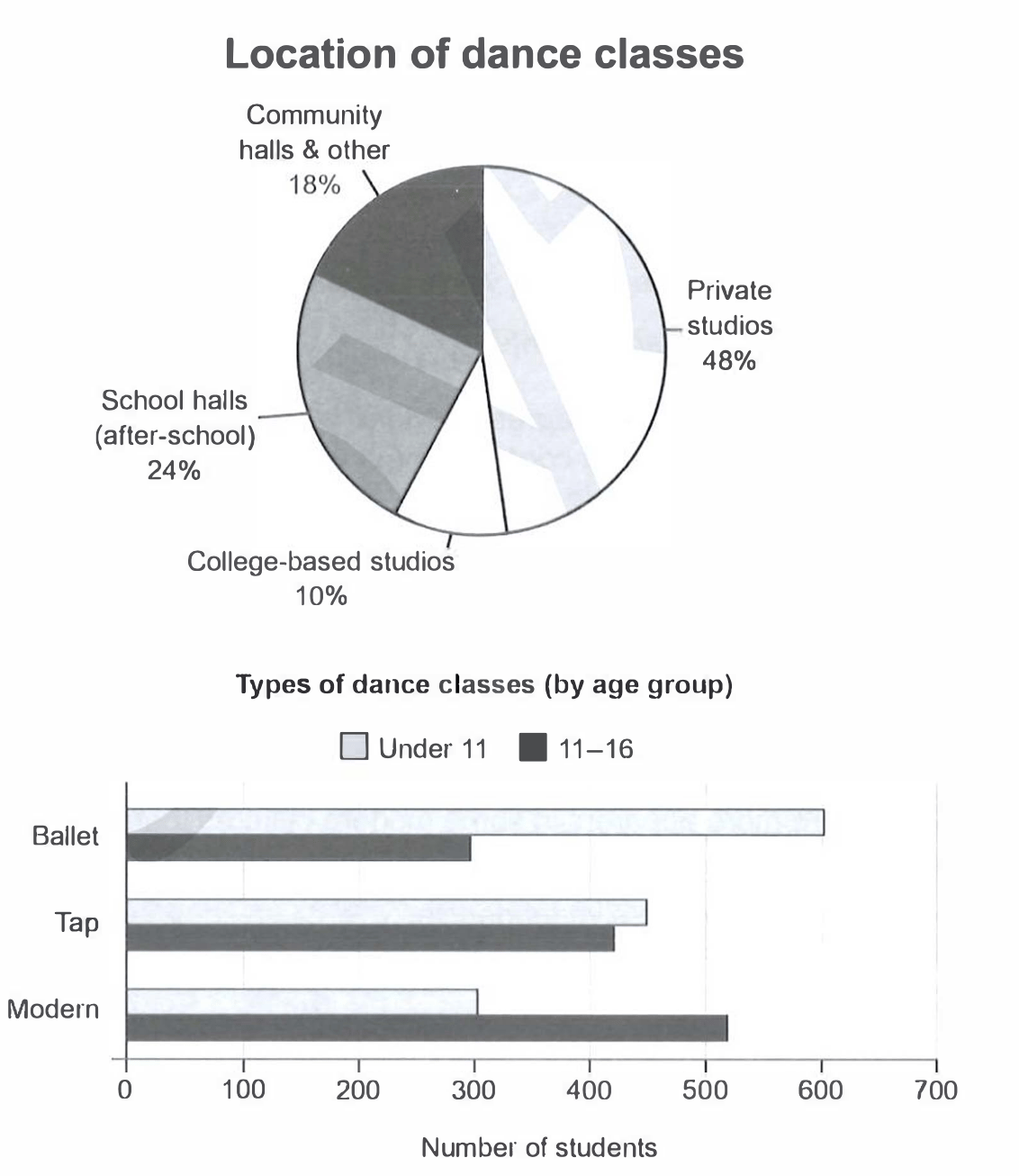
The charts below give information on the location and types of dance classes young people in a town in Australia are currently attending.
Summarise the information by selecting and reporting the main features, and make comparisons where relevant.
Student answer (Band 6.0)
The charts show the location and dance class types of young people who attend in a town of Australia.
First chart shows the comparison in percantages of attending people's dance class location, where almost half of the attendee like to go in private studios which is like 48%, then the second highest percantage belongs to school halls having 24% of total but after school. After that community halls & other places have 18% of total. Lastlty, college-based studios have the least total percatgae which is 10%, almost 5 times less than private studios.
Second chart shows that there are 3 types of dance classes which are Ballet, Top & Modern, and 2 age groups, one is under 11 and another is from 11 to 16 ages' people.
Moreover, from the chart, it is clearly shown that most Australian under 11 aged students like Ballet which has about 600 numbers in total, and have the least favourite in Modern dance which is likely 300 numbers. For, students aged 11 to 16, we see the opposite, as they love Modern dance most having around 520 total in numbers and have little interest in Ballet which has 300 numbers. However, for Tap dance, both age groups have same interest having over 450 students, though comparatively under 11 aged have slightly more in numbers.
AI examiner evaluation
| Criterion | Band |
|---|---|
| Task Achievement / Task Response | 6.0 |
| Coherence and Cohesion | 6.5 |
| Lexical Resource | 5.5 |
| Grammatical Range and Accuracy | 5.5 |
| Overall | 6.0 |
Task Achievement / Task Response: Band 6.0
You cover both charts and report the main location proportions accurately, including private studios as the largest share and college-based studios as the smallest. You also identify the key age-group contrast: under-11s favour ballet, while 11–16-year-olds favour modern. However, the overview is implicit rather than clearly stated, and some comparisons are imprecise. In particular, the tap figures are about 450 for under-11s and 420 for older students, so they are similar but not the same, and the older group does not exceed 450. The phrase “almost 5 times less” for college studios is also misleading: 10% is just under one quarter of 48%. A concise overview and more exact comparisons would make the report more complete.
Coherence and Cohesion: Band 6.5
The response has a clear overall arrangement: it discusses the location chart first and the age-group chart second, with paragraph breaks that help the reader follow the shift. Linking expressions such as “After that,” “Moreover,” and “However” also show an effort to connect information. This gives the report a coherent progression, though some transitions feel mechanical and the second paragraph mainly lists chart details rather than grouping comparisons efficiently. For example, the age-group figures could be organised by contrasting preferences, then comparing tap numbers. The opening could also lead into a distinct overview before the detailed paragraphs. More purposeful grouping and less formulaic linking would make the cohesion smoother.
Lexical Resource: Band 5.5
You use relevant chart vocabulary, including “percentage,” “attendees,” “age groups,” “favourite,” and “comparatively,” and the reader can generally understand the comparisons. However, several word choices and collocations are inaccurate or awkward, such as “attending people's dance class location,” “like to go in private studios,” and “have little interest in Ballet.” There are also spelling errors in “percantages,” “percantage,” and “Lastlty,” which reduce precision. Repetition of “total” and “numbers” also limits the range. Aim for concise, conventional reporting language—for example, “accounted for,” “the most popular,” and “approximately”—and check spelling and word forms carefully.
Grammatical Range and Accuracy: Band 5.5
You attempt both simple and more complex sentences, including the contrast in “For students aged 11 to 16, we see the opposite” and the clause beginning “though comparatively…”. Meaning is usually recoverable, but some grammatical errors remain, particularly in sentence construction and agreement. For example, “First chart shows” and “Second chart shows” omit the article, while “under 11 aged students” and “11 to 16 ages' people” use faulty noun phrases. In “both age groups have same interest,” an article is also needed, and “have the least favourite” does not form a correct grammatical expression. Practise accurate article use and age-group phrasing, and proofread long sentences for complete, well-formed clauses.
See this exact question answered at other band scores. The same prompt compared across bands.
Browse more IELTS Writing model answers or get your own writing scored by the same AI examiner.