Band 5.5 IELTS Writing Task 1 Model Answer
Overall Band Score: 5.5 · Cambridge IELTS 19 · 2026-11-26
IELTS Writing Task 1 question
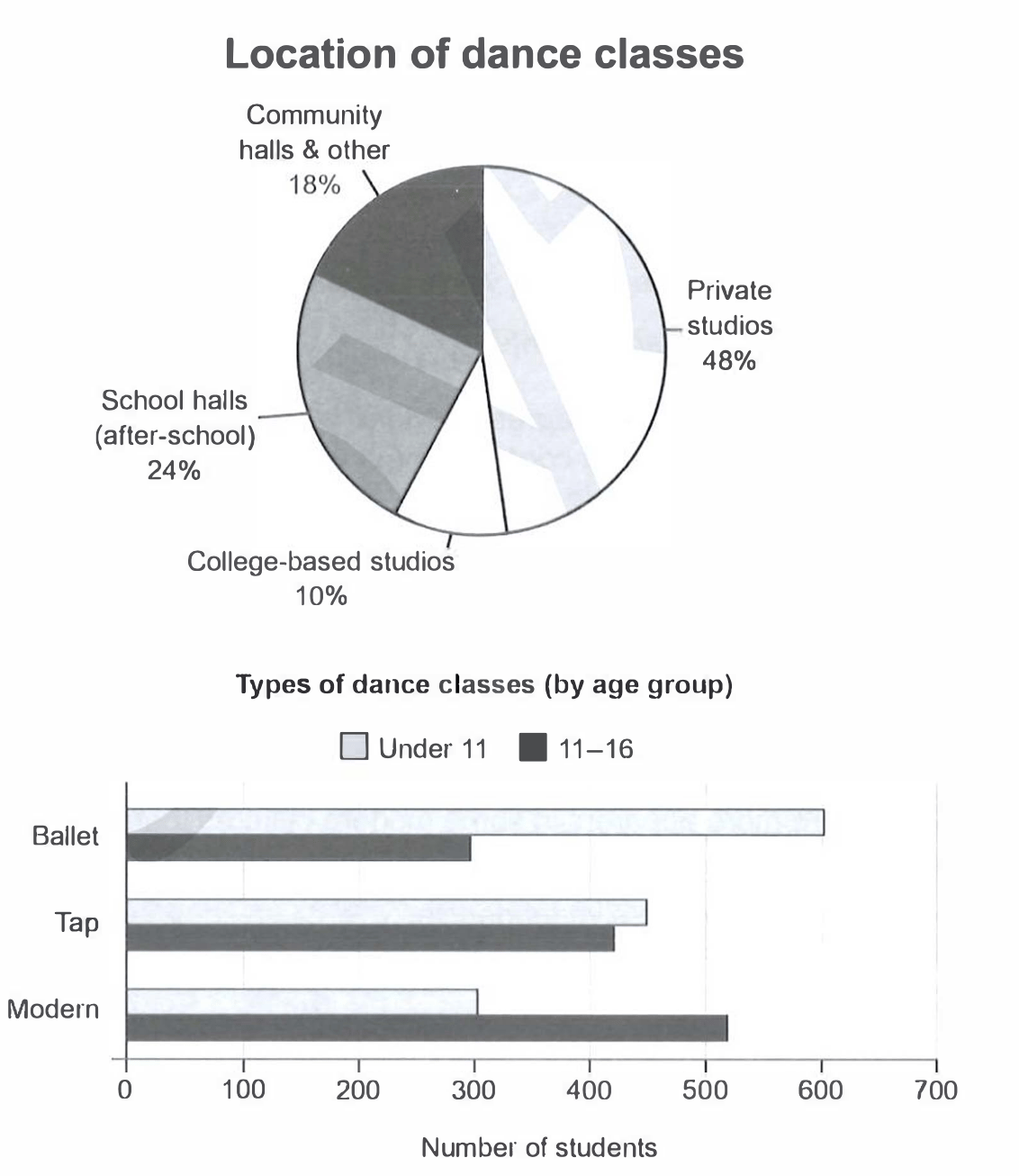
The charts below give information on the location and types of dance classes young people in a town in Australia are currently attending.
Summarise the information by selecting and reporting the main features, and make comparisons where relevant.
Student answer (Band 5.5)
The charts illustrate the various location of dance classes and the data of different age groups in a small town in Australia.
Overall, the first chart shows the percentage of different location of dance classes while other chart demonstrates the data of various age groups. Moreover it shows three different kinds of dance classes by their age groups.
Firstly, there are four different types of location for dance classes, the highest one is private studio which stands on 48% and the lowest one is college based studio which has 10% of the students. Moreover, the school hall (after-school) and community halls have almost same percentage which is 24% and 18%.
Furthermore, three different classes for different age groups which are under 11 contain 600 students for Ballet class and 300 learners are under 16 in Ballet class. As well as the second class contain almost same numbers of learners for Tap class. The thrid one is modern class which has 300 students for under 11 age group and 500 students for under 16.
AI examiner evaluation
| Criterion | Band |
|---|---|
| Task Achievement / Task Response | 5.5 |
| Coherence and Cohesion | 6.0 |
| Lexical Resource | 5.5 |
| Grammatical Range and Accuracy | 5.5 |
| Overall | 5.5 |
Task Achievement / Task Response: Band 5.5
You identify both charts and report several key figures accurately, including private studios as the largest location share (48%), college-based studios as the smallest (10%), and the under-11 figures for ballet and modern. However, the overview mostly describes what the charts show rather than summarising their main patterns. The age-group comparisons are also incomplete or unclear: the response does not accurately report that modern is about 520 for ages 11–16, and “almost same numbers” for tap does not specify the contrast between roughly 450 younger students and 420 older students. The statement that school halls and community halls have “almost same percentage” is also imprecise. Select the strongest comparisons and state them clearly to make the report more complete.
Coherence and Cohesion: Band 6.0
The response has a recognisable structure: an introduction, an overview, and separate paragraphs for the location and dance-type information. This makes the two charts easy to distinguish. Linking expressions such as “Firstly” and “Furthermore” help signal movement between points, although the progression within the final paragraph becomes difficult to follow. For example, “As well as the second class contain almost same numbers” does not clearly identify which age groups or figures are being compared, and “The thrid one” requires the reader to infer that this means modern dance. Use clearer topic sentences and connect each comparison directly to its figures. More precise referencing would make the cohesion less mechanical and the information easier to follow.
Lexical Resource: Band 5.5
You use enough task-related vocabulary to communicate the general subject, including “percentage,” “age groups,” “private studio,” and the dance styles. However, the range is limited and several phrases are repetitive or imprecise, such as “different location,” “different age groups,” and “different classes.” Some word combinations are unnatural, including “stands on 48%” and “contain 600 students.” Spelling errors such as “thrid” also reduce accuracy. Choose more precise reporting language and vary how you describe figures and comparisons; for example, use “accounted for” or “represented” for proportions, and “enrolled” or “numbered” for student totals. This would make the report more natural and precise.
Grammatical Range and Accuracy: Band 5.5
You attempt a mixture of simple statements and longer sentences, and the main message is generally understandable. However, errors in sentence structure and agreement recur, particularly in the final paragraph. For instance, “the second class contain almost same numbers” has an incorrect verb form and an incomplete comparison, while “three different classes … which are under 11 contain” makes the relationship between classes and age groups unclear. There are also article and plural issues in phrases such as “the various location” and “the school hall.” Aim for shorter, complete comparison sentences, checking subject–verb agreement and singular/plural forms. For example, state each age group’s figure in a separate clause before comparing the totals.
See this exact question answered at other band scores. The same prompt compared across bands.
Browse more IELTS Writing model answers or get your own writing scored by the same AI examiner.