Band 6.0 IELTS Writing Task 1 Model Answer
Overall Band Score: 6.0 · Cambridge IELTS 19 · 2026-11-26
IELTS Writing Task 1 question
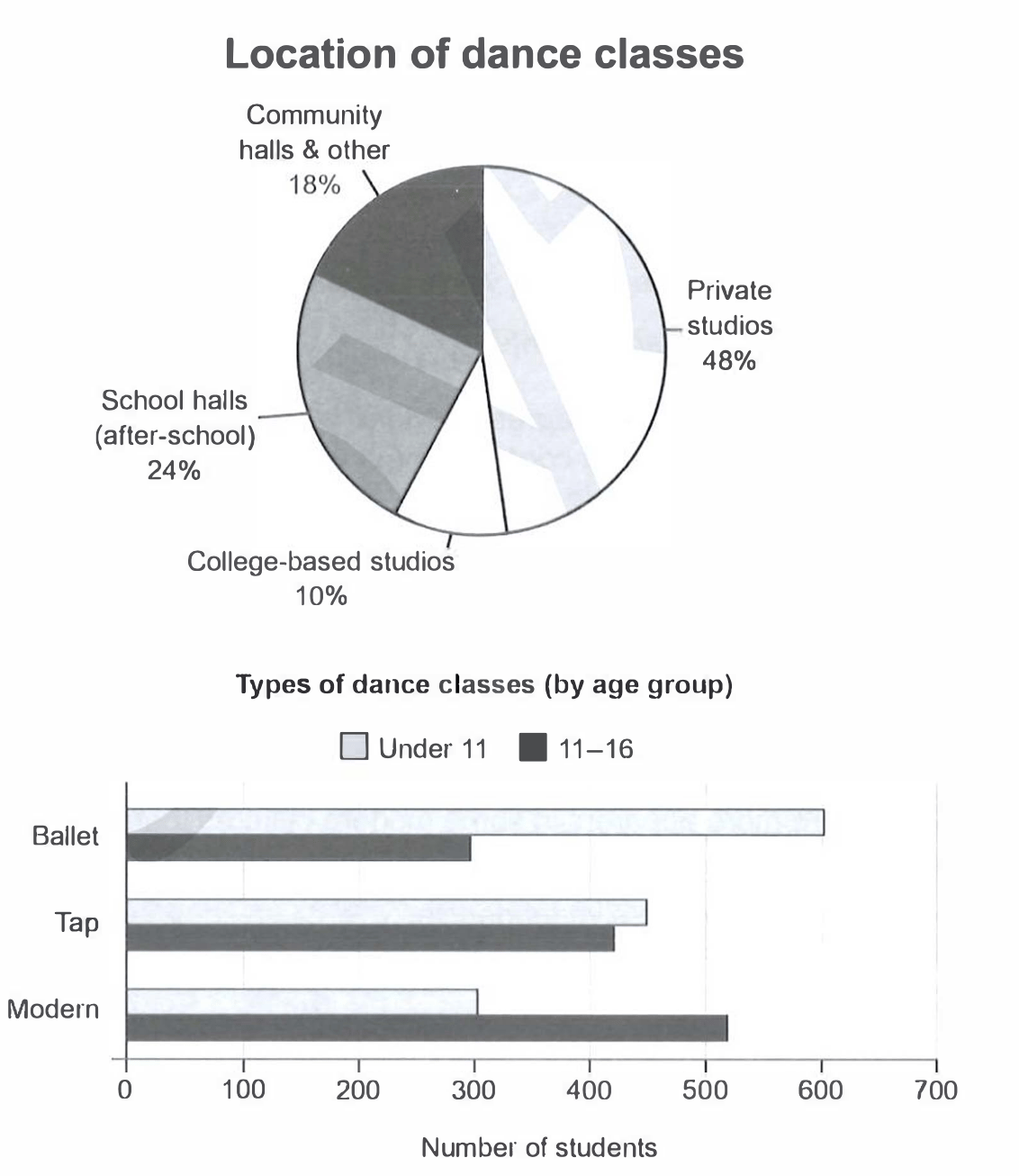
The charts below give information on the location and types of dance classes young people in a town in Australia are currently attending.
Summarise the information by selecting and reporting the main features, and make comparisons where relevant.
Student answer (Band 6.0)
The pie chart shows percentages of the loctions of dance classes in an unamed town in Australia.
While the largest portion goes to private studios with a 48%, only 10% goes to college-based studios. An 18% of locations are allocated to community halls and other, and 24% to School halls.
The bar chart shows the type of dance classes deffrentiated by age group along with numbers of students in each dance calss.
Whereas Ballet dance class has the largest number of students under 11, around 600, it has also the fewest students between ages 11-16 among all classes, around 300.
Tap dance class has close numbers of students in each age group, slightly more than 400 students under 11 can be seen, however, the age group from 11 to 16 has even more students in that class, around 450.
Modern dance class has slightly over 500 students between ages 11-16, along side with 300 of students under 11.
AI examiner evaluation
| Criterion | Band |
|---|---|
| Task Achievement / Task Response | 5.5 |
| Coherence and Cohesion | 6.5 |
| Lexical Resource | 6.0 |
| Grammatical Range and Accuracy | 6.0 |
| Overall | 6.0 |
Task Achievement / Task Response: Band 5.5
You report the main figures for both charts and make relevant comparisons, including the largest share for private studios (48%), the smallest for college-based studios (10%), and the contrast between age groups in ballet and modern. However, there is no clear overall summary bringing the charts’ main patterns together. Some details are inaccurate: tap has about 450 students under 11 and 420 aged 11–16, so the older group does not have more; the response reverses these figures. Also, “slightly more than 400” is less precise than the chart’s approximate value. These errors and the limited overview mean the key features are not fully and accurately presented. Add a concise overview and check each comparison against the data.
Coherence and Cohesion: Band 6.5
The response is arranged in a clear sequence: it first describes the pie chart, then moves to the bar chart, with separate paragraphs for the dance styles. This makes the information easy to follow, and linking expressions such as “Whereas” and “however” help signal comparisons. The organisation is coherent overall, but the opening paragraphs mainly introduce each chart rather than giving an overview of the most important patterns. Some connections are also slightly awkward: “Whereas” begins a comparison that is not completed in the same sentence, and “however” joins two clauses with a comma. To strengthen progression, add a brief overview after the introduction and use comparison links in grammatically complete, clearly connected sentences.
Lexical Resource: Band 6.0
You use a suitable range of chart vocabulary, including “percentages,” “largest portion,” “age group,” and “students,” and the meaning is generally clear. There are also attempts at more precise expressions such as “allocated to” and “differentiated by age group.” However, several spelling errors—“loctions,” “unamed,” “deffrentiated,” and “calss”—reduce accuracy. Some phrasing is also unnatural or imprecise: “the largest portion goes to” and “along side with 300 of students” do not sound idiomatic in a data report. Choose standard reporting collocations and proofread spelling; this would make the vocabulary more controlled while preserving the clear meaning.
Grammatical Range and Accuracy: Band 6.0
You use a mix of simple statements and more complex comparisons, for example, “Whereas Ballet dance class has the largest number … it has also the fewest,” and the main relationships remain understandable. Some grammatical errors occur, but they rarely prevent communication. In “An 18% of locations are allocated,” the article is unnecessary, while “with a 48%” needs a different construction, such as “at 48%.” The sentence beginning “Whereas” is awkwardly structured, and “slightly more than 400 students under 11 can be seen, however…” joins clauses incorrectly with a comma. Review articles, percentage constructions, and punctuation between independent clauses. More consistently accurate complex sentences would improve control.
See this exact question answered at other band scores. The same prompt compared across bands.
Browse more IELTS Writing model answers or get your own writing scored by the same AI examiner.