Band 5.5 IELTS Writing Task 1 Model Answer
Overall Band Score: 5.5 · Cambridge IELTS 19 · 2026-11-26
IELTS Writing Task 1 question
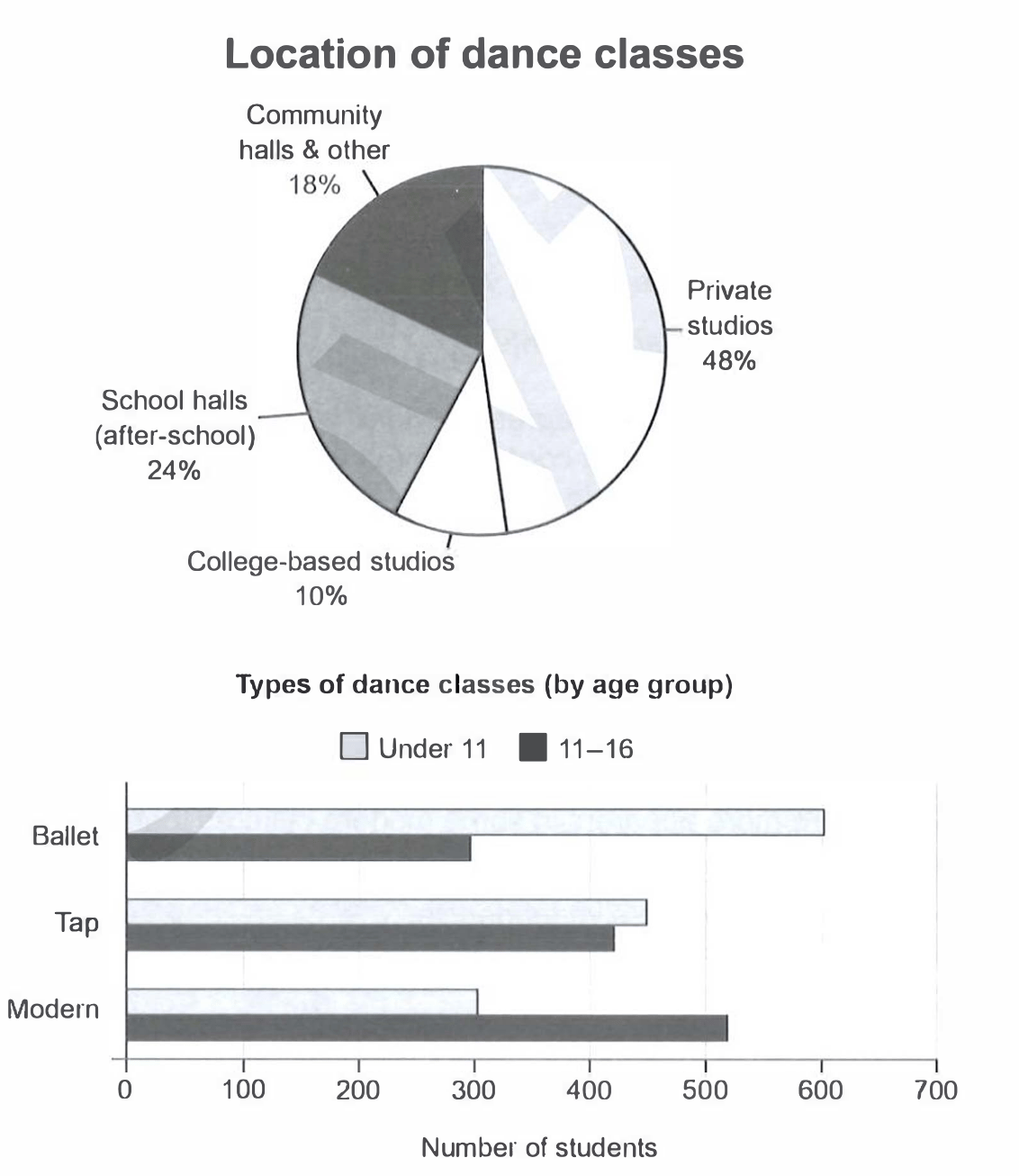
The charts below give information on the location and types of dance classes young people in a town in Australia are currently attending.
Summarise the information by selecting and reporting the main features, and make comparisons where relevant.
Student answer (Band 5.5)
The given charts depict information about dance classes of young people that show location and types of dances in town in Australia are currently attending.
Overall, approximately half of young people prefer private studios. In contrast they don't prefer college-based studios, however the biggest number of students enjoyed ballet they under 11 years, while the fewest was by students 11 to 16 in ballet.
Getting back to the details, the largest location of dance classes was in private studios at 48%, half of this number made up in school halls by 24%, while community halls and others experienced 18%, before ending with college based studios wit 10%.
On the other hand, the biggest type of dance classes was ballet made up by students under 11 years at more then 600 students, while students 11 to 16 around 300 students in ballet. In contrast they made up more then 500 students in modern.
AI examiner evaluation
| Criterion | Band |
|---|---|
| Task Achievement / Task Response | 5.5 |
| Coherence and Cohesion | 5.5 |
| Lexical Resource | 5.0 |
| Grammatical Range and Accuracy | 5.0 |
| Overall | 5.5 |
Task Achievement / Task Response: Band 5.5
You identify the main location pattern accurately: private studios are the largest share at 48%, followed by school halls at 24%, community halls at 18%, and college-based studios at 10%. You also make a relevant comparison between age groups in ballet and note the high figure for older students in modern. However, coverage of the dance-type chart is incomplete: tap is not reported, and the under-11 figures for tap and modern are omitted. The overview’s claim that ballet was the biggest type is too broad, since ballet leads only among under-11s; modern is highest for the 11–16 group. Some comparisons are also imprecise. Select the key contrasts across both charts and state them clearly to make the summary more complete.
Coherence and Cohesion: Band 5.5
The response has a recognisable structure, with an introduction, an overview, and separate paragraphs for location and dance types. This gives the reader some organisation, and phrases such as “In contrast” signal comparison. However, progression is uneven: the overview combines location preferences with age-group results, while the final paragraph reports only selected dance figures and ends without a concluding comparison. Several linking expressions are awkward or do not clearly connect the ideas, including “Getting back to the details” and “On the other hand.” The reference in “they made up more than 500 students in modern” is also unclear. Grouping the age-group figures systematically and using simpler, more precise transitions would improve the flow.
Lexical Resource: Band 5.0
You use some relevant chart vocabulary, including “approximately,” “private studios,” “school halls,” and “students,” and you attempt to describe proportions and comparisons. However, the range is limited and several word combinations are unnatural or imprecise, such as “prefer college-based studios,” “the biggest type of dance classes,” and “made up by students.” These choices sometimes make it difficult to tell whether you mean attendance, preference, or the number of students. There are also spelling and form errors, including “wit” and “more then.” Aim for accurate reporting verbs and collocations suited to charts, such as “accounted for,” “recorded,” and “the most popular class,” while avoiding claims about preference unless the chart measures preference.
Grammatical Range and Accuracy: Band 5.0
You attempt both simple and longer sentences, and the response is generally understandable, but complex constructions are often faulty and errors occur frequently. For example, “the biggest number of students enjoyed ballet they under 11 years” has an unclear clause structure, while “the fewest was by students 11 to 16 in ballet” lacks a clear grammatical subject. In “half of this number made up in school halls,” the verb pattern is incomplete, and “students 11 to 16 around 300 students in ballet” is missing a verb. Articles, prepositions, and sentence boundaries also need attention. Practise building clear comparison sentences with a subject and verb, for example, “Under-11s recorded about 600 ballet students, compared with 300 among 11–16-year-olds.”
See this exact question answered at other band scores. The same prompt compared across bands.
Browse more IELTS Writing model answers or get your own writing scored by the same AI examiner.