Band 6.0 IELTS Writing Task 1 Model Answer
Overall Band Score: 6.0 · Cambridge IELTS 19 · 2026-11-27
IELTS Writing Task 1 question
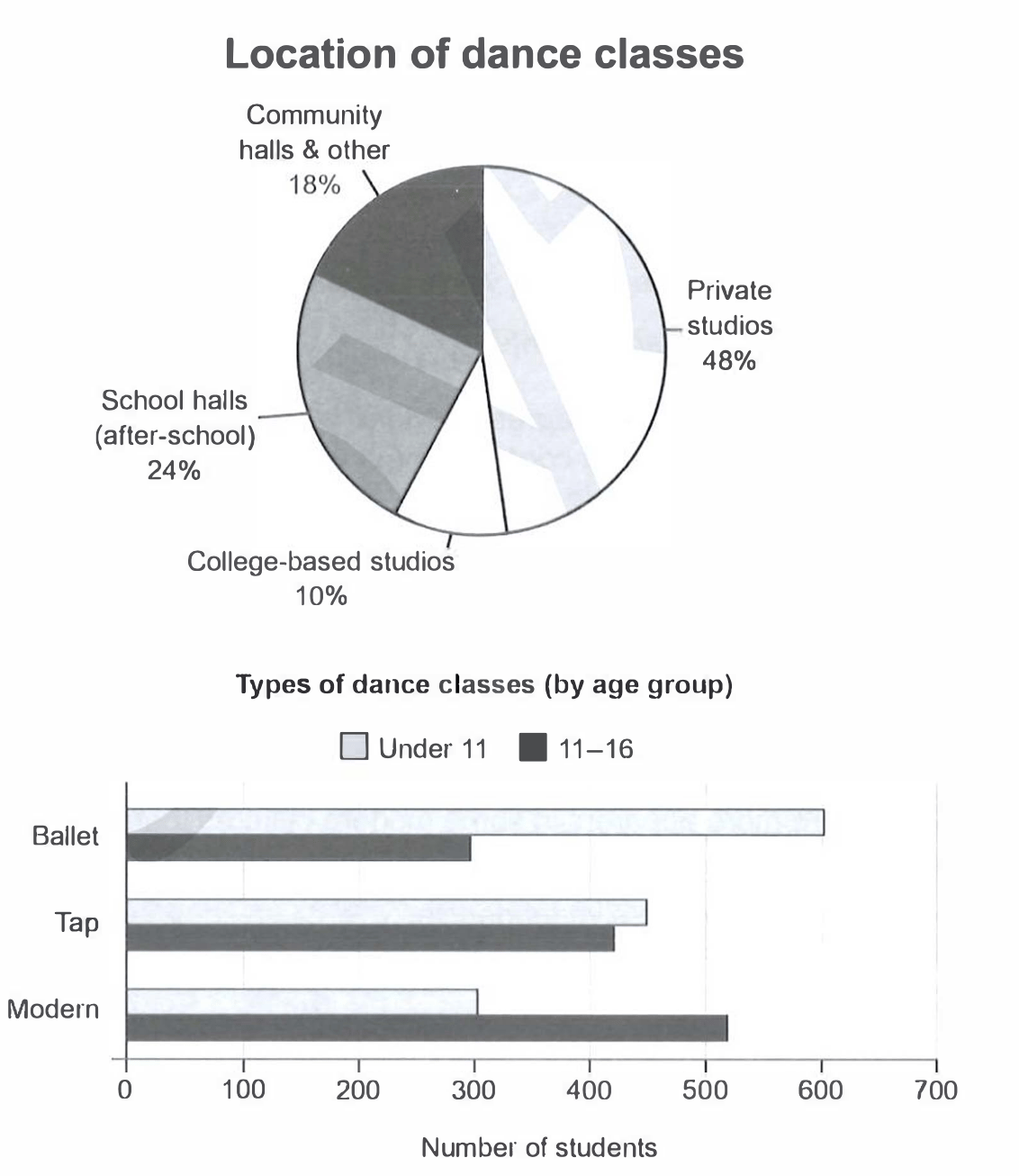
The charts below give information on the location and types of dance classes young people in a town in Australia are currently attending.
Summarise the information by selecting and reporting the main features, and make comparisons where relevant.
Student answer (Band 6.0)
The pie chart shows the percentage of participant of varies dance workshop location. Whereas, The bar chart compares the data of different style of dance with the number of students attending it divided into two age groups in Australia.
Overall, The privet studio is attracting most amount of participants. While, collage based studio's is less popular. Youngsters under age of 11 are more interested in ballet and children from 11 to 16 are more attractive towards modern style.
In pie chart, The private studios are holding 48% of people followed by school halls which are unoccupied after school is attracting 24% of people. While only 18% people prefer community halls and others but least popular location is college based studios which is choose by only 10% of people.
In bar chart, over 600 children below the age of 11 are interest in ballet then around 450 of them are found of tap style while modern type is chosen by only 300 students which is also the least popular. children between 11 to 16 are most found of modern style where around 530 of them are learning and only 300 of them are interest in ballet.
AI examiner evaluation
| Criterion | Band |
|---|---|
| Task Achievement / Task Response | 7.0 |
| Coherence and Cohesion | 6.5 |
| Lexical Resource | 5.5 |
| Grammatical Range and Accuracy | 5.5 |
| Overall | 6.0 |
Task Achievement / Task Response: Band 7.0
You cover both charts and give a clear overview of the main patterns: private studios have the largest share, college-based studios the smallest, and preferences differ by age group. Most figures are accurately reported, including the location percentages and the under-11 ballet and tap figures. Your comparison that older students favour modern dance is also supported by the chart. However, the overview says under-11s are more interested in ballet without explicitly comparing this with the older group, and the bar-chart account omits the older group’s tap figure (about 420). The claim that modern is the least popular for under-11s is accurate within that age group, but could be framed more precisely. Overall, the key information is selected and supported, though a few comparisons could be more complete.
Coherence and Cohesion: Band 6.5
The response has a clear four-part structure: introduction, overview, and separate paragraphs for the two charts. This makes the information easy to locate, and linking expressions such as “followed by” and “while” help show comparisons. The overview also gives the reader a useful direction before the details. However, some transitions are mechanical or awkward, particularly the repeated “While” at the start of sentences, and the final bar-chart paragraph moves from one age group to the other without a fully balanced comparison. Capitalising “The” after commas also interrupts the flow. To strengthen progression, group the age-group figures in parallel sentences and use a wider range of precise links, such as “by contrast” or “whereas,” while keeping punctuation consistent.
Lexical Resource: Band 5.5
You use enough topic vocabulary to communicate the chart content, including “percentage,” “participants,” “age groups,” and “popular.” However, several inaccurate word choices and collocations make the description less natural and sometimes obscure the intended meaning. For example, “participant of varies dance workshop location” is unclear, “holding 48% of people” is not an appropriate way to describe a share, and “most found of modern style” appears to mean “most fond of modern dance.” There are also spelling and word-form errors such as “privet,” “collage,” and “varies.” Aim for accurate chart language and natural collocations, such as “accounted for,” “attracted,” and “preferred.” This would make your vocabulary more precise and fluent.
Grammatical Range and Accuracy: Band 5.5
You attempt both simple and more complex sentence forms, including comparisons with “while” and clauses describing the age groups. The main information is generally understandable, but grammatical control is uneven. Examples include “The pie chart shows the percentage of participant,” where the noun should be plural, and “which is choose by only 10%,” where the passive verb form is incorrect. In “children between 11 to 16 are most found,” the age-range construction and sentence structure are faulty. Capital letters after commas and inconsistent sentence punctuation also affect accuracy. Practise plural forms, articles, agreement, and passive constructions, and check each sentence for a complete, correctly formed clause. More reliable control of these patterns would make your comparisons clearer.
See this exact question answered at other band scores. The same prompt compared across bands.
Browse more IELTS Writing model answers or get your own writing scored by the same AI examiner.