Band 5.5 IELTS Writing Task 1 Model Answer
Overall Band Score: 5.5 · Cambridge IELTS 19 · 2026-11-27
IELTS Writing Task 1 question
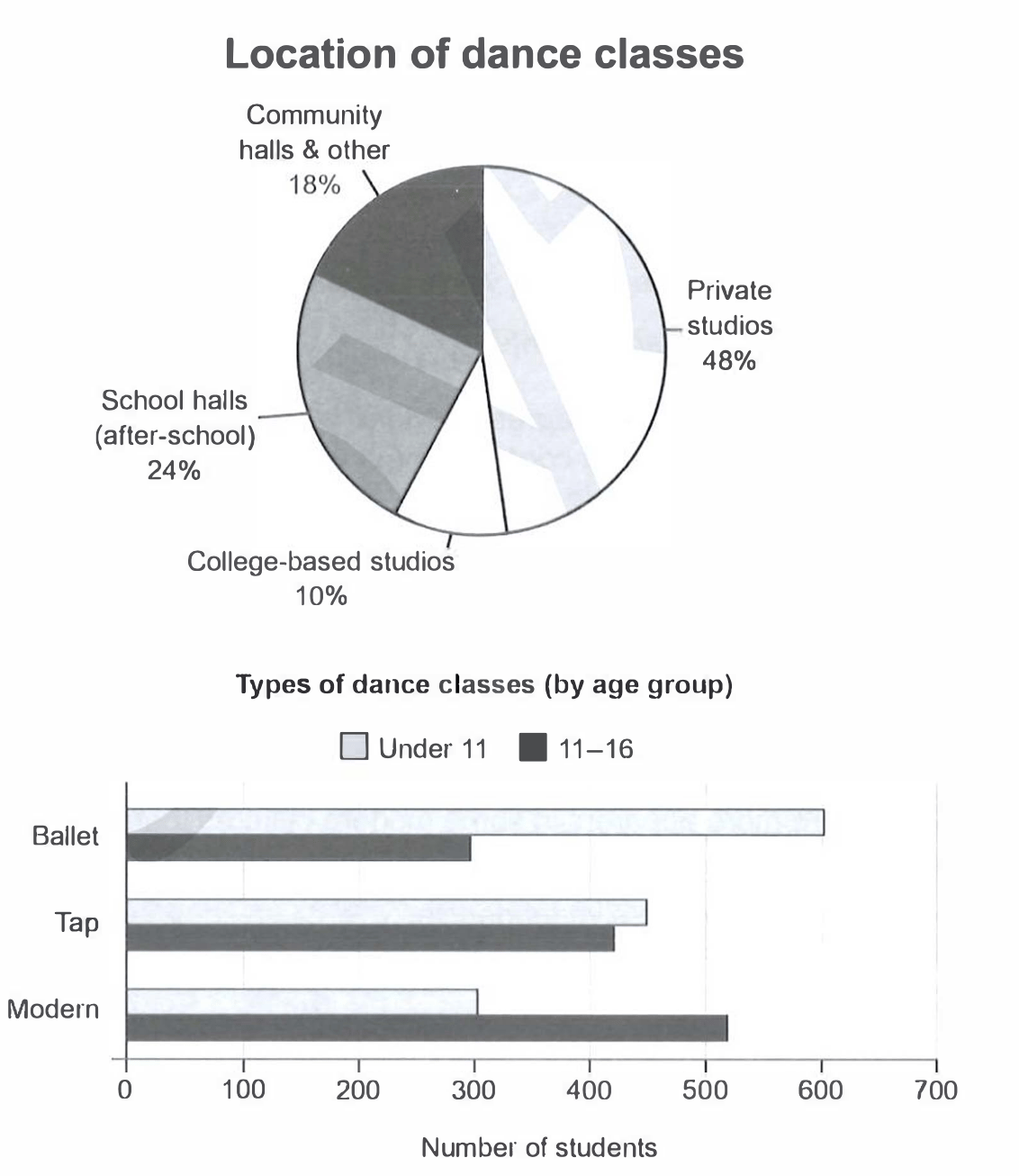
The charts below give information on the location and types of dance classes young people in a town in Australia are currently attending.
Summarise the information by selecting and reporting the main features, and make comparisons where relevant.
Student answer (Band 5.5)
The pie chart illustrates data of young resident taking part in dance classes based on location whereas, bar chart shows the collected data based on age and type of dance classes that has been attended in a town in Australia by young individuals.
According to pie chart the large proportion of younger people prefer to attend in a private studios followed by school halls and community halls. While they often give least preferance to attend collage-based studios.
Whereas, bar chart show a comparison based on three categories including age group, number of students and type of dance class they prefer. Individuals under 11 are more prone towards ballet dancing followed by Tap and modern dancing which were lower than that. While, students between 11 to 16 age are more interested in modern dancing followed by tap and ballet dancing. Ballet dancing remain the most enroll (under 11 age) and least enroll in other group (11-16 age). Similarly, modern enroll more in one group (11-16 age) and least enroll in under 11 group.
AI examiner evaluation
| Criterion | Band |
|---|---|
| Task Achievement / Task Response | 6.0 |
| Coherence and Cohesion | 6.0 |
| Lexical Resource | 5.5 |
| Grammatical Range and Accuracy | 5.0 |
| Overall | 5.5 |
Task Achievement / Task Response: Band 6.0
You cover both charts and identify several important patterns: private studios are the most common location, college-based studios the least common, and the leading dance style differs by age group. The comparisons for the bar chart are broadly accurate, including ballet being highest among under-11s and modern highest among 11–16-year-olds. However, the overview is not fully precise: school halls are not the second-largest location (they account for 24%, compared with 18% for community halls and other venues), and the response does not report the chart’s percentages or student figures. Some comparisons are also repeated rather than developed. To strengthen the report, include key figures and make the ranking of all four locations accurate.
Coherence and Cohesion: Band 6.0
The response has a generally understandable order: it introduces the two charts, discusses locations, and then compares dance styles by age. Paragraphing helps distinguish the chart information, and linking expressions such as “followed by,” “whereas,” and “similarly” show an effort to connect ideas. However, several transitions are mechanical or awkward, particularly the repeated use of “Whereas” to begin a sentence, and the final comparisons repeat earlier points without adding much. The reference in “other group” is also not fully clear. A more effective progression would give a concise overview first, then group the most important location figures and age-group contrasts, using clear links between them.
Lexical Resource: Band 5.5
You use relevant vocabulary for describing charts, including “proportion,” “comparison,” “age group,” and “followed by,” so the main information is usually understandable. There is also some attempt to vary wording, for example “more prone towards” and “more interested in.” However, several choices are inaccurate or unnatural for this task: “give least preference,” “the most enroll,” and “modern enroll” do not express the intended comparisons clearly. Spelling errors such as “preferance” and “collage-based” also reduce precision. Aim for standard chart-reporting collocations and use the same clear terms consistently, such as “accounted for,” “was the most popular,” and “had the highest enrolment.”
Grammatical Range and Accuracy: Band 5.0
You attempt both simple and more complex sentence forms, including comparisons between age groups, and the reader can generally follow the main message. Some sentences are grammatically controlled, such as the opening description of what each chart shows. However, errors in sentence structure, agreement, articles, and punctuation recur. For example, “bar chart show” needs subject–verb agreement, while “Ballet dancing remain” should use a past-tense verb to match the report. The opening sentence also has an awkward clause connection around “whereas,” and several sentences begin with “Whereas” without a complete main clause. Work on complete sentence construction, consistent past-tense reporting, and accurate singular/plural forms.
See this exact question answered at other band scores. The same prompt compared across bands.
Browse more IELTS Writing model answers or get your own writing scored by the same AI examiner.